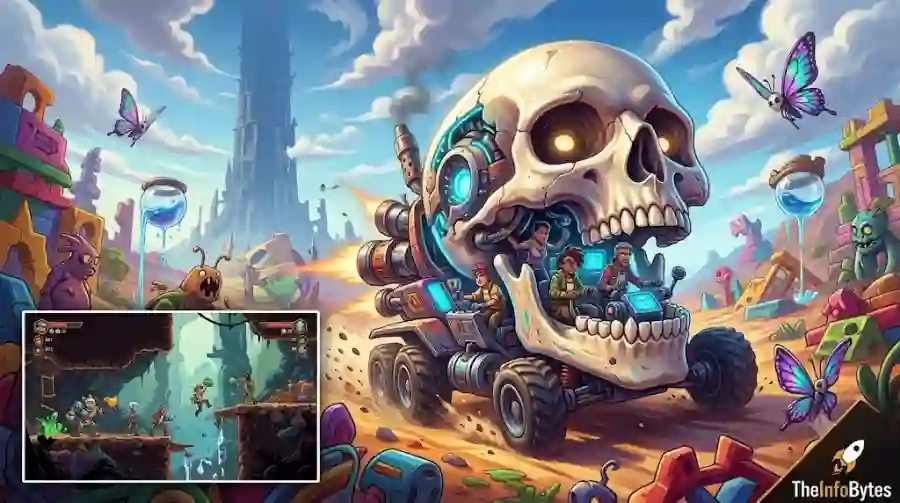
This Strange New Co-Op Game Makes Four Players Control One Giant Skull Across a Toy-Punk Wasteland
Players must communicate and operate different controls inside the skull to determine its movement, power, distance and trajectory.
Then, when the group reaches a new area, players can leave the skull and explore the world through traditional 2D platforming.
It sounds strange.
That is exactly why it stands out.
Bye Bye Bonnie was revealed during the Future Games Show at Gamescom 2026, introducing a colorful but melancholic post-apocalyptic world filled with strange creatures, physics-based dungeons and a mysterious tower.
The game is being developed by Brainwash Gang and published by Raw Fury.
It is currently announced for PC through Steam, but there is no confirmed release date yet.
Four Players, One Skull
The central idea behind Bye Bye Bonnie is extremely simple to explain but potentially difficult to master.
Four players can work together to control Bonnie.
Inside the skull is a control station containing different buttons, levers and abilities.
Each player is responsible for part of the machine.
Everyone has to coordinate their actions.
One player might control the power of the launch.
Another can influence the distance.
Someone else can affect the trajectory.
Other abilities can change how Bonnie moves through the environment.
The team therefore needs to communicate before every major movement.
A poorly coordinated launch can send the skull in the wrong direction.
A perfectly coordinated one can send the entire group exactly where they need to go.
That turns movement itself into a multiplayer puzzle.
Bonnie Is More Than a Vehicle
The giant skull is not simply a vehicle that takes players between locations.
It is effectively the game's main cooperative character.
Players live inside it.
They control it together.
They upgrade it.
And they use it to navigate dangerous areas.
The developers describe the experience as a mixture of precision platforming and golf-inspired mechanics.
That comparison makes sense because the skull is essentially being “teed up” and launched through environments.
Players must consider angles, power and timing.
Gravity becomes an enemy.
The environment becomes a puzzle.
And communication becomes just as important as reflexes.
Falling Is Part of the Challenge
Because Bonnie moves according to physics, players cannot simply point toward a destination and press a button.
The trajectory matters.
If the team chooses the wrong angle, the skull can miss its landing point.
Too much power can send the group flying past their destination.
Too little power can leave Bonnie stranded.
The game therefore turns simple movement into a cooperative skill.
That could create some hilarious multiplayer moments.
Four friends might spend several attempts trying to reach the same platform.
One mistake can send everyone rolling in the wrong direction.
But a successful launch should feel like a team accomplishment because everyone contributed to it.
The Game Changes Into a Platformer
One of Bye Bye Bonnie's most interesting design choices is that players do not remain inside the skull for the entire game.
When the group reaches certain areas, players can leave Bonnie.
The experience then changes into a more traditional 2D side-scrolling platformer.
Players can explore the environment on foot.
They can collect resources.
They can solve environmental puzzles.
They can interact with strange characters.
And they can deal with enemies.
This creates two distinct gameplay styles inside the same adventure.
Inside Bonnie
Players focus on:
- Cooperative controls
- Physics
- Launch power
- Trajectory
- Distance
- Timing
- Team communication
Outside Bonnie
Players focus on:
- Platforming
- Exploration
- Resources
- Environmental puzzles
- NPC interactions
- Collectibles
- Combat and hazards
The transition between these two modes gives the game much more variety than its unusual skull mechanic might initially suggest.
A Dystopian World Seen Through Children's Eyes
The setting of Bye Bye Bonnie is post-apocalyptic.
But it does not look like a conventional grim survival game.
Instead, the developers describe the world as a colorful toy-punk wasteland.
The environments are filled with unusual shapes, bright colors and strange creatures.
That visual contrast is important.
The story is about a broken family searching for missing siblings.
The world itself is damaged.
Yet everything is presented through a playful visual style.
The result is a setting that can feel cheerful at first glance while hiding a much darker story underneath.
Mother Has Disappeared
The story begins with a mystery.
A character known as Mother has disappeared.
She has also taken most of the protagonist's siblings with her.
All that remains is a note, a collection of songs and a huge tower visible in the distance.
The remaining children decide to go after them.
Their solution is bizarre.
They climb into Bonnie, the talking skull, and begin traveling through the wasteland.
The tower becomes the ultimate destination.
But reaching it will require solving the mysteries surrounding their broken world.
That gives the game a narrative reason for its strange journey.
The characters are not simply exploring random levels.
They are trying to find their family.
The Tower Is the Ultimate Goal
The massive tower dominates the game's world.
Players must eventually reach it.
But the tower is not designed as a simple final level.
The developers describe it as a major cooperative challenge requiring coordinated teamwork.
That fits perfectly with the game's central mechanic.
Players have spent the adventure learning how to operate Bonnie together.
The final tower can therefore test everything they have learned.
Communication.
Timing.
Movement.
Abilities.
Platforming.
And cooperation.
The tower becomes the destination that brings all of those systems together.
Four Biomes Create Different Challenges
Bye Bye Bonnie features at least four different biomes.
Each environment can introduce its own hazards and physics-based challenges.
Some areas contain pinball-inspired structures.
Others feature gravity-reversing water traps.
There are also dungeons designed around unusual physical rules.
That means players cannot necessarily rely on the same strategy everywhere.
A technique that works in one environment could fail completely in another.
The game is therefore designed to constantly challenge the team's understanding of Bonnie's movement.
Gravity Can Turn Against the Players
Gravity is one of the game's biggest gameplay tools.
Certain areas can manipulate how objects move.
Gravity-reversing water traps are one example.
These hazards can completely change the expected trajectory of Bonnie.
Players therefore have to think about more than simple distance.
They must understand the environment.
Where will the skull land?
Will gravity pull it downward?
Will a water trap reverse the movement?
Is there enough room for the group to recover after a bad launch?
These questions make the physics system part of the puzzle design.
The World Is Filled With Strange Creatures
The wasteland is not empty.
Players will encounter unusual creatures and hostile environmental hazards.
One particularly strange threat comes from skull-stealing butterflies.
These creatures can interfere with the group's progress.
That is another example of how Bye Bye Bonnie mixes cute visual design with potentially dangerous mechanics.
The game is not trying to create traditional horror.
Instead, it creates danger from bizarre situations.
A colorful butterfly can suddenly become a serious problem if it attempts to steal Bonnie.
Players Can Leave Bonnie to Collect Resources
Exploration outside the skull serves a practical purpose.
Players can leave their rolling home to collect resources.
Those resources can then be used to improve Bonnie.
This creates a progression loop.
Travel through the wasteland.
Find resources.
Return to Bonnie.
Upgrade abilities.
Explore a more difficult area.
Repeat.
That means exploration is directly connected to character and vehicle progression.
The player is not simply collecting items for cosmetic reasons.
The resources help the team become more capable.
Bonnie Can Be Upgraded
The talking skull can gain new abilities throughout the adventure.
The developers have specifically mentioned abilities including a parachute and space manipulation.
These upgrades can change how players approach the environment.
A parachute could allow Bonnie to survive longer falls.
Space manipulation could create entirely new movement possibilities.
As more abilities become available, previously inaccessible areas could become reachable.
That gives exploration a Metroidvania-like progression structure even though the game is not being presented as a traditional Metroidvania.
Communication Is a Core Mechanic
Many co-op games reward communication.
Bye Bye Bonnie practically requires it.
Since players are controlling one shared object, everyone needs to understand what the others are doing.
Imagine one player changing the launch power while another is adjusting the trajectory.
If they make those changes without communicating, the result could be disastrous.
The game therefore creates a natural reason for players to talk.
Instead of communication being optional advice, it becomes part of the control system.
The better the group communicates, the better Bonnie moves.
Every Landing Belongs to Everyone
The developers emphasize that every action is shared.
Every lever.
Every ability.
Every launch.
Every landing.
The entire team experiences the result together.
This is different from conventional co-op platformers where each player controls a separate character.
In those games, one player can sometimes compensate for another player's mistake.
In Bye Bye Bonnie, everyone is attached to the same outcome.
If Bonnie misses the platform, everyone falls.
If the launch is perfect, everyone succeeds.
That creates a very direct connection between teamwork and progression.
The Game Can Be Played Alone
Although Bye Bye Bonnie is designed around cooperative play, the Steam listing also supports single-player.
That means players who do not have a group of four friends can still experience the game.
The multiplayer structure remains the main attraction, but solo play gives the project more accessibility.
The developers have not yet explained exactly how the single-player control scheme will work compared with the four-player version.
That will be an important detail to watch as development continues.
Local and Online Co-Op Are Supported
The Steam listing confirms multiple cooperative options.
Bye Bye Bonnie supports:
- Online co-op
- Shared/split-screen co-op
- Remote Play Together
- Single-player
That gives players several ways to experience the game with others.
Local co-op is particularly interesting because the game is built around communication.
Having several players sitting together and coordinating Bonnie's controls could create a very different experience from playing online.
The shared-screen format also fits the game's arcade-like design.
A Story Told Through Songs
The game's story is not delivered only through traditional dialogue.
Players can also collect scattered songs throughout the wasteland.
These songs help tell the story of the fractured world.
That gives exploration another purpose.
Players who rush directly toward objectives may miss pieces of the narrative.
Those who search the environment can discover additional information about the family and the world.
The soundtrack therefore becomes part of the storytelling system.
Cosmetics and Secrets Reward Exploration
The wasteland also contains hidden collectibles and cosmetic items.
Players can search areas between major objectives to find additional secrets.
This gives completionists another reason to explore.
The developers are not forcing players to find every collectible.
Instead, the rewards encourage players to investigate unusual areas.
That works particularly well with the physics-based world.
A hidden area may require a clever Bonnie launch to reach.
Another collectible could be behind a platforming challenge.
Exploration therefore becomes connected to the game's movement system.
Why Bye Bye Bonnie Stands Out
The biggest reason Bye Bye Bonnie has attracted attention is simple.
There are many cooperative platformers.
There are many physics-based games.
There are many post-apocalyptic adventures.
But there are very few games where four players jointly control one giant talking skull.
That single mechanic gives the game an immediate identity.
It is easy to understand.
It looks unusual.
And it creates a gameplay problem that naturally requires cooperation.
The developers do not need to explain why friends should communicate.
The controls make communication necessary.
It Is More Than a Gimmick
The major question is whether the skull mechanic can support an entire game.
A strange concept can attract attention for a trailer.
But players need depth once they start playing.
Fortunately, Bye Bye Bonnie appears to have systems beyond the central idea.
There are multiple biomes.
Physics-based dungeons.
Platforming.
Resources.
Upgrades.
Secrets.
Cosmetics.
Story collectibles.
NPC interactions.
And the Tower.
Those systems could give the skull mechanic enough variety to remain interesting throughout the adventure.
The Visual Style Could Become Another Selling Point
Brainwash Gang is taking a very distinctive visual approach.
The wasteland is colorful, hand-crafted and toy-like rather than photorealistic.
That makes the game visually different from many modern survival titles.
The contrast between cute characters and a dystopian setting also supports the game's story.
The world is broken.
But it is seen through a playful lens.
That creates a melancholic atmosphere rather than pure horror.
The art style should also make the game easy to recognize in storefronts and social media feeds.
No Release Date Yet
One important detail is still missing.
Bye Bye Bonnie does not currently have a confirmed release date.
The Steam page lists the game as “To be announced.”
The developers have confirmed PC through Steam.
However, there is currently no official launch date for the game.
Players should therefore avoid assuming that it will release soon simply because it was shown during Gamescom.
The project is still in development.
PC Is the Confirmed Platform
The current announcement is specifically for PC.
The Steam page confirms the game is being developed for the platform.
No PlayStation 5, Xbox Series X|S or Nintendo Switch 2 version has been officially listed on the current Steam information.
That could change later.
For now, PC is the confirmed destination.
What We Know About the Game
The confirmed information currently includes:
- Bye Bye Bonnie was revealed during the Future Games Show at Gamescom 2026.
- Brainwash Gang is developing the game.
- Raw Fury is publishing it.
- The game supports up to four players.
- Players jointly control a giant talking skull.
- Bonnie can be launched using physics-based mechanics.
- Players control different systems inside the skull.
- Players can leave Bonnie and explore on foot.
- The game includes 2D platforming.
- There are at least four biomes.
- Physics-based dungeons are included.
- Gravity-reversing hazards are included.
- Players can collect resources.
- Bonnie can be upgraded.
- Abilities include a parachute and space manipulation.
- Players can collect songs that reveal story details.
- Hidden cosmetics and secrets are available.
- The Tower is a major cooperative challenge.
- Single-player is supported.
- Online co-op is supported.
- Shared/split-screen co-op is supported.
- Remote Play Together is supported.
- PC is the currently announced platform.
- The release date is still TBA.
What Remains Unknown
Several important details have not yet been confirmed.
The developers have not announced:
- A final release date
- Pricing
- Console versions
- A full system-requirements list
- The complete story length
- The exact number of levels
- The full upgrade tree
These details should become clearer as the game moves closer to launch.
Why TheInfoBytes Readers Should Watch It
Bye Bye Bonnie is exactly the kind of game that can perform well as a discovery story.
It is not another sequel.
It is not another annual sports game.
It is not another generic open-world shooter.
The headline itself creates curiosity.
Four players control one giant talking skull.
That is enough to make someone stop scrolling.
The unusual gameplay also gives the article strong social-media potential because clips of successful or disastrous cooperative launches could be entertaining.
For a gaming-news site, that creates multiple content opportunities later.
A release-date article.
A gameplay guide.
A co-op guide.
A system-requirements article.
A beginner's guide.
And potentially an article about the best strategies for controlling Bonnie.
Conclusion
Bye Bye Bonnie is one of the strangest new cooperative games revealed during Gamescom 2026, and its central idea could make it surprisingly memorable.
Instead of giving four players four separate characters, the game puts everyone inside one giant talking skull.
Players must coordinate buttons, levers and abilities to control Bonnie's power, distance and trajectory.
Then they can leave the skull and explore a colorful dystopian world through 2D platforming.
The game combines physics puzzles, platforming, exploration, resource collection and character progression.
Its story follows a group searching for missing siblings after their mysterious Mother disappears, while a massive tower waits on the horizon.
The combination of a dark premise and playful toy-punk presentation gives the project a distinctive identity.
The biggest unanswered question is whether the shared-skull mechanic will remain entertaining over a full campaign.
The developers appear to be building enough systems around it to make that possible.
With multiple biomes, upgradeable abilities, physics-based dungeons, secrets, story collectibles and a major final tower challenge, Bye Bye Bonnie has more going on than its unusual premise initially suggests.
There is still no release date.
But when it eventually arrives on PC, it could become the kind of cooperative game that creates unforgettable moments between friends.
Four players. One skull. Absolutely no room for bad communication.