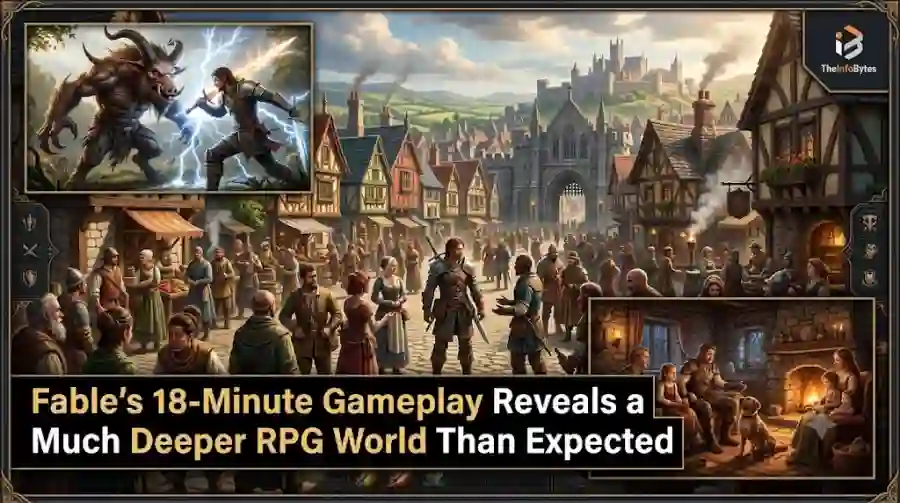
Playground Games Shows How Bowerstone, NPCs, Reputation, Family and Combat Shape the New Fable
Xbox and Playground Games have released an 18-minute gameplay walkthrough showing a much deeper look at how the new Fable actually plays.
Instead of focusing only on cinematic scenes or short combat clips, the demonstration follows the Hero through a substantial quest in Bowerstone, the capital of Albion.
The footage gives players a better understanding of what Playground Games is trying to build.
This is not simply a modern remake of the original Fable.
It is a new RPG designed around a reactive world where exploration, relationships, reputation, combat and player decisions all interact with each other.
The demonstration shows the Hero moving through Bowerstone, interacting with residents, managing a home and family, making decisions, fighting enemies and using different abilities.
Most importantly, the footage gives players their clearest look yet at how the world is supposed to function outside the main story.
Fable is currently scheduled to launch on February 23, 2027, for PlayStation 5, Xbox Series X|S and PC. It will also be available through Game Pass.
Bowerstone Is More Than a Backdrop
One of the strongest parts of the new demonstration is Bowerstone itself.
The city is not presented as a collection of decorative buildings surrounding a quest marker.
Playground Games wants Bowerstone to feel like a functioning settlement.
The footage shows shops, homes, streets, residents and different social spaces operating as part of the larger world.
Players can walk through the city and interact with people rather than simply moving between mission locations.
That difference could become one of the defining characteristics of the new Fable.
The original games were known for creating a world where the Hero could become part of the community.
The reboot appears to be taking that idea much further.
Bowerstone Has Around 400 NPCs
One particularly interesting detail from the gameplay demonstration is the scale of Bowerstone's population.
The city is designed around approximately 400 NPCs, with residents having their own homes, personalities, hobbies, traits and voiced interactions.
That does not necessarily mean every NPC is equally important.
Instead, the goal appears to be creating the impression that Bowerstone is populated by actual people rather than generic background characters.
This could have a major effect on exploration.
A player might encounter someone in one location and then see that character somewhere else later.
Residents can have routines.
They can react to the Hero.
They can become part of the player's social experience.
That makes the city feel more like a community.
NPC Simulation Could Change How Players Explore
The NPC system is particularly important because Fable has always placed a strong emphasis on its world and characters.
A highly populated city means exploration could become unpredictable.
Players may enter a street looking for a quest and instead encounter a character with an unrelated problem.
Another resident could provide information.
Someone else might react to the Hero's reputation.
The city therefore becomes part of the gameplay rather than simply a location where missions begin.
This could encourage players to slow down.
Instead of rushing toward the next objective, they may want to explore streets, talk to residents and discover smaller stories.
Reputation Is Returning in a Bigger Way
Reputation is another major system shown during the gameplay footage.
The Hero's actions influence how other characters perceive them.
This is important because Fable's identity has always been closely connected to the idea that the player can become a different type of hero.
A player can make choices that create a positive reputation.
Another player might take a more selfish or aggressive path.
The new game appears to be using reputation as a broader system that connects the Hero's actions with the world.
That could make decisions feel more meaningful.
Your Hero Can Have a Family
One of the more unusual elements demonstrated is the ability to build a personal life.
The Hero can own a home and have a family.
The footage shows a domestic side of the game that is very different from the usual fantasy-RPG formula.
Instead of spending every moment fighting monsters or completing quests, players can return to a home and interact with family members.
This creates a contrast between the Hero's dangerous adventures and their everyday life.
That contrast has always been one of the more distinctive ideas associated with Fable.
Owning Property Adds Another Layer
Property ownership is also part of the experience.
Players can own homes and businesses.
That means exploration is not only about finding weapons or completing quests.
The world can also become something the player invests in.
A home provides a place to return to.
A business can become part of the Hero's economic progression.
These systems give players reasons to care about locations beyond their usefulness during missions.
Choices Are Central to the Experience
The new gameplay footage also reinforces the importance of player choice.
Fable is built around the idea that the Hero's decisions matter.
Those decisions can influence reputation, relationships and how the world responds.
The game is not simply asking players to choose between two obvious moral options.
Instead, the developers appear to be creating situations where the consequences can emerge from how the player behaves.
That creates more room for role-playing.
Players can decide what kind of Hero they want to become.
The Humor Is Still There
One thing that stands out in the footage is that the new Fable is not taking itself completely seriously.
The game contains dark fantasy elements, but it also has British humor and absurd situations.
That balance is important.
A purely serious fantasy RPG would make the reboot feel very different from its predecessors.
Fable's identity has always included humor.
Characters can be strange.
Situations can become ridiculous.
Dialogue can deliberately break the tension.
The new game appears to understand that this tone is part of what made the original series memorable.
Combat Is Being Modernized
The new gameplay footage also provides a better look at combat.
The system combines melee attacks, ranged weapons and magic.
The original Fable's basic combat philosophy remains recognizable, but the reboot introduces a more modern structure.
Players can move around enemies, dodge attacks and combine different abilities.
The game is not trying to become a hardcore Soulslike.
Instead, combat is designed to fit into a larger RPG experience.
That distinction is important.
The focus remains on player choice and adventure rather than making every fight extremely punishing.
Three Main Combat Paths
Fable continues to organize combat around different styles.
The gameplay demonstration shows the return of familiar categories built around:
- Strength
- Skill
- Will
These represent different approaches to fighting.
Strength focuses on physical melee combat.
Skill is associated with ranged and precision-based attacks.
Will represents magical abilities.
The system gives players freedom to specialize or combine approaches.
Magic Has Several Different Abilities
The demonstration also revealed several spells.
These include:
- Fireball
- Lightning
- Blade
- Lift
- Rush
- Push
- Befowl
The variety suggests that magic is not simply a single ranged attack.
Different spells can change how players approach combat.
Some are designed for direct damage.
Others can control enemies or alter positioning.
This could make magical combat especially useful when combined with melee and ranged abilities.
Combat Does Not Exist Separately From Exploration
One of the more interesting aspects of the demonstration is how naturally combat fits into the wider world.
Players are not constantly entering separate combat arenas.
Instead, fights happen as part of quests and exploration.
That helps maintain the feeling that Albion is a continuous world.
A normal conversation can lead to a conflict.
An exploration sequence can suddenly become dangerous.
A quest can combine dialogue, investigation and combat.
This structure should help keep the gameplay varied.
The Quest Demonstrated by Playground Games
The 18-minute presentation follows an early quest involving the Heroes' Guild and a conflict surrounding property.
The sequence begins with the Hero exploring Bowerstone and interacting with its residents.
The player then becomes involved in a larger situation that eventually leads to combat.
This was a smart choice for the demonstration.
Instead of showing disconnected gameplay systems, Playground Games uses one quest to demonstrate how those systems work together.
Players can see exploration.
Then dialogue.
Then decision-making.
Then combat.
Then the consequences of those actions.
That provides a much better picture of the actual game than a traditional cinematic trailer.
Fable's World Wants to React to You
The biggest promise of the new footage is the idea of a reactive world.
The Hero is not simply completing a list of objectives.
The player's actions can change reputation and relationships.
The Hero can own property.
The Hero can build a family.
NPCs have routines and personalities.
Combat abilities can be developed according to player preference.
These systems are designed to work together.
That is what could make the new Fable feel like a genuine role-playing game rather than a linear fantasy adventure.
The New Fable Is Bigger Than a Visual Reboot
It would be easy to describe the game as a graphical remake.
That would undersell what Playground Games is attempting.
The new Fable is being built from the ground up as a modern RPG.
The developers are preserving the recognizable ideas of Albion while redesigning the systems around modern hardware.
The result is intended to feel familiar without simply reproducing the original games.
That is a difficult balance.
Fans want the identity of Fable.
New players expect modern gameplay.
Why the 18-Minute Demo Matters
The timing of the demonstration is important.
Fable is scheduled for release in early 2027.
The new footage gives players months to understand what Playground Games is building before launch.
More importantly, it allows the developers to respond to concerns.
The demonstration has already generated discussion around combat responsiveness, facial animation and the game's presentation.
That feedback could be useful while development continues.
The game is not launching tomorrow.
There is still time for refinement.
The Visual Style Is More Realistic
The new Fable has a more grounded visual presentation than the earlier games.
Characters and environments are more detailed.
Lighting is more realistic.
Bowerstone has a much larger and denser appearance.
However, the game still retains the fantasy identity of Albion.
There are magical abilities.
Strange creatures.
Humorous characters.
Supernatural events.
That combination is important because making Fable completely realistic would remove part of its personality.
The World Looks Built for Exploration
Bowerstone is only one part of Albion.
The full game will contain additional environments outside the city.
That means the systems demonstrated in Bowerstone could potentially extend throughout the wider world.
If NPC routines, reputation and property ownership work consistently across different areas, the final game could offer a much deeper simulation than earlier entries.
The biggest unknown is how much of this systemic behavior will remain meaningful outside major cities.
Family Systems Could Make the World Feel Personal
The family system is another feature worth watching.
Many RPGs allow players to form relationships.
Fewer make family life part of the broader gameplay loop.
If family members have their own personalities and respond to the Hero's actions, returning home could become an important part of the experience.
It could also create consequences.
A Hero who spends months away fighting monsters may have a different relationship with their family than someone who regularly returns home.
The developers have not revealed every detail yet.
But the possibility is interesting.
Player Choice Could Affect More Than Dialogue
The most important question is how deep the choice system becomes.
It is easy for an RPG to give players different dialogue options.
The more difficult task is making those decisions affect the world.
Fable has the opportunity to do exactly that.
A player's reputation could influence which characters trust them.
Property ownership could influence wealth.
Relationships could influence personal stories.
Moral choices could influence the Hero's identity.
If these systems connect properly, the game could offer meaningful replayability.
Fable Is Not Trying to Be Elden Ring
The combat footage has already attracted comparisons with other modern action RPGs.
But Fable appears to be pursuing a different goal.
The game is not designed around extreme difficulty.
It is not built around punishing boss encounters.
Its combat exists alongside dialogue, exploration, relationships, humor and role-playing.
That is important when evaluating the footage.
The combat does not need to compete with the fastest action games.
It needs to support the broader Fable experience.
The Game's February 2027 Release Is Important
Playground Games has set February 23, 2027 as the release date.
The game is planned for:
- Xbox Series X|S
- PlayStation 5
- PC
It will also be available through Game Pass.
The PlayStation release is particularly notable because Fable has historically been strongly associated with Xbox.
Bringing the reboot to PlayStation gives the game access to a significantly wider audience.
Game Pass Makes Fable Easier to Try
Game Pass could also help Fable reach players who are uncertain about the reboot.
A large RPG can be expensive to purchase.
Game Pass removes some of that barrier for subscribers.
Players can try the game without committing to the full purchase price.
That could be particularly useful for a reboot.
Some players will be longtime Fable fans.
Others will have never played a Fable game.
Game Pass gives the latter group a relatively easy way to discover the franchise.
What We Still Don't Know
Despite the long gameplay demonstration, several major questions remain unanswered.
We still need to know exactly how large the full world will be.
The complete quest structure has not been revealed.
The depth of the family system remains unclear.
The long-term impact of reputation is still unknown.
The full character progression system has not been shown.
There are also unanswered questions about endgame content and replayability.
The 18-minute demo is substantial, but it is still only a small part of the finished RPG.
What the Gameplay Demo Confirms
The latest footage confirms several important features:
- Bowerstone is a major living city.
- The city contains around 400 NPCs.
- NPCs have individual traits and routines.
- Players can interact with residents.
- Reputation plays a role in the world.
- Players can own property.
- Players can build a family.
- Combat includes melee, ranged and magical abilities.
- Strength, Skill and Will remain important combat paths.
- Multiple spells are available.
- Player decisions influence the experience.
- The game is scheduled for February 23, 2027.
- PlayStation 5, Xbox Series X|S and PC versions are confirmed.
- Game Pass availability is planned.
What Could Make Fable Special
The strongest aspect of the new Fable may not be any individual mechanic.
It could be the combination.
A city filled with living NPCs is interesting.
A reputation system is interesting.
A family system is interesting.
Property ownership is interesting.
Combat and magic are interesting.
But if all of these systems interact with one another, the game could become something much more compelling.
That is the real promise behind the new Fable.
The Biggest Risk
The biggest risk is that some of these systems may turn out to be shallower than they appear.
A city can have hundreds of NPCs without every character being meaningful.
A reputation system can exist without substantially changing the story.
Family mechanics can become decorative.
Property ownership can become a simple money-making system.
The final game will need to make these mechanics matter.
The 18-minute demonstration gives reason to be optimistic, but it does not prove how deep the systems will become across a complete playthrough.
The new 18-minute Fable gameplay demonstration is easily one of the most useful looks yet at Playground Games' ambitious reboot.
Instead of relying on cinematic trailers, the presentation shows how several of the game's systems actually connect.
Bowerstone is populated by hundreds of NPCs.
Residents have individual traits and routines.
Players can build reputation, own property and create a family.
Combat combines melee, ranged attacks and magic.
And the Hero's decisions are designed to influence how the world responds.
That combination gives Fable a clear identity.
It is not attempting to become another ultra-hard action RPG.
It is not simply remaking the original game.
It is trying to create a modern fantasy RPG where the player can build a life inside Albion while also becoming the Hero of its larger story.
The biggest question now is whether Playground Games can make all of those systems meaningfully interact throughout the full campaign.
If it can, Fable could become one of the most interesting RPG releases of 2027.
The wait continues until February 23, 2027.
But after this 18-minute demonstration, players finally have a much clearer idea of what Playground Games has been building.