Graveyard Keeper 2 Turns Zombie Apocalypse Survival Into a Profitable Medieval Business This September
Graveyard Keeper 2 takes the unusual management concept of the original game and pushes it into a much larger world.
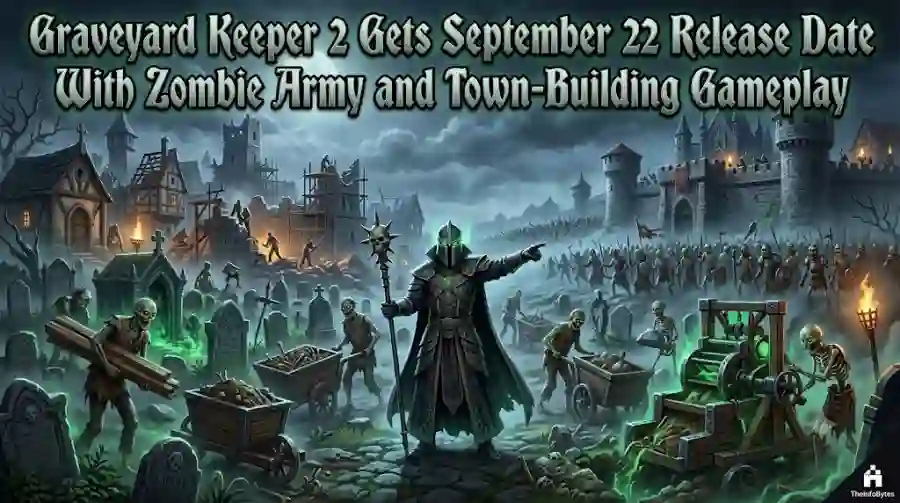
Players become the Grand Inquisitor and are responsible for rebuilding a damaged town while managing a medieval graveyard. At the same time, an approaching zombie apocalypse creates an entirely new problem: players must build and command an undead army to defend the kingdom.
The result is a strange combination of cemetery management, crafting, automation, town building, RPG progression and strategy combat.
That combination is what makes the sequel stand out from the many conventional survival and management games arriving this year.
Graveyard Keeper 2 Launches September 22
The release date is now officially confirmed for September 22, 2026.
The game will launch across a wide range of platforms, including:
- PC
- PlayStation 5
- PlayStation 4
- Xbox Series X|S
- Xbox One
- Nintendo Switch
- Nintendo Switch 2
The Steam listing confirms the September 22 release, while PlayStation and Nintendo's official storefronts also list the same date.
That broad launch means players do not need to move to a new generation of hardware to experience the sequel.
The game is also designed as a single-player experience, keeping the focus on management, exploration, progression and the player's own expanding medieval operation.
You Are Now the Grand Inquisitor
The biggest change in Graveyard Keeper 2 is the player's new role.
Instead of simply being a cemetery keeper, the protagonist becomes the Grand Inquisitor.
That position comes with considerably more responsibility.
The kingdom is facing a zombie apocalypse, and the player has to help restore the town while preparing for the undead threat.
This creates a much broader objective than simply maintaining a graveyard.
Players need to develop their operation, improve infrastructure, gather resources and eventually lead undead forces into battle.
The official game description frames the sequel around three major activities: managing the graveyard, saving the kingdom and rebuilding the town for profit.
Those systems are closely connected.
A stronger production operation can provide resources.
Resources can be used to create equipment and machinery.
The rebuilt town can generate additional opportunities.
And the undead workforce can reduce the amount of manual work required.
The game essentially turns the apocalypse into one enormous management problem.
Graveyard Management Returns
The graveyard remains at the center of the experience.
Players can build and manage their own medieval cemetery while collecting resources from the surrounding world.
The game's deliberately dark sense of humor returns, with corpses and human remains becoming part of the production system.
According to the official descriptions, players can harvest flora, fauna and human remains to create machinery and automate production.
That means the cemetery is not simply a decorative location.
It is effectively the foundation of the player's business.
The more efficiently it operates, the more resources the player can produce.
The management systems are therefore expected to reward players who carefully organize their production chains.
Zombie Automation Becomes a Major Mechanic
One of the sequel's most interesting additions is its expanded automation system.
Graveyard Keeper 2 allows players to use zombies as workers.
Instead of personally completing every repetitive task, players can create systems where undead workers handle production and other jobs.
This is a natural extension of the original game's management philosophy.
The sequel appears to push that idea much further.
Players can establish production chains and then use zombie workers to keep those systems operating.
That creates a management loop where the player's job gradually changes from performing tasks to designing better systems.
The more efficient the operation becomes, the more resources can be produced without constant manual intervention.
For players who enjoy automation-heavy games, this could become one of the most addictive parts of the sequel.
Rebuilding the Town Is Another Major Goal
The town is significantly more important in Graveyard Keeper 2.
Players are not simply managing their own cemetery.
They also need to help rebuild the surrounding settlement.
The official Nintendo listing explains that players can help townsfolk restore their homes and complete quests throughout the city.
But this is still Graveyard Keeper.
The objective is not entirely charitable.
The game allows players to turn the town's problems into opportunities for profit.
That creates the series' trademark dark humor.
A damaged building becomes another project.
A villager's problem becomes another quest.
A new production requirement becomes another business opportunity.
Players can gradually transform the settlement while simultaneously expanding their own operation.
The Undead Army Changes the Gameplay
The most significant new feature is arguably the undead army.
Graveyard Keeper 2 does not stop at resource management.
Players can build an army of zombies and send them into battle to defend the kingdom.
The official game description says players can build towers and fortifications, craft armor and weapons, and train their undead troops before sending them into combat.
This introduces a strategic layer that was not the central focus of the original game.
Instead of simply building an efficient cemetery, players must eventually think about defense.
That means resources now have multiple potential uses.
Should materials be invested into production?
Should they be used to upgrade the town?
Should they be spent on weapons and armor?
Or should players strengthen their defensive structures?
Those decisions could become increasingly important as the zombie threat develops.
Building Defenses Against the Zombie Apocalypse
The zombie army is not only useful for attacking.
Players must also prepare the town for the approaching threat.
The sequel includes defensive construction, including towers and fortifications.
This means the town itself becomes part of the player's strategic infrastructure.
A well-developed settlement should provide more opportunities for production and progression, but it also needs protection.
That creates another layer of planning.
Players must balance economic growth against military preparation.
Expanding too aggressively without adequate defenses could potentially leave the settlement vulnerable.
On the other hand, spending too many resources on defense could slow down economic development.
The exact difficulty and balance will only become clear once the full game is released.
Crafting Remains Central
Crafting is another major part of the sequel.
Players can gather materials and use them to create machinery, weapons and equipment.
The official descriptions specifically mention powerful armor and weapons for the undead army.
This gives crafting a direct connection to the game's combat systems.
Resources collected through the graveyard and surrounding world can ultimately be transformed into military equipment.
That means production is not isolated from the strategy mechanics.
Everything feeds into another system.
The graveyard supports production.
Production supports crafting.
Crafting supports the army.
The army protects the town.
The town creates new opportunities for the player's business.
That interconnected structure could become the defining feature of Graveyard Keeper 2.
The Game Keeps Its Dark Sense of Humor
Despite the zombie apocalypse setting, Graveyard Keeper 2 is not designed as a traditional horror game.
Its tone is intentionally absurd.
The official Steam description continues to describe the game as an intentionally inaccurate medieval cemetery simulator, while its Steam tags include dark humor, simulation, automation, crafting and fantasy.
That distinction is important.
The game uses corpses, zombies and medieval death as part of its comedy rather than trying to create a purely frightening atmosphere.
The result is closer to a dark management sandbox.
Players can build elaborate systems around things that would normally be considered disturbing, while the game presents them through an intentionally ridiculous business-management perspective.
A Bigger World Than the Original
The sequel is designed to expand the original game's formula rather than completely replace it.
The graveyard remains important, but the surrounding town is now a much larger part of the player's activities.
There are also additional systems involving zombie workers, combat, fortifications and town restoration.
That gives players more reasons to leave the cemetery and explore.
It also means the sequel has more interconnected progression systems.
The player's operation can grow in several directions.
Some players may focus heavily on automation.
Others may spend more time rebuilding the town.
Some may prioritize the military side and create a powerful undead force.
The flexibility should allow different play styles to emerge.
Platforms and Availability
Graveyard Keeper 2 will be available on both current and previous-generation consoles.
The official listings confirm:
PlayStation: PS5 and PS4
Xbox: Xbox Series X|S and Xbox One
Nintendo: Nintendo Switch and Nintendo Switch 2
PC: Steam
The Steam store currently lists the game for September 22, while PlayStation's store lists the same release date for PS5. Nintendo's store also confirms September 22 for both Switch and Switch 2 versions.
That makes the launch accessible to a wide audience.
What Makes Graveyard Keeper 2 Different?
The management genre is crowded with farming games, city builders and survival simulations.
Graveyard Keeper 2 has a much stranger identity.
It combines:
- Medieval management
- Graveyard simulation
- Crafting
- Automation
- Zombie workers
- Town building
- RPG progression
- Strategy combat
- Dark comedy
The combination is unusual enough to give the game a clear identity.
Instead of farming crops and selling vegetables, players are managing corpses and undead workers.
Instead of simply building a city, players are rebuilding one while preparing for a zombie apocalypse.
Instead of treating zombies exclusively as enemies, the game turns them into a workforce.
That unusual combination is the game's biggest selling point.
Confirmed Information
The officially confirmed details include:
- Graveyard Keeper 2 launches September 22, 2026.
- Developer: Lazy Bear Games.
- Publisher: tinyBuild Games.
- Platforms include PC, PS5, PS4, Xbox Series X|S, Xbox One, Nintendo Switch and Nintendo Switch 2.
- The player becomes the Grand Inquisitor.
- Players manage a medieval graveyard.
- Zombie workers can automate production.
- Players can rebuild the town.
- Players can lead undead armies into battle.
- Defensive structures can be built.
- Armor and weapons can be crafted.
- The game is single-player.
- The September 22 date is confirmed by Steam, PlayStation and Nintendo listings.
Rumors / Speculation
There are currently no major unconfirmed details needed to explain the launch.
The release date and platforms have been officially listed.
Players should be careful with claims about future DLC, additional playable systems or post-launch content unless those details come directly from tinyBuild or Lazy Bear Games.
The game's core concept is confirmed, but its long-term post-launch roadmap should not be treated as official until the developers announce it.
Conclusion
Graveyard Keeper 2 is officially launching on September 22, 2026, bringing the unusual medieval management formula of the original game into a much larger zombie-apocalypse setting.
Players will once again manage a graveyard, but this time their responsibilities extend far beyond cemetery operations.
They will become the Grand Inquisitor, rebuild a damaged town, automate production with zombie workers and command undead soldiers against the forces threatening the kingdom.
The most interesting part is how those systems connect.
The graveyard produces resources.
Resources support automation and crafting.
Zombie workers improve production.
Crafting provides weapons and armor.
The undead army protects the settlement.
And the rebuilt town creates new opportunities for expansion.
That interconnected design gives Graveyard Keeper 2 a strong identity in an increasingly crowded management-game market.
For fans of the original, the sequel offers a significantly expanded version of the formula.
For newcomers, its bizarre combination of business simulation, medieval fantasy and zombie strategy could make it one of September's more unusual releases.
With the release now set for September 22 across PC and consoles, the wait for the sequel is nearly over.