Dust till Dawn Turns a Peaceful Japanese Cleaning Job Into a Paranormal Horror Mystery
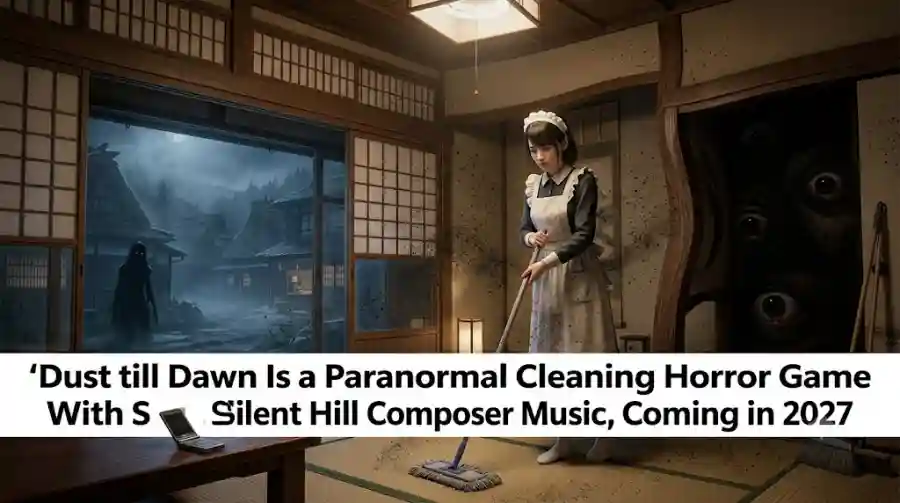
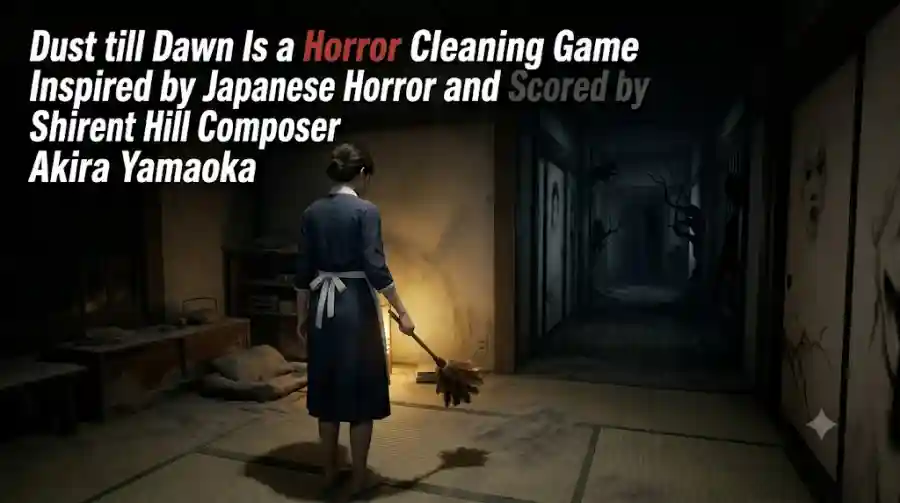
Dust till Dawn was announced during the PC Gaming Show Tokyo Direct 2026, introducing a first-person cleaning game set inside a quiet rural Japanese village where something is clearly wrong.
Players take on the role of a maid whose job appears straightforward at first: clean homes, businesses and community spaces, earn money and restore the village.
But the dust keeps coming back.
Rooms can change.
Objects can move.
And staying too late may expose the player to things that should not be there.
The game is being developed by Mac n Cheese Games and is planned for PC through Steam. The Steam listing currently gives 2027 as the planned release year, while an exact launch date has not been announced.
What makes Dust till Dawn particularly unusual is its combination of relaxing cleaning mechanics and Japanese horror imagery.
The game also features music from Akira Yamaoka, the composer known for his work on the Silent Hill series.
What Is Dust till Dawn?
Dust till Dawn is described as a cozy paranormal cleaning game set in a fictional rural Japanese village.
The basic premise is deliberately peaceful.
Players receive cleaning jobs and travel around the village to restore different locations.
The work includes:
- Sweeping
- Mopping
- Washing
- Squeegeeing
- Restoring rooms
- Investigating environments
- Purchasing improved equipment
- Unlocking new locations
But the peaceful routine gradually becomes more unsettling.
The mysterious dust appearing throughout the village refuses to stay gone.
The more players investigate their surroundings, the more they can discover that something unusual is happening beneath the surface.
This creates a two-sided gameplay concept.
During the day, Dust till Dawn resembles a relaxing cleaning simulator.
After dark, it starts to resemble a psychological horror game.
The Village Is the Real Mystery
The game's setting is a fictional rural Japanese village.
At first glance, it seems like an ordinary place where residents simply need help cleaning their homes and businesses.
However, the village has a strange problem.
A mysterious dust has begun appearing across different locations.
Cleaning it does not completely solve the problem.
The game's official description suggests that players can look around the spaces they are cleaning and investigate clues connected to the recurring dust.
That means the environments aren't simply workplaces.
They are also pieces of the game's mystery.
Players are encouraged to pay attention to their surroundings instead of rushing through every cleaning job.
Cleaning Is the Core Gameplay Mechanic
Dust till Dawn does not abandon the cleaning-simulator formula just because it is a horror game.
Cleaning remains central to the experience.
Players use different tools for different tasks and gradually restore locations throughout the village.
The Steam description specifically mentions dusting, mopping and using a squeegee.
The money earned from completing jobs can then be used to improve equipment and unlock additional rooms and locations, including areas such as the local school and market.
That creates a straightforward progression loop:
Take a job → clean the location → earn money → improve equipment → unlock new areas → discover more of the mystery.
The horror elements are built around that otherwise familiar structure.
The Dust Is Not Just Dirt
The biggest mystery surrounding Dust till Dawn is the recurring dust itself.
In an ordinary cleaning game, dirt exists because an environment needs cleaning.
Here, the dust appears to have a reason.
The official description says the mysterious dust has begun appearing throughout homes, businesses and community spaces.
Players can investigate their surroundings while working.
That means the cleaning process doubles as an investigation.
Instead of simply asking:
“How quickly can I finish this room?”
players may eventually start asking:
“Why does this room keep becoming dirty?”
That distinction is central to the game's horror premise.
Staying Late Could Be Dangerous
Dust till Dawn also builds tension around the time of day.
The game's promotional material repeatedly emphasizes not staying too late.
The Steam description literally warns players not to remain in the village after dark.
This gives the cleaning routine an interesting risk-reward structure.
Players want to complete more work because completing jobs provides money and progression.
But remaining in the village for longer can expose them to the supernatural side of the game.
The longer a seemingly ordinary cleaning session continues, the less ordinary the environment becomes.
That is a simple idea, but it can create a strong psychological contrast.
Japanese Horror Influences the Atmosphere
Dust till Dawn draws heavily from the visual language of Japanese horror.
The developer describes the game as combining the satisfaction of cleaning games with the unease and surreal imagery associated with Japanese horror manga.
This is particularly interesting because Japanese horror often relies on atmosphere and unsettling details rather than constant action.
That approach suits a cleaning game surprisingly well.
A quiet room gives players time to examine their surroundings.
A strange object sitting somewhere it should not be can become more noticeable.
A room that looks slightly different after returning can create tension without requiring a conventional monster encounter.
The game therefore appears to be using the slow pace of cleaning as a way to make its horror more effective.
Akira Yamaoka Is Composing the Music
One of the biggest names attached to Dust till Dawn is Akira Yamaoka.
Yamaoka is widely recognized for his work on the Silent Hill series, making his involvement especially notable for a game built around psychological and Japanese horror influences.
Music can be particularly important in a game like this.
A cleaning simulator naturally creates a calm atmosphere.
Adding an unsettling soundtrack can gradually change how players interpret the exact same environment.
A quiet room can feel safe when accompanied by peaceful music.
The same room can become uncomfortable when the soundtrack changes.
That contrast is likely to play a major role in Dust till Dawn's atmosphere.
The Game Comes From Mac n Cheese Games
Dust till Dawn is being developed by Mac n Cheese Games.
The studio is also associated with Void Martyrs, another horror-focused project.
With Dust till Dawn, the studio is taking a very different route.
Rather than placing players directly into a traditional combat-heavy horror scenario, it is building tension around an everyday occupation.
The player isn't a soldier.
They aren't a monster hunter.
They are a maid trying to finish cleaning jobs.
That makes the horror premise more unusual.
There Is No Combat Focus
Based on the currently published information, Dust till Dawn is centered around cleaning, exploration and investigation rather than conventional combat.
The Steam page lists it as a single-player game and focuses on cleaning tools, upgrading equipment and uncovering what is happening in the village.
That means players should not approach the game expecting a traditional survival-horror shooter.
The tension comes from the environment and the mystery.
The player is vulnerable precisely because they are not entering the village heavily armed.
Their primary tools are cleaning equipment.
Upgrading Tools Is Part of Progression
Money earned through cleaning jobs can be used to purchase better equipment.
The Steam listing says improved tools can unlock new rooms and locations.
This creates a progression system that connects the ordinary and supernatural sides of the game.
Cleaning earns money.
Money improves equipment.
Better equipment opens new locations.
New locations reveal more clues.
Those clues lead deeper into the mystery.
The system gives players a practical reason to continue taking jobs even as the village becomes increasingly disturbing.
Exploration Matters as Much as Cleaning
Dust till Dawn encourages players to look around while performing their jobs.
The official Steam description specifically invites players to examine other people's belongings and search for clues about why the dust keeps returning.
That changes the player's relationship with the environment.
A cupboard isn't necessarily just part of a room.
A desk isn't necessarily decoration.
An object placed somewhere unusual could potentially provide information.
This approach can make even ordinary spaces feel important.
The Game Uses a Slow-Burn Horror Formula
Dust till Dawn appears designed around gradual escalation.
It does not begin by immediately throwing a monster at the player.
Instead, the game starts with something familiar.
Clean a room.
Complete a job.
Earn money.
Buy equipment.
Return to work.
Then something feels wrong.
The dust returns.
Something moves.
The environment changes.
The player begins looking more carefully.
That gradual escalation is consistent with the game's Japanese horror influences.
Dust till Dawn's Release Date
Dust till Dawn does not currently have a specific release date.
The game was announced on September 20, 2026, and the Steam page currently lists its release window simply as 2027.
This distinction is important.
Some early reports describe the game as newly announced for PC without giving a date.
Steam currently provides the more specific information that the planned release year is 2027.
Players should therefore not expect a confirmed 2026 launch.
Platforms
At announcement, Dust till Dawn is confirmed for:
- PC
- Steam
No PlayStation, Xbox or Nintendo version has been announced in the available official information.
The Steam listing identifies Mac n Cheese Games as both developer and publisher.
A console release should not be assumed unless the developer confirms one.
Dust till Dawn Gameplay Features
The currently confirmed or officially described features include:
Cleaning Jobs
Players take jobs around the village and restore different locations using multiple cleaning tools.
Equipment Upgrades
Money earned from jobs can be used to purchase improved equipment.
New Locations
Better tools can open additional rooms and locations, including places such as the school and market.
Environmental Investigation
Players can inspect locations and search for clues connected to the strange dust.
Paranormal Events
The village contains supernatural elements that become increasingly important as the player investigates.
Single-Player Experience
The Steam listing identifies Dust till Dawn as a single-player game.
Japanese Horror Atmosphere
The game uses surreal imagery and horror influences inspired by Japanese manga.
Why the Cleaning Mechanic Works for Horror
The most interesting design decision is arguably the choice of cleaning as the primary activity.
Cleaning games are usually built around satisfaction.
You enter a dirty environment.
You make it clean.
You see visible progress.
The environment becomes orderly.
That naturally creates a relaxing gameplay loop.
Dust till Dawn can use the same feeling against the player.
Imagine cleaning an entire room until it looks perfect.
Then returning later and discovering that dust has appeared again.
Or finding an object that wasn't there before.
Or realizing that the room's layout has subtly changed.
The more familiar the cleaning routine becomes, the more noticeable an abnormal event can feel.
That gives the horror a foundation that doesn't require constant jump scares.
What Makes Dust till Dawn Different?
The game combines several ideas that rarely appear together:
Cleaning simulation
Japanese rural setting
Paranormal mystery
Psychological horror
Environmental investigation
Progression through equipment upgrades
The combination gives Dust till Dawn a clear identity.
There are already many cleaning games.
There are also many horror games.
But a game where cleaning itself becomes the way players uncover a supernatural mystery is much less common.
The Silent Hill Connection Adds Extra Attention
Akira Yamaoka's involvement gives the project another obvious connection to established Japanese horror.
This does not mean Dust till Dawn is a Silent Hill game or a Silent Hill spin-off.
It is not.
The game is an original project from Mac n Cheese Games.
However, Yamaoka's soundtrack involvement is relevant because his previous work includes Silent Hill, one of the most influential psychological horror franchises in gaming.
That makes the soundtrack worth watching as the game approaches launch.
What Players Still Don't Know
Despite the announcement, several important details remain unknown.
There is currently no confirmed:
- Exact release date
- Price
- Console version
- Full system requirements
- Complete story explanation
- Length of the full game
- Detailed progression structure
- Final launch content
The developer has therefore revealed the concept and core gameplay direction without giving every detail.
Players should avoid treating unofficial speculation about these areas as confirmed information.
What to Expect From the PC Release
For now, Dust till Dawn should be viewed as a 2027 PC horror release to watch, rather than an immediately playable game.
The Steam page currently allows players to wishlist the title and also lists a future playtest opportunity.
That gives interested players two ways to follow development:
- Wishlist the game on Steam.
- Request access to the playtest when available.
The developer can then use those channels to communicate future updates.
Dust till Dawn vs Traditional Cleaning Games
Traditional cleaning games are primarily about satisfaction and progression.
Dust till Dawn keeps those elements but adds uncertainty.
| Element | Traditional Cleaning Game | Dust till Dawn |
|---|---|---|
| Cleaning | Main activity | Main activity |
| Upgrades | Common | Yes |
| Exploration | Usually limited | Important |
| Mystery | Rare | Central |
| Horror | Usually absent | Major component |
| Paranormal events | No | Yes |
| Japanese horror influence | Rare | Core aesthetic |
| Nighttime danger | Usually absent | Important |
| Investigation | Limited | Part of gameplay |
The difference is clear.
Dust till Dawn is not abandoning the cleaning genre.
It is using the genre as the foundation for something darker.
Who Should Watch Dust till Dawn?
The game could be particularly interesting for players who enjoy:
- Psychological horror
- Japanese horror
- Slow-burn mysteries
- Cleaning simulators
- First-person exploration
- Atmospheric indie games
- Paranormal stories
- Environmental storytelling
- Silent Hill-style horror atmosphere
It may be less appealing to players specifically looking for fast combat, competitive multiplayer or large open-world exploration.
Final Takeaway
Dust till Dawn is one of the more unusual new PC games revealed during the September 2026 Tokyo gaming showcase period.
Mac n Cheese Games has taken the familiar cleaning-simulation formula and placed it inside a fictional Japanese village where strange dust keeps returning and increasingly disturbing events begin occurring.
Players work as a maid, clean different locations, earn money, upgrade equipment and unlock new areas.
But the cleaning jobs also provide a way to investigate the village's mystery.
The horror is built around what players discover while performing an otherwise ordinary job.
The project becomes even more notable because its music is being created by Akira Yamaoka, the composer associated with Silent Hill.
Dust till Dawn is currently planned for PC via Steam in 2027, with no exact release date announced yet.
For now, the most interesting question is not whether players can clean the village.
It is what they will discover after the cleaning is finished.
FAQs
What is Dust till Dawn?
Dust till Dawn is a paranormal cleaning and horror game from Mac n Cheese Games set in a fictional rural Japanese village.
When does Dust till Dawn release?
The game is currently planned for 2027 on Steam, but an exact release date has not been announced.