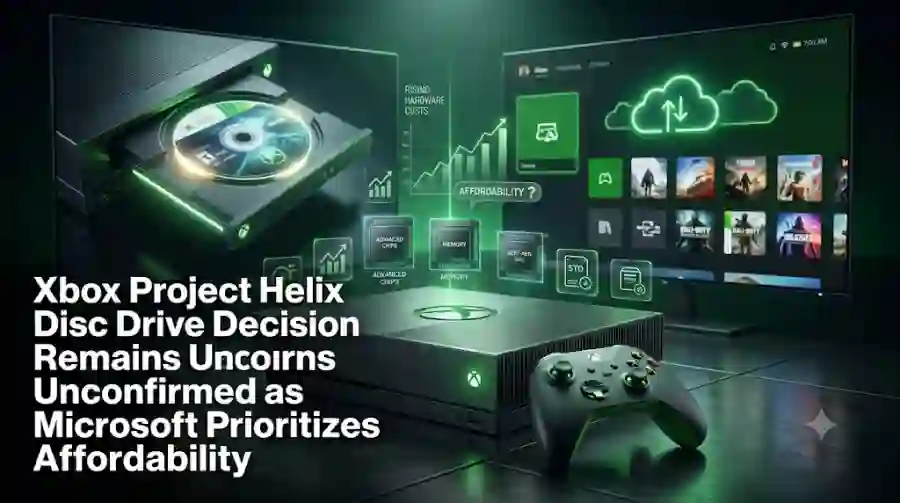
Xbox CEO Asha Sharma Won’t Confirm a Disc Drive for Project Helix as Next-Gen Hardware Costs Rise
Instead, she focused on two issues that could have a major impact on the console's final design: affordability and hardware efficiency.
The comments arrive at an important time for the gaming industry.
Sony has already announced that production of physical discs for new PlayStation games will end beginning in January 2028. Microsoft, meanwhile, has introduced its own Disc-to-Digital program that allows supported physical Xbox games to receive digital entitlements.
That combination has naturally led to speculation about whether Project Helix could eventually move toward a digital-first design.
However, Microsoft has not confirmed that Project Helix will be digital-only.
That distinction is important.
What Is Project Helix?
Project Helix is Microsoft's codename for its next-generation Xbox hardware.
Microsoft has previously indicated that it is developing future Xbox hardware, but the company has not yet revealed the final consumer design, official name, price or complete specifications.
Project Helix is therefore still a development project rather than a finished product available for purchase.
The console is expected to represent Microsoft's next major hardware generation after Xbox Series X|S.
However, Microsoft is approaching the next generation differently from previous console cycles.
The company increasingly treats Xbox as an ecosystem spanning consoles, PCs, cloud gaming and other devices.
That makes the hardware itself only one part of Microsoft's broader strategy.
Xbox Is Prioritizing Affordability
Sharma's latest comments suggest that the cost of next-generation hardware is one of Microsoft's biggest concerns.
Speaking around Gamescom, she explained that the industry needs to think more seriously about efficiency and affordability as hardware and component costs continue to change.
The issue isn't simply the price of the console itself.
Modern gaming hardware requires increasingly expensive components, including:
- High-performance processors
- Advanced GPUs
- Large amounts of memory
- Fast storage
- Cooling systems
- Connectivity hardware
- Power delivery components
Adding additional hardware features can push the final retail price higher.
A disc drive is one of those components Microsoft will have to consider.
That doesn't mean the company has decided to remove it.
It means the decision needs to be evaluated alongside the overall cost and design of the machine.
Microsoft Refuses to Confirm a Disc Drive
The biggest new detail is what Sharma didn't say.
When asked whether Project Helix will contain a disc drive, she avoided giving a direct answer.
Instead, she returned to the company's focus on efficiency, affordability and performance.
That leaves several possibilities open.
Project Helix could launch with:
- An integrated disc drive
- A digital-only configuration
- Multiple hardware configurations
- An optional external drive
- Another approach Microsoft has not yet revealed
At this point, none of those possibilities has been officially confirmed.
Therefore, reports claiming that Project Helix will definitely be digital-only are premature.
Why the Disc Drive Question Matters
The disc-drive question isn't simply about how players install games.
Physical media remains important to a significant part of the gaming community.
Physical games can be:
- Resold
- Loaned
- Collected
- Displayed
- Bought second-hand
- Used without relying entirely on a digital storefront
Collectors especially value physical editions because they provide something tangible beyond a digital license.
Removing the disc drive would therefore represent a major change in how Xbox players interact with their libraries.
But Microsoft also has to consider how many players actually use physical media.
Sony has said the preference for digital games has significantly outpaced physical discs, which was part of its justification for ending physical disc production for new PlayStation releases from January 2028.
Xbox's Disc-to-Digital Program Adds Another Piece
Microsoft's newly announced Disc-to-Digital feature makes the situation even more interesting.
As covered separately by TheInfoBytes, Xbox is testing a system that lets owners of supported Xbox One and Xbox Series X disc games claim digital entitlements.
Testing begins with Xbox Insiders on August 31, 2026.
The program is designed to give existing physical libraries greater flexibility.
Where supported, converted games can gain access to features such as Xbox Play Anywhere and Xbox Cloud Gaming.
Importantly, the physical disc continues to work.
Microsoft has described the feature as part of its broader approach to game preservation.
But it would be wrong to say that the Disc-to-Digital program proves Project Helix will not have a disc drive.
Microsoft has not made that connection officially.
Rising Hardware Costs Are Becoming a Bigger Problem
The next Xbox is being designed during an unusual period for the technology industry.
Demand for advanced computing hardware has increased substantially, particularly because of artificial intelligence infrastructure.
That creates pressure across the broader component market.
Gaming hardware manufacturers therefore have to balance performance against manufacturing costs.
A console that is dramatically more powerful but too expensive could struggle to reach a mass-market audience.
Sharma's comments suggest Microsoft wants to avoid that problem.
She emphasized the need to think about hardware efficiency and affordability alongside performance.
That could influence almost every part of Project Helix.
The Next Xbox May Focus on Choice
Microsoft's current strategy appears to emphasize player choice.
Xbox is already available across several platforms and services.
Players can use:
- Xbox consoles
- Windows PCs
- Cloud Gaming
- Game Pass
- Compatible handheld devices
Microsoft has also repeatedly discussed making games available across different devices.
Sharma has described the future of gaming as something that exists across devices rather than being restricted to one piece of hardware.
That philosophy could also influence Project Helix.
Instead of creating one rigid hardware configuration, Microsoft could potentially offer different ways for consumers to access its ecosystem.
However, the company has not announced such a strategy for Project Helix.
Could Project Helix Be Digital-Only?
This is currently one of the biggest questions surrounding the console.
The possibility is certainly being discussed because of three developments:
First, Sony is ending production of physical discs for new PlayStation games from 2028.
Second, Microsoft is testing Disc-to-Digital functionality for existing physical Xbox games.
Third, Xbox leadership is emphasizing affordability and efficiency for next-generation hardware.
Together, these developments create a logical basis for speculation.
But speculation is still speculation.
Microsoft has not announced that Project Helix will be digital-only.
It has also not announced that the console will lack a disc drive.
Until Microsoft officially reveals the hardware configuration, players should treat all claims about a digital-only Helix as unconfirmed.
An External Disc Drive Could Be One Solution
One possibility being discussed by Xbox-focused outlets is an external optical drive.
Such a system could allow Microsoft to reduce the complexity of the main console while still giving physical-media users an option.
An external drive could also make it easier to offer different configurations.
For example, a lower-cost digital model could target players who primarily buy games digitally, while physical-media users could purchase an additional drive.
Again, this is not a confirmed Project Helix feature.
Microsoft has not announced an external drive for the console.
It is simply one possible solution to the hardware and consumer-choice problem.
Physical Media Is Entering a Major Transition
Project Helix is arriving during a broader transformation in how games are distributed.
For decades, physical copies were the primary way to purchase console games.
That has changed dramatically.
Digital storefronts now allow players to purchase and download games without visiting a retailer.
Cloud gaming adds another layer by allowing some games to be played without downloading the full software package.
Subscription services such as Game Pass further change the traditional concept of game ownership.
The industry is therefore moving toward a more flexible but also more complicated relationship between players and their libraries.
Sony and Xbox Are Taking Different Approaches
Sony's announcement is straightforward.
From January 2028, new PlayStation games will no longer have physical disc production and will instead be available digitally, including through retail channels in digital formats. Existing and pre-2028 disc releases are not affected.
Xbox has not announced the same policy.
Instead, Microsoft is experimenting with a system that makes existing physical games more useful within its digital ecosystem.
That could allow Xbox to appeal to both groups:
Digital-first players who want convenience.
Physical collectors who still want discs.
Whether that approach survives into the next hardware generation remains to be seen.
Xbox Still Has Time to Make the Decision
Project Helix has not received a complete consumer reveal.
That means Microsoft still has time to determine exactly how the hardware will be positioned.
The company can evaluate:
- Component costs
- Manufacturing expenses
- Consumer demand
- Disc-drive availability
- Digital sales trends
- Cloud gaming adoption
- Game Pass growth
- Physical-media demand
The final decision could therefore depend on market conditions much closer to launch.
This is why Sharma's refusal to confirm the disc drive should not be interpreted as an announcement that it has been removed.
It simply means Microsoft isn't ready to reveal that part of the hardware strategy.
What Gamers Should Watch Next
The next important Project Helix announcements will likely involve the hardware itself.
Players will want answers about:
- Official console name
- Release date
- Price
- CPU and GPU architecture
- Storage capacity
- Physical-disc support
- External drive support
- Backward compatibility
- Controller design
- Cross-platform functionality
- Game compatibility
The disc-drive decision will be particularly important because it could affect how millions of existing Xbox players carry their physical libraries into the next generation.
Confirmed Information
Microsoft has confirmed or stated that:
- Project Helix is part of Xbox's next-generation hardware plans.
- Xbox is prioritizing affordability and efficiency alongside performance.
- Hardware and component costs are an important consideration.
- Asha Sharma has not confirmed whether Project Helix will include a disc drive.
- Xbox is continuing to support a broad ecosystem across console, PC and cloud.
- Microsoft is testing Disc-to-Digital for supported physical games.
- Disc-to-Digital testing begins August 31, 2026 for Xbox Insiders.
Rumors / Speculation
The following remain unconfirmed:
- Project Helix being digital-only
- Project Helix shipping without a disc drive
- An external disc drive being offered
- Multiple hardware configurations
- The final price of Project Helix
- The final release date
- Whether every existing physical Xbox game will eventually receive a digital entitlement
These claims should not be treated as confirmed until Microsoft provides official details.
Why Project Helix Could Be a Major Turning Point for Xbox
The next Xbox is being designed at a very different moment from the Xbox One and Xbox Series generations.
Microsoft now operates one of the industry's largest gaming ecosystems across console, PC and cloud.
At the same time, the company faces higher hardware costs and a market that increasingly favors digital distribution.
That creates a difficult balancing act.
Microsoft needs to produce hardware powerful enough to justify a new generation without pricing ordinary players out of the market.
At the same time, it needs to decide how much importance physical media should have in the future.
Sharma's latest comments show that Microsoft is thinking carefully about those questions.
But they don't provide the final answers yet.
Conclusion
Xbox Project Helix remains one of the biggest unanswered questions in the console market, and Gamescom 2026 has provided another important clue without giving players a definitive answer.
Xbox CEO Asha Sharma has confirmed that affordability and hardware efficiency are major priorities, but she has refused to reveal whether the next-generation console will include a physical disc drive.
That leaves the door open to several possibilities.
Project Helix could retain a built-in drive, adopt an optional external solution, offer different configurations or move entirely toward digital distribution.
For now, none has been confirmed.
Microsoft's new Disc-to-Digital program shows that the company is already thinking about how physical libraries can work alongside a digital ecosystem. But that program should not be treated as proof that Project Helix will be disc-free.
The next-generation Xbox is being designed around a simple but difficult goal: deliver strong performance without making the hardware unaffordable.
How Microsoft balances that goal with physical game ownership could define one of the most important parts of Project Helix.
Frequently Asked Questions
What is Xbox Project Helix?
Project Helix is the codename for Microsoft's next-generation Xbox hardware.
Will Project Helix have a disc drive?
Microsoft has not confirmed whether Project Helix will include a disc drive.
Is Project Helix digital-only?
No. Microsoft has not confirmed that the console will be digital-only.