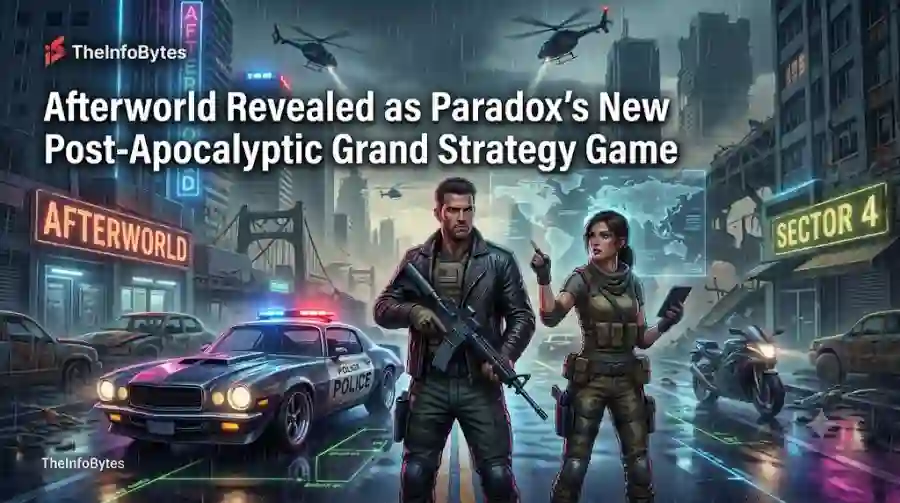
Paradox Leaves History Behind With Afterworld, a Survival Strategy Game About Rebuilding America
The project is particularly notable because it comes from Paradox Development Studio, the team behind major grand strategy games such as Crusader Kings III and Hearts of Iron IV.
Instead of controlling an established kingdom or historical nation, players begin with a small group of survivors and gradually develop settlements, establish laws, form alliances, discover lost technology and potentially build an empire across the continent.
Paradox describes the game as an original post-apocalyptic survival grand strategy experience.
The release date is currently TBA, with the game planned for PC.
Afterworld Takes Paradox Into a New Setting
Paradox has spent years building strategy games around real historical periods.
Crusader Kings focuses on dynasties and medieval politics.
Hearts of Iron puts players in command during World War II.
Europa Universalis explores centuries of global history.
Afterworld is different.
There is no historical timeline that players need to follow.
Instead, Paradox has created its own version of post-apocalyptic North America.
The old world has collapsed, leaving dangerous wastelands, abandoned technology and scattered communities behind.
That gives the developers much more freedom to create political systems, factions and historical events specifically for the game rather than adapting real-world history.
Paradox says Afterworld is the studio's first original setting in a decade, making the announcement particularly important for fans of its strategy games.
Players Begin With Almost Nothing
The scale of Afterworld is one of its most interesting ideas.
Players don't begin with a powerful empire.
They begin with a small group of survivors.
The official game description says players must keep their initial group alive while exploring hostile environments, collecting resources and establishing their first settlements.
Food, water and fuel become critical resources.
That creates a different starting point from many traditional grand strategy games.
Instead of beginning with a functioning economy, established borders and a large army, players must first solve basic survival problems.
Only after the community becomes stable can the player begin thinking about larger political ambitions.
This creates a natural progression:
survival → settlement → tribe → nation → empire.
Different Origins Create Different Starts
Afterworld will allow players to begin from different origins.
One example is shelterfolk emerging from a failing nuclear bunker.
Another involves zealots searching for their goddess in the wastelands.
These origins can change the way a campaign begins.
A community emerging from a bunker could have access to different knowledge or technology than a group shaped by religious beliefs.
That means the opening hours of a campaign may not always follow the same pattern.
The different starting backgrounds could also encourage players to replay the game using completely different approaches.
A Procedurally Generated North America
One of Afterworld's biggest features is its strategic map.
Paradox says the game will feature a procedurally generated North America.
The broad geography remains recognizable, but resources, tribes and threats can change between playthroughs.
This is important for a grand strategy game.
A fixed map can eventually become familiar to experienced players.
Procedural generation can make each campaign less predictable.
A resource-rich region might be valuable in one game but difficult to reach in another.
A powerful tribe could appear in a different location.
Threats and opportunities can change.
That should encourage players to react to the world instead of simply following a memorized opening strategy.
Survival Is Part of the Grand Strategy
Afterworld isn't simply a traditional grand strategy game with a post-apocalyptic visual theme.
Survival is built into the foundation.
Players need to manage essential resources while their population grows.
Food, water and fuel must be gathered and distributed.
Settlements must be established in locations that can support continued development.
The challenge becomes more complicated as the player's territory expands.
A small group can survive with limited infrastructure.
A growing nation cannot.
That creates a natural tension between expansion and stability.
Growing too quickly could stretch resources too far, while staying small for too long could leave the community vulnerable to stronger factions.
Lost Technology Can Change the Balance of Power
The ruins of the old world are not simply environmental decoration.
Players can explore them to discover lost technologies.
Paradox says Afterworld includes a dynamic Ideas Tree where discoveries can unlock new advancements based on what players encounter.
This makes technological development more connected to exploration.
Instead of simply selecting technologies from a static menu, players can discover knowledge through their actions.
For example, encountering certain environments or communities can lead to new ideas.
A river could inspire irrigation.
Meeting another tribe could introduce organized religion.
This system could make technological progression feel more connected to the actual story of a campaign.
Politics Will Shape Your New Society
Building an empire is not only about collecting resources and defeating enemies.
Players will also have to decide what kind of society they want to create.
Afterworld allows players to establish laws and make decisions about how scarce resources are distributed.
Players can determine who receives political influence and what their emerging nation stands for.
These choices can create different political identities.
A player might build a society focused on cooperation and stability.
Another might prioritize military strength and expansion.
Someone else could create a more authoritarian state designed to survive constant external threats.
Paradox has built much of its reputation around systems where political decisions create long-term consequences, and Afterworld appears to continue that philosophy.
Diplomacy Can Be as Important as War
The post-apocalyptic setting is full of competing groups.
Players will encounter other survivor communities, tribes and hostile factions.
Not every encounter has to end in combat.
The official description says players can negotiate trades, form alliances and absorb wandering tribes into their growing nation.
But peaceful diplomacy is only one option.
Players can also raid rivals or wage wars when negotiations fail.
This creates a familiar Paradox-style strategic choice.
A neighboring faction could become an ally, trading partner or future enemy depending on the player's decisions.
The consequences of those relationships could become increasingly important as the player's territory expands.
Raiders, Cultists and the Immortal Ancients
Afterworld's world isn't populated only by ordinary survivor groups.
Paradox has introduced several more unusual factions and threats.
Players will encounter cultists, raider warlords and the mysterious Ancients.
The Ancients are particularly interesting.
They are described as immortal leaders who survived the old world through forgotten technology.
They still have their own ideas about who should control the future.
That creates a conflict between the new societies being built by survivors and remnants of the old civilization.
The Ancients could therefore become one of the game's most important long-term threats.
Players Can Build an Empire Across the Continent
The ultimate scale of Afterworld is much larger than simple settlement survival.
Paradox describes the experience as growing from a small and approachable beginning into a full grand strategy campaign.
Players can expand across the continent, establish multiple settlements, manage supply lines and organize their growing nation.
This creates an interesting progression curve.
Early gameplay is about survival.
Mid-game strategy becomes focused on alliances, territory and resources.
Later stages can involve large-scale political struggles and wars.
That progression could make Afterworld easier for newcomers to understand while still offering the complexity longtime Paradox players expect.
Supply Lines and Migration Add Another Layer
Expansion isn't as simple as capturing territory.
Players have to keep their communities supplied.
Afterworld includes convoys and supply lines, allowing players to move resources between settlements.
The game also allows entire communities to migrate when their current region becomes unsuitable.
That is a major difference from traditional empire-building games.
A settlement isn't necessarily permanent.
If resources run out or environmental conditions become too dangerous, abandoning a settlement and moving elsewhere could become the best strategic decision.
That creates another meaningful choice:
Do you defend an established settlement at great cost, or move your population toward a more promising region?
The World Can Tell Emergent Stories
Paradox is known for systems that produce unexpected stories.
Afterworld appears designed around the same philosophy.
Because the map, resources, factions and threats can change between campaigns, individual games should create different situations.
A minor tribe encountered early could eventually become a major rival.
A resource shortage could trigger political unrest.
A technological discovery could completely change a player's military capabilities.
A diplomatic decision could determine whether two nations become allies or enemies.
These emergent situations could be one of Afterworld's strongest features.
Instead of following a fixed narrative from beginning to end, players create their own history.
Multiplayer Is Planned
Afterworld is not limited to solo strategy.
Paradox's official game information lists competitive multiplayer and co-op among its features.
That could significantly expand the game's replay value.
Cooperative players could work together to build a shared post-apocalyptic nation.
Competitive players could instead fight for control of resources and territory.
However, Paradox has not yet provided full details about player counts, multiplayer modes or how cooperative campaigns will work.
Those details should be treated as information still to come.
Afterworld Is Designed to Be More Approachable
Grand strategy games can be intimidating.
Paradox titles are famous for their depth, but newcomers can sometimes struggle to understand hundreds of interconnected systems.
Afterworld is being described as a game that is easy to learn but difficult to survive.
That could make it an important entry point for new players.
Starting with a small group instead of a massive empire naturally limits the number of systems players need to manage immediately.
As the settlement grows, additional mechanics can gradually become relevant.
If Paradox successfully manages that progression, Afterworld could attract players who normally avoid traditional grand strategy games.
Confirmed Information
The following details have been officially confirmed:
- Afterworld is a new grand strategy game from Paradox Development Studio.
- It was revealed during Gamescom Opening Night Live 2026.
- It uses an original post-apocalyptic setting.
- The game takes place in a ruined version of North America.
- Players begin with small groups of survivors.
- Multiple starting origins are planned.
- The strategic map is procedurally generated.
- Players manage settlements and resources.
- Food, water and fuel are important survival resources.
- Lost technologies can be discovered through exploration.
- The game includes laws, diplomacy and political decisions.
- Players can form alliances, trade, absorb tribes or wage war.
- Cultists, raiders and the Ancients are among the threats.
- Convoys and supply lines are part of the strategy systems.
- Competitive multiplayer and co-op are planned.
- The game is being developed for PC.
- The release date is currently TBA.
Rumors and Speculation
Paradox has not announced a specific release date for Afterworld.
The company has also not confirmed the final player count for multiplayer or co-op.
Pricing, early-access plans, beta testing and exact system requirements have not been officially announced.
Claims about a specific launch month or unannounced platforms should therefore be treated as speculation.
Why Afterworld Could Be Important for Paradox
Afterworld is more than another strategy game announcement.
It represents Paradox Development Studio experimenting with a setting that isn't tied to real history.
That gives the developers much greater creative freedom.
They can create fictional societies, technologies, political conflicts and civilizations without needing to follow historical events.
At the same time, the game retains the systems that Paradox players expect: diplomacy, warfare, economics, politics and long-term empire building.
The post-apocalyptic setting also fits naturally with the studio's strategy philosophy.
Civilization has collapsed, so players effectively get to decide what comes next.
What Players Should Watch Next
The most important missing information is the release schedule.
Paradox has not yet given Afterworld a launch window.
More gameplay footage will also be important.
The announcement establishes many systems, but players still need to see how the survival mechanics connect with grand strategy.
The transition from a small settlement to a continent-spanning empire will be particularly important.
If Paradox can make that progression understandable without sacrificing depth, Afterworld could appeal to both longtime strategy fans and newcomers.
Conclusion
Afterworld is one of the more interesting new strategy announcements from Gamescom 2026.
Paradox Development Studio is leaving its traditional historical settings behind and creating an original post-apocalyptic North America where players can build a civilization from almost nothing.
The game combines survival, settlement management, technology, diplomacy, politics and warfare.
Procedurally generated maps should make each campaign less predictable, while different origins give players multiple ways to begin their journey.
The presence of co-op and competitive multiplayer also gives the project a much broader potential audience.
There is still no confirmed release date, and many gameplay details remain to be revealed.
But the basic concept is already clear: Afterworld is about deciding what civilization looks like after the old world is gone.
If Paradox can successfully combine its trademark grand-strategy depth with a more approachable survival-focused beginning, Afterworld could become one of the studio's most distinctive new games in years.