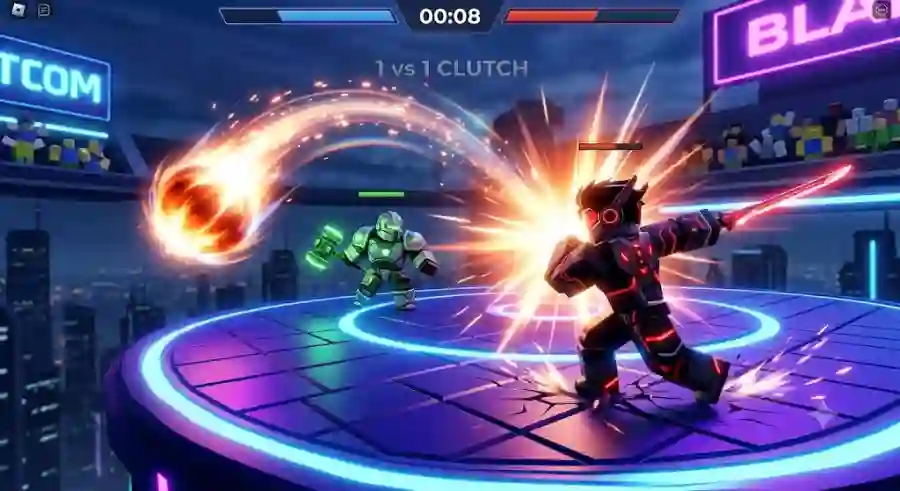
Dominate Blade Ball End-Game Duels With Perfect Deflect Timing, Powerful Abilities and Advanced Mind Games
The ball moves faster than your eyes can properly follow. A single missed block, a tiny delay caused by network lag, or one wrong prediction can instantly end the match. While your opponent celebrates the victory, you are left wondering what went wrong.
Many beginners rely on constant clicking and panic blocking during the early stages of a round. This strategy may work when the pace is slow, but experienced Blade Ball players quickly punish random reactions.
Highlights: What Separates Good Players From Elite Blade Ball Fighters
Before jumping into advanced strategies, every competitive player needs to understand the core mechanics that decide most 1v1 fights.
Key Skills Required for Winning Clutches:
- Perfect defensive block timing
- Understanding changing ball speeds
- Managing ping and latency
- Reading opponent camera movements
- Countering curveball attacks
- Using abilities strategically
- Controlling distance and positioning
The difference between an average player and an advanced player is prediction. Skilled players do not simply react to the ball. They predict what their opponent is trying to do before the attack happens.
1. Mastering the Parry: Understanding Ball Speed and Ping
The foundation of Blade Ball is simple:
Block the ball at the correct moment.
However, the real challenge begins when the ball starts gaining speed after every successful deflection.
Each successful hit increases the pressure on both players because the reaction window becomes smaller and smaller. The timing that works during the beginning of a round will eventually fail during an end-game battle.
Understanding how ball speed changes throughout a match is essential.
How Ball Speed Changes Your Reaction Window
Early Game: Slow Ball Speed
During the opening moments of a match, the ball travels relatively slowly.
Players usually have around half a second to react, giving them enough time to watch the ball and prepare their block.
At this stage, beginners should focus on accuracy rather than speed.
The best approach is:
- Wait until the red target indicator fully locks onto your character.
- Avoid unnecessary panic clicking.
- Build rhythm and confidence before the ball becomes faster.
Early-game mistakes are usually caused by blocking too soon because players become nervous.
Mid-Game: Moderate Ball Speed
As players continue successfully deflecting the ball, the speed increases significantly.
At this point, directly watching the ball becomes more difficult because the animation starts moving too quickly.
Experienced players begin relying less on visual tracking and more on awareness.
Instead of only following the ball, focus on:
- Your opponent’s position
- The distance between players
- The direction of movement
- The timing pattern of previous attacks
Spatial awareness becomes more valuable than simply watching the projectile.
End-Game and 1v1 Clutches: Hyper Speed Battles
The final stage of Blade Ball matches creates the most intense moments.
The ball can move so quickly that the visual animation may appear slightly behind the actual hit-box.
This means your eyes can trick you.
Many players lose because they wait until they physically see the ball reaching them. By that point, the server may already consider the attack successful.
During high-speed rallies, you need to activate your block slightly earlier than your visual reaction suggests.
Elite players learn to trust prediction instead of waiting for confirmation.
Accounting for Ping: Why Latency Can Decide Your Match
Network latency plays a huge role in competitive Blade Ball gameplay.
A player with excellent reflexes can still lose if their connection creates noticeable delay.
For example, if your ping is between 80ms and 120ms, blocking when the ball visually reaches your character may already be too late from the server’s perspective.
The game may register the attack before your input reaches the server.
Important Ping Rule
If your ping is above 60ms, adjust your timing.
A useful rule is:
Press block when the ball is approximately one character-length farther away than your instincts tell you.
This small adjustment helps compensate for network delay.
During extremely fast rallies, visual information becomes unreliable. Instead, many advanced players depend on audio signals.
The sound of an opponent’s successful block can often provide a faster and more accurate reaction cue than watching the ball’s movement.
2. How to Read and Deflect Curveballs
Curveballs are one of the biggest reasons players lose advanced 1v1 battles.
A skilled opponent does not simply send the ball directly toward you. They manipulate its direction, angle, and visual movement to force mistakes.
Curveballs create confusion because the ball’s visible path does not always match the exact moment it reaches your hit-box.
Learning to recognize different curveball styles can completely change your performance.
Common Curveball Techniques and How to Counter Them
| Curveball Style | What the Opponent Does | Best Counter Strategy |
|---|---|---|
| Flick Curve | Turns the camera 90° to 180° while hitting, creating a wide trajectory before the ball returns toward you | Stay calm and track camera movement. Delay your block slightly because the ball travels farther |
| High-Arc Curve | Jumps and aims upward, causing the ball to travel above before dropping sharply | Move your camera upward and watch the highest point before blocking during the downward movement |
| Ground-Skim | Sends the ball close to the floor, reducing the visible travel distance | Block earlier because the hit-box arrives faster than expected |
Countering the Flick Curve
The flick curve is designed to make players panic.
The opponent quickly rotates their camera while hitting the ball, creating an unusual angle. The ball appears unpredictable before automatically targeting you again.
The biggest mistake is instantly blocking.
Instead:
- Watch the opponent’s camera direction.
- Estimate the longer travel path.
- Wait slightly longer before activating your defense.
Patience beats panic.
Countering the High-Arc Curve
The high-arc curve uses vertical movement to confuse opponents.
The attacker jumps and sends the ball upward, making it appear slower before it suddenly drops toward you.
The correct response:
- Move your camera toward the sky.
- Track the highest point of the ball.
- Block as the ball begins accelerating downward.
Players who only watch horizontally often miss this attack completely.
Blade Ball Curveball Mastery: How to Create Your Own Unpredictable Attacks
Understanding curveballs is not only about defending against them. The best Blade Ball players also know how to create their own unpredictable attacks.
A well-executed curveball can force an opponent into an early block, destroy their timing rhythm, and create an easy elimination opportunity.
To perform a curveball, your camera movement must match the exact moment you activate your block.
The technique requires:
- Moving your camera sharply left, right, or upward
- Pressing block at the same instant
- Allowing the ball to inherit the initial direction of your camera movement
When performed correctly, the ball follows your chosen angle before the game’s homing system redirects it toward your opponent.
This small movement creates uncertainty because your opponent expects a normal straight attack but receives a delayed and unusual trajectory instead.
The goal is not just to make the ball move differently. The real purpose is to break your opponent’s timing.
A player who constantly sends predictable attacks becomes easy to read. A player who mixes normal shots with curveballs keeps opponents guessing throughout the entire match.
3. Blade Ball Ability Tier List for Winning 1v1 Clutches
Abilities become extremely important when only two players remain.
During normal rounds, almost any ability can provide some value. However, in high-pressure 1v1 situations, certain abilities become significantly stronger because they affect timing, movement, and prediction.
Passive advantages and mobility skills can help, but abilities that manipulate ball speed, player visibility, or positioning usually dominate competitive duels.
The strongest clutch abilities include:
Top-Tier Blade Ball Abilities
| Ability | Main Advantage |
|---|---|
| Rapture | Creates a massive velocity shift and forces extremely fast reactions |
| Invisibility | Removes opponent targeting information and creates confusion |
| Freeze | Stops ball momentum and destroys opponent rhythm |
| Telekinesis | Changes ball direction and target instantly |
1. Rapture: The Ultimate Execution Ability
Rapture is one of the strongest abilities for aggressive 1v1 situations.
The ability launches the ball upward with increased momentum while dramatically increasing its speed.
In a close-range battle, Rapture can become almost impossible to react to unless your opponent already predicted the move.
The biggest strength of Rapture is surprise.
When activated at the correct distance, it creates a sudden speed change that destroys normal reaction patterns.
Best Time to Use Rapture:
- During the final 1v1 battle
- When standing close to your opponent
- After creating a predictable rhythm
- When your opponent has already used their defensive ability
A common mistake is wasting Rapture early in the match.
Because it has a long cooldown, experienced players save it for moments when one successful attack can secure victory.
2. Invisibility: Winning Through Mind Games
Blade Ball is not only a reaction-based game. It is also a psychological battle.
Invisibility takes advantage of this by removing important visual information from your opponent.
When activated, the opponent loses the normal lock-on visual indicator that helps them judge incoming attacks.
During a fast rally, this creates immediate confusion.
Many players rely heavily on visual signals. When those signals disappear, they panic and block too early.
This creates an opportunity.
Best Invisibility Strategy:
- Activate it during a fast exchange
- Force your opponent into a premature block
- Punish their mistake after the failed defense
The ability works best against players who depend more on reaction than prediction.
3. Freeze and Forcefield: The Ultimate Rhythm Breakers
High-level Blade Ball battles often develop into a repeated pattern.
Both players exchange blocks.
The speed increases.
The timing becomes automatic.
Players enter a rhythm where their muscle memory controls their actions.
Freeze destroys that rhythm instantly.
Freeze Ability
Freeze stops the ball’s momentum completely and resets its speed.
This creates a huge mental disruption because your opponent expects the next attack to continue at maximum speed.
Instead, the situation suddenly changes.
Their previous timing becomes useless.
A player who was perfectly blocking every attack can suddenly miss because their brain expects a faster movement pattern.
Forcefield Ability
Forcefield provides a temporary automatic defense system.
It protects players by automatically deflecting incoming attacks for a short duration.
This makes it especially useful when:
- Your ping suddenly increases
- Your reaction timing becomes unreliable
- You need emergency protection during a difficult rally
Although Forcefield does not create the same offensive pressure as Rapture, it provides valuable survival potential.
4. Advanced Blade Ball 1v1 Tactics: Winning Through Positioning
Mechanical skill is important, but positioning often decides close matches.
Two players with similar reaction speed can have completely different results depending on where they stand.
A smart player controls distance, movement, and pressure.
Strategy A: Close-Range Clashing (The Clinch)
Close-range fighting is the ultimate test of reflexes.
Players who have:
- Low ping
- Fast reactions
- Strong timing confidence
can move directly toward their opponent and force a pure reaction battle.
Execution:
- Run directly toward your opponent
- Use alternating blocks
- Maintain aggressive pressure
Goal:
The objective is simple:
Force your opponent to make a mistake before you do.
At zero distance, there is less time for prediction. The fight becomes a test of timing accuracy.
Risk:
This strategy has extremely high danger.
One incorrect block timing immediately eliminates you.
There is no extra travel distance to recover from mistakes.
The clinch strategy rewards confident players but punishes hesitation.
Strategy B: Kiting Method (Spacing Control)
Not every player should fight aggressively.
If your opponent has a powerful close-range ability or better connection quality, maintaining distance can create a major advantage.
This is called the kiting strategy.
Instead of rushing forward, you create space and force your opponent to attack from farther away.
Execution:
- Move backward around the arena edges
- Maintain distance from your opponent
- Use mobility abilities such as Dash or Phase
- Keep enough space to read incoming attacks
Goal:
The purpose is to increase the ball’s travel distance.
More distance gives you extra time to:
- Analyze trajectory changes
- Recognize curveballs
- Predict opponent movement
Risk:
Spacing is not perfect.
If you lose camera tracking, skilled opponents can punish you with long-range curveballs.
A player who constantly runs away without awareness becomes predictable.
Winning Blade Ball Clutches: Final Checklist
Before entering your next competitive match, remember these important rules.
Watch the Opponent, Not Only the Ball
The ball tells you what is happening now.
Your opponent tells you what is about to happen.
Pay attention to:
- Character direction
- Camera movement
- Position changes
- Attack patterns
A player’s movement often reveals a curveball before the ball even starts moving.
Trust Audio During High-Speed Battles
Visual information becomes unreliable when the ball reaches extreme speeds.
During intense rallies:
- Listen for block sounds
- React to audio timing
- Avoid depending only on animation
Experienced players often use sound as an additional reaction tool.
Save Powerful Abilities for End-Game Moments
Abilities like:
- Rapture
- Telekinesis
- Freeze
can completely change a final duel.
Do not waste them during the beginning of the match.
The strongest players understand timing.
A powerful ability used at the correct moment is worth more than several random uses earlier.
Never Double-Tap Your Block
One of the biggest mistakes beginners make is repeatedly pressing the parry button.
Spam clicking feels safe, but it creates problems.
The game’s internal cooldown system can leave you temporarily unable to defend.
During that short window, even one attack can end the match.
Successful Blade Ball players do not panic.
They tap with purpose.
Every block should have a reason.
Industry Impact: Why Blade Ball Became a Competitive Roblox Favorite
Blade Ball represents how Roblox games have evolved beyond simple casual experiences.
Modern Roblox titles increasingly focus on:
- Skill-based combat
- Competitive mechanics
- Strategy
- Timing-based gameplay
- Player-versus-player competition
Unlike games where progression depends mostly on collecting items or upgrading characters, Blade Ball rewards mechanical improvement.
A new player can become stronger by learning timing, studying opponents, and practicing movement.
This competitive design has helped Blade Ball maintain popularity among Roblox players who enjoy fast reactions and intense battles.
Why These Skills Matter for Every Blade Ball Player
The best Blade Ball players are not simply the fastest clickers.
They understand information.
They understand timing.
They understand psychology.
Winning a clutch situation requires combining multiple skills:
- Predicting opponent actions
- Managing latency
- Reading movement
- Choosing the correct ability
- Controlling distance
- Staying calm under pressure
A player who masters these fundamentals can defeat opponents with stronger abilities or more experience.