Dotemu Surprise-Releases a Chaotic New Party Game With 15 Bugs, 15 Arenas and Five Multiplayer Modes
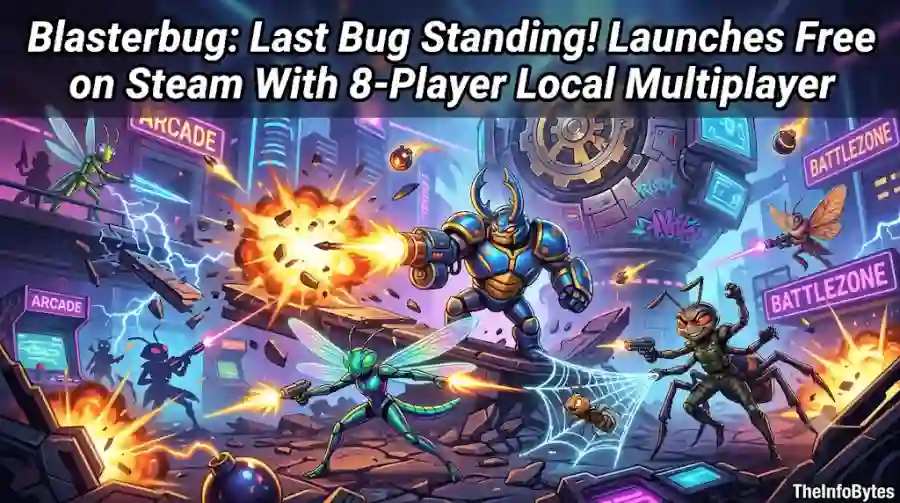
Players choose from a collection of strange bugs, enter constantly changing arenas and attempt to become the last insect standing.
But Blasterbug adds its own mechanics to the familiar bomb-based party formula.
Players can punch opponents, use special abilities and throw explosive "Pome-grenades" while trying to survive hazards and environmental changes.
Most importantly, the game supports up to eight players locally, making it specifically designed for group gaming sessions.
Blasterbug Is Available Now and Free
The biggest part of the announcement is also the easiest to understand.
Blasterbug: Last Bug Standing! is available now on Steam and is free to play.
There is no need to wait for an early-access launch or upcoming release window.
Players can download the game and start playing immediately.
That surprise-release approach makes the game particularly interesting for players searching for something new to play right now.
The Steam listing classifies it as an action, casual and indie title, while also featuring local multiplayer, PvP, co-op and party-game elements.
For a game designed around short multiplayer matches, the free entry point could also make it easier for groups of friends to try it together.
15 Playable Bugs Have Different Abilities
Blasterbug does not simply give every player an identical character.
There are 15 playable bugs, each with its own special moves.
That adds a small character-selection strategy to the otherwise chaotic gameplay.
For example, the Steam description highlights different abilities for different insects.
A fly can use its mobility to escape dangerous situations.
A spider can use webs to trap opponents.
A beetle can roll a destructive flaming dung ball across the arena.
Each bug therefore has a different way of approaching a match.
This should encourage players to experiment rather than simply choosing one character and never changing.
A player who prefers movement can choose an insect with mobility-based abilities, while another player may prefer traps or direct attacks.
15 Arenas Change the Battles
Character abilities are only one part of the game's variety.
Blasterbug also features 15 playable areas, with different arenas introducing different environmental challenges.
The game's environments include locations such as the Temple, Bugville and a Kitchen.
These aren't simply different backgrounds.
The Steam description says the arenas contain gameplay twists that can change how players approach each match.
For example, one environment can introduce dangerous hazards while another can create fast-moving situations or objects that players must avoid.
That means knowing the arena can become just as important as knowing your chosen bug.
Five Game Modes Are Included
Blasterbug launches with five different game modes.
They are:
- Death Battle
- Coin Battle
- Crown Battle
- Paint Battle
- Party Battle
Death Battle follows the game's basic last-bug-standing concept.
Coin Battle rewards the player who collects the most coins.
Crown Battle focuses on holding onto the crown.
Paint Battle adds territory-style competition through spreading paint.
Party Battle combines the other modes with random modifiers.
This variety is important because the game is built around replaying short matches.
If every round followed exactly the same rules, the novelty could disappear quickly.
The different objectives give groups a reason to change how they approach each match.
Eight Players Can Join Locally
The strongest feature for party-game fans may be the player count.
Blasterbug supports up to eight players locally.
That puts the focus firmly on shared-screen multiplayer.
Instead of requiring every player to own a separate copy of the game, a group can gather around one system and compete together.
The format makes the game suitable for parties, family gatherings or casual gaming sessions where players want something that can be understood quickly.
The game's design also favors short, chaotic encounters rather than lengthy campaigns.
That is consistent with Dotemu's description of Blasterbug as a quick-fire multiplayer experience.
The Arenas Are Built Around Chaos
Blasterbug's combat revolves around explosive attacks.
Players can throw Pome-grenades and attack opponents directly while attempting to avoid being caught in their own explosions.
The arenas are also described as evolving battlefields.
That means players have to react to what is happening around them instead of relying on a fixed strategy.
A player who survives one round may immediately have to adapt when the next arena introduces a different environmental hazard.
This gives the game a simple but useful gameplay loop:
Choose a bug, enter an arena, use your abilities, survive the chaos and adapt to the environment.
Special Abilities Add More Depth
Although Blasterbug is designed to be accessible, the different bug abilities give experienced players opportunities to develop their own strategies.
A web-based trap can restrict an opponent's movement.
A mobility ability can help a player escape an explosion.
A powerful attack can turn a crowded area into a dangerous zone.
Because matches can contain several players at once, these abilities can also interact with each other.
A player may avoid one opponent's attack only to become vulnerable to another player's trap.
That unpredictability is likely to be one of the game's biggest strengths during group matches.
There Is Also a Single-Player Option
Despite its focus on local multiplayer, Blasterbug is not exclusively multiplayer.
The Steam listing includes single-player support, alongside shared-screen PvP and co-op.
That means players can experiment with the game's bugs and arenas even when they do not have a group available.
However, the game's core design remains heavily focused on multiplayer.
The eight-player local mode is clearly one of its major selling points.
A Small System Requirements Footprint
Another interesting aspect of Blasterbug is its relatively modest PC requirements.
The minimum specification calls for Windows 10, 8 GB of RAM and older hardware such as a Core 2 Quad Q9450 or AMD Phenom II X4 973, along with a GeForce GTS 250 or Radeon HD 4850.
The recommended requirements are also relatively low by modern gaming standards.
The game requires only around 200 MB of storage.
That makes it accessible to players using older gaming PCs or systems that are not designed for demanding AAA releases.
For a multiplayer party game, this is a practical advantage.
The easier it is to run, the easier it is for players to set up a local gaming session.
The Absolum Pack Is Optional Paid Content
Although the base game is free, Dotemu is also selling an optional crossover DLC called the Absolum Pack.
The Steam listing currently prices the pack at $1.99.
The free game itself remains playable without purchasing the DLC.
This gives Dotemu a straightforward monetization model.
Players can access the core game without paying, while fans who want the crossover content have the option to purchase it.
That approach could also help Blasterbug build a larger player base than a traditional paid multiplayer game.
Why the Surprise Release Matters
Most multiplayer games spend months or years building anticipation before launch.
Blasterbug took a different route.
Dotemu announced the game and made it available immediately.
The developer itself promoted the title as being available now and free on Steam.
That makes the story more relevant than simply another upcoming indie announcement.
Players can act on the news immediately.
There is no release date to remember and no preorder period to wait through.
The game is already playable.
Blasterbug Has a Clear Audience
The game's design does not appear to be aimed at replacing large-scale competitive shooters or deep strategy games.
Its appeal is much simpler.
It is designed for people who want quick multiplayer matches with friends.
The eight-player local support reinforces that goal.
The colorful bugs, absurd attacks and short arcade-style matches also make it easier for new players to understand.
That accessibility could be more important than technical complexity.
Party games succeed when players can pick up a controller and understand the objective quickly.
Blasterbug appears to be built around exactly that principle.
Confirmed Information
The following details are confirmed through Dotemu's announcement and the official Steam listing:
- Blasterbug: Last Bug Standing! was released on August 24, 2026.
- It is free to play.
- It is available on PC through Steam.
- Dotemu developed and published the game.
- It supports up to eight players locally.
- There are 15 playable bugs.
- Each bug has its own special abilities.
- There are 15 playable arenas.
- Five game modes are available.
- The game supports single-player.
- Shared-screen PvP and co-op are supported.
- The game uses explosive Pome-grenades.
- The Absolum Pack is available as paid DLC for $1.99.
- The game requires approximately 200 MB of storage.
Rumors and Speculation
There are currently no reliable indications that Blasterbug will receive a major console release.
The current official Steam listing identifies PC as its platform, so claims about PlayStation, Xbox or Nintendo versions should not be treated as confirmed.
Likewise, future characters, arenas or additional modes have not been announced as part of a confirmed roadmap.
Any speculation about future content should remain separate from the current launch information.
Why Players Should Watch Blasterbug
The biggest question is whether Blasterbug can maintain a player base beyond the initial curiosity surrounding its surprise launch.
The free-to-play model removes one major barrier.
The eight-player local mode gives the game a clear identity.
And the combination of 15 characters, 15 arenas and five modes provides a reasonable amount of variety for a lightweight party game.
The game's long-term success will depend on whether Dotemu continues supporting it and whether players keep returning after the initial launch period.
For now, however, the game has an advantage that many new multiplayer releases do not.
There is very little risk involved in trying it.
Conclusion
Blasterbug: Last Bug Standing! is a surprisingly accessible new multiplayer game that arrived at exactly the right time for players looking for something different.
Dotemu has released the game for free on Steam, giving players immediate access to chaotic matches featuring 15 bugs, 15 arenas and five game modes.
The ability to play with up to eight people locally is arguably the game's biggest feature.
Instead of trying to compete directly with massive online multiplayer games, Blasterbug focuses on quick, chaotic sessions that are easy to understand and designed around shared-screen fun.
The free-to-play release also gives the game an opportunity to attract a large audience without requiring an upfront purchase.
Whether it develops into a long-running multiplayer title remains to be seen.
But for players looking for a free new party game to play with friends right now, Blasterbug: Last Bug Standing! is worth putting on the list.
Frequently Asked Questions
Is Blasterbug: Last Bug Standing! free?
Yes. The base game is free to play on Steam.
How many players can play Blasterbug locally?
Up to eight players can participate in local multiplayer.
How many playable bugs are there?
The game launches with 15 playable bugs, each featuring dedicated special abilities.