AlphaGenome Atlas Turns AI Into a Searchable Map of 9 Billion Human DNA Changes
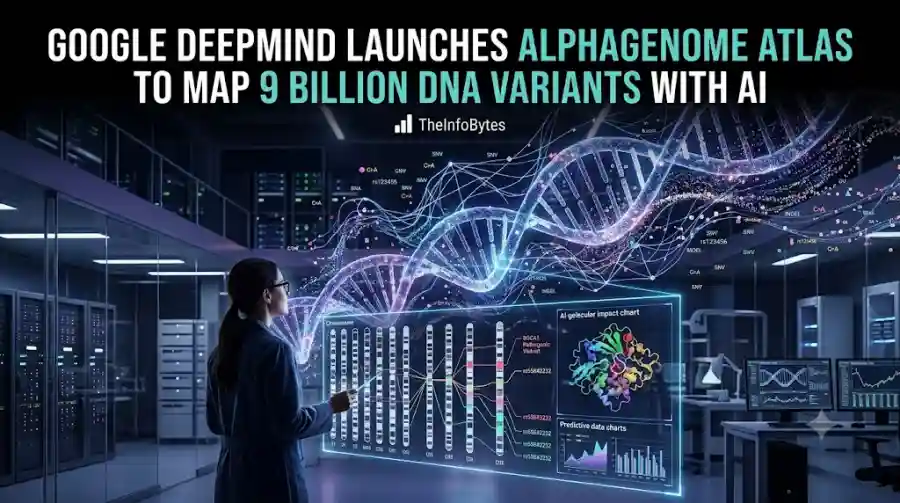
Called AlphaGenome Atlas, the platform contains predictions for the molecular effects of approximately 9 billion possible single-letter changes in the human genome.
The Atlas was announced on September 8, 2026, and is available through a searchable web portal for academic research. Google DeepMind says the resource is designed to help researchers quickly identify genetic variants that may have important biological effects.
The scale is enormous.
The human genome contains roughly 3 billion DNA letters. A change to just one letter can sometimes affect how genes work, but understanding the consequences of those changes is extremely difficult.
Instead of asking researchers to analyze every possible mutation individually, DeepMind has used its AlphaGenome model to precompute predictions across the genome.
The result is a massive AI-generated resource containing about 1 petabyte of data.
What Is AlphaGenome Atlas?
AlphaGenome Atlas is a searchable database built using predictions from Google DeepMind's AlphaGenome model.
The underlying AlphaGenome system was designed to understand how DNA sequences influence molecular processes.
AlphaGenome Atlas takes that capability and applies it at genome-wide scale.
The platform contains predicted effects for every possible single-nucleotide variant across the human genome. That means researchers can investigate what might happen when one DNA letter is changed.
The Atlas covers both:
- Protein-coding DNA
- Non-coding DNA
- Gene regulation
- RNA processing
- Other molecular processes influenced by genetic sequence
This is particularly important because scientists understand only a relatively small portion of the genome in detail.
Why the 98% of Non-Coding DNA Matters
One of the biggest challenges in genomics is the enormous amount of DNA that does not directly encode proteins.
Only around 2% of the human genome consists of protein-coding regions.
The remaining portion includes regulatory regions that help determine when, where and how genes are activated.
These regions can influence biological processes even though they do not directly produce proteins.
A genetic change in one of these regions could therefore have important consequences.
The problem is identifying which changes matter.
There are billions of possible variations.
Testing each one experimentally would be extremely difficult and expensive.
AlphaGenome Atlas attempts to narrow that search using AI predictions.
How AlphaGenome Atlas Works
The basic idea is relatively simple.
Researchers start with a genetic variant.
The Atlas provides predictions about its possible molecular impact.
Instead of manually running a complex AI model for every variation, scientists can query the precomputed Atlas.
The workflow becomes:
DNA variant → AI prediction → molecular impact → prioritization → scientific investigation
This can save researchers significant time during the early stages of genomic research.
The system is not replacing laboratory experiments.
Instead, it can help researchers decide which variants deserve closer attention.
The AlphaGenome Variant Impact Score
One of the most useful features of the Atlas is the AlphaGenome Variant Impact score, or AVI.
The score provides a way to prioritize variants based on their predicted molecular impact.
Researchers dealing with thousands or millions of possible variants can therefore focus first on those that appear most significant.
DeepMind says the score combines predictions across coding and non-coding regions to help researchers prioritize potential variants.
This could be particularly valuable for researchers investigating rare diseases.
Instead of manually examining every genetic difference, scientists can use the score to create a ranked list.
The highest-priority variants can then receive additional laboratory or clinical investigation.
AlphaGenome Atlas Does Not Diagnose Diseases
This distinction is important.
AlphaGenome Atlas is an AI research resource.
It does not mean that researchers can enter a person's DNA and automatically receive a complete medical diagnosis.
The system predicts molecular effects.
A predicted molecular change does not automatically prove that the variant causes a specific disease.
Biological systems are extremely complex.
A mutation may affect gene regulation without producing a clear clinical outcome.
Environmental factors, other genes and biological interactions can also influence disease.
Therefore, AlphaGenome Atlas should be viewed as a research and prioritization tool rather than a diagnostic system.
A One-Petabyte Genomic Resource
The scale of the Atlas is one of its most remarkable characteristics.
DeepMind says the dataset is approximately 1 petabyte in size.
That is roughly one million gigabytes of data.
The dataset contains predictions generated across approximately 9 billion possible single-letter changes.
Creating such a resource would be impractical if every researcher had to calculate the predictions independently.
By precomputing the information and making it searchable, DeepMind is effectively turning a huge computational problem into a lookup and analysis problem.
This could make genomic AI more accessible to research teams.
Researchers Can Use the Atlas Without Coding
Another important part of the launch is accessibility.
Google DeepMind says AlphaGenome Atlas is available through an intuitive website portal and does not require researchers to write code to explore the resource.
That matters because not every biologist or clinical researcher is also a machine-learning engineer.
Traditional AI research tools can sometimes require:
- Programming
- Model configuration
- Data processing
- GPU resources
- Specialized infrastructure
- Technical knowledge
A browser-based interface can remove some of those barriers.
Researchers can focus on the biological question rather than building the computational pipeline themselves.
AlphaGenome Atlas Could Help Rare-Disease Research
One of the most interesting applications is rare-disease investigation.
Some patients have genetic variants that are difficult to interpret.
A researcher may know that a particular DNA change exists but not understand whether it has functional consequences.
AlphaGenome can help prioritize these variants based on predicted molecular effects.
DeepMind says researchers at the Broad Institute used the Atlas to prioritize variants in an unsolved rare-disease case.
The system highlighted a variant in the DNM1 gene and predicted that it could interfere with RNA splicing, providing supporting evidence for the investigation.
This does not mean AI independently solved the medical case.
Rather, it shows how AI predictions can help researchers narrow down the search for potentially important genetic changes.
AI Can Search the Genome More Efficiently
Genomics produces huge amounts of information.
A major challenge is not simply generating more data.
It is finding useful information inside that data.
AlphaGenome Atlas approaches this problem by creating a searchable map.
Instead of asking:
"How do I analyze this enormous dataset?"
researchers can increasingly ask:
"Which variants are most likely to matter?"
That change in workflow could be significant.
AI becomes a filter between enormous biological datasets and human researchers.
AlphaGenome Atlas Also Helps Study Complex Traits
The potential applications go beyond rare diseases.
DeepMind says researchers have also used AlphaGenome predictions to study complex traits.
In one example, researchers analyzed data from more than 54,000 UK Biobank participants.
By grouping variants according to predicted molecular effects, researchers reported finding more non-coding genetic associations.
DeepMind says the approach identified 19 genetic regions associated with body mass index after focusing on the highest-impact predicted variants.
These results are research findings, not medical recommendations.
However, they demonstrate how AI-generated predictions can potentially help researchers explore relationships between genetic variation and complex biological traits.
Why Non-Coding DNA Is So Important
For years, genetic research naturally focused heavily on protein-coding genes.
They are easier to connect to biological functions because they directly encode proteins.
But regulatory DNA can be equally important.
A small change in a regulatory region could affect how much of a particular protein a cell produces.
It could also influence:
- When a gene becomes active
- Where a gene is active
- How RNA is processed
- How cells respond to signals
- How biological pathways behave
This makes non-coding DNA a major frontier for genomic research.
AlphaGenome is designed to analyze both coding and non-coding variation.
AlphaGenome Atlas Could Accelerate Drug Discovery
Drug development is another area that could eventually benefit.
Understanding disease biology often requires identifying the molecular mechanisms responsible for a condition.
If researchers can more quickly identify important genetic variants, they may gain better clues about:
- Disease mechanisms
- Biological pathways
- Potential therapeutic targets
- Patient subgroups
- Genetic risk factors
This does not mean AlphaGenome directly discovers a finished drug.
Instead, it could become one component of a larger research pipeline.
AI can prioritize the biological questions.
Researchers can then validate those predictions experimentally.
Google DeepMind Is Building a Larger AI-for-Science Ecosystem
AlphaGenome Atlas is not an isolated project.
Google DeepMind has increasingly been applying AI to scientific problems.
Its research portfolio includes systems such as:
- AlphaFold
- AlphaGenome
- WeatherNext
- AlphaEvolve
- AI systems for scientific discovery
The company is effectively trying to use AI not only to generate content but to help scientists understand complex natural systems.
AlphaGenome Atlas fits directly into that strategy.
AlphaGenome Atlas and AlphaGenome Are Different
It is useful to distinguish the two names.
AlphaGenome is the underlying AI model.
It analyzes DNA sequences and predicts molecular effects.
AlphaGenome Atlas is the large-scale searchable resource created by running AlphaGenome across billions of possible single-letter DNA changes.
In simple terms:
AlphaGenome = AI model
AlphaGenome Atlas = genome-wide prediction database
This distinction matters because researchers can use the Atlas without necessarily having to run the underlying model themselves.
Google DeepMind Adds AlphaGenome Skills
DeepMind is also extending AlphaGenome through AI-assisted scientific workflows.
Its AlphaGenome research page describes AlphaGenome Skills, which can connect AlphaGenome and AlphaGenome Atlas with Google's Antigravity scientific workbench.
The system is designed to help researchers:
- Prioritize genetic variants
- Explain biological context
- Generate visualizations
- Navigate relevant Atlas results
- Automate parts of genomic analysis
This points toward another important direction in AI research.
The future may not simply involve databases that scientists search manually.
AI assistants could increasingly operate on top of those databases.
From Search Engines to Scientific Agents
A traditional scientific database requires researchers to know what they are looking for.
An AI-assisted research environment could potentially work differently.
A researcher could ask a question in natural language.
The AI could then:
- Identify relevant variants.
- Query the genomic database.
- Rank potential candidates.
- Explain the predicted molecular effects.
- Generate visualizations.
- Suggest follow-up research questions.
AlphaGenome Skills are an early example of this direction.
The important shift is from information retrieval toward AI-assisted scientific workflows.
AlphaGenome Atlas Is Free for Academic Research
Google DeepMind says AlphaGenome Atlas is available for academic research through its website portal.
The goal is to make the resource accessible to researchers without requiring them to build the infrastructure themselves.
Commercial access is expected to follow through Google Cloud.
This creates a potentially useful model:
Academic research → open access
Commercial applications → cloud-based access
The exact commercial availability and terms will be important for companies interested in integrating AlphaGenome into production research systems.
What Makes AlphaGenome Atlas Different?
There are many genomic databases already available.
The key difference is the scale and predictive nature of AlphaGenome Atlas.
It is not simply cataloguing known genetic mutations.
It provides AI-generated predictions about the potential molecular impact of every possible single-letter change across the genome.
That creates a much larger search space.
Researchers can investigate variants that may never have been extensively studied experimentally.
The Biggest Limitation Is Experimental Validation
AI predictions can accelerate research, but they do not replace biology.
A model can identify a variant as potentially important.
Researchers still need to determine whether the prediction is correct.
That may require:
- Laboratory experiments
- Cell studies
- Animal models
- Population studies
- Clinical research
This validation process remains essential.
The value of AlphaGenome Atlas is therefore not that it eliminates experiments.
Its value is that it can help researchers decide which experiments are worth doing first.
Why AlphaGenome Atlas Matters for AI
The launch demonstrates an important evolution in AI.
Early AI systems were largely judged by their ability to:
- Write text
- Generate images
- Answer questions
- Create code
Scientific AI is different.
Its value can be measured by whether it helps researchers discover something they could not efficiently find otherwise.
AlphaGenome Atlas is designed around exactly that problem.
It applies AI to a massive search space and attempts to make the results accessible to scientists.
What This Could Mean for Future AI Research
AlphaGenome Atlas could be part of a broader transition toward AI-powered scientific infrastructure.
Instead of using AI only as a chatbot, researchers could use specialized AI systems as layers over massive scientific datasets.
The architecture could look like:
Scientific data → AI model → Searchable predictions → AI research assistant → Human scientist
This approach could eventually be applied to:
- Genomics
- Drug discovery
- Materials science
- Climate science
- Physics
- Chemistry
- Neuroscience
Each field has enormous datasets and complex relationships that are difficult for humans to analyze manually.
AI can help narrow those search spaces.
Google DeepMind's AlphaGenome Atlas is one of the most significant AI-for-science launches of September 2026 because it turns billions of possible genetic changes into a searchable research resource.
The platform contains predictions for roughly 9 billion single-letter DNA variants and is built from the AlphaGenome model. DeepMind says the resulting dataset is approximately 1 petabyte in size.
Its AlphaGenome Variant Impact score gives researchers another way to prioritize potentially important mutations.
The platform could be particularly valuable for rare-disease research and for studying the poorly understood non-coding regions of the genome.
But AlphaGenome Atlas should not be treated as a diagnostic tool.
Its predictions describe potential molecular effects and still require scientific validation.
The larger significance is the workflow.
Instead of asking researchers to manually search through billions of possibilities, DeepMind has created an AI-powered map that can help narrow the field.
That is where AI-for-science systems could become increasingly powerful.
The future of scientific AI may not be about replacing scientists.
It may be about giving scientists dramatically better ways to search, prioritize and understand enormous spaces of possibilities.
AlphaGenome Atlas is a strong example of that future beginning to take shape.
FAQs
What is AlphaGenome Atlas?
AlphaGenome Atlas is a Google DeepMind AI-powered genomic research platform containing predictions for the molecular effects of approximately 9 billion possible single-letter changes in the human genome.
What is the difference between AlphaGenome and AlphaGenome Atlas?
AlphaGenome is the underlying AI model that predicts molecular effects from DNA sequences. AlphaGenome Atlas is the genome-wide database created by applying those predictions to approximately 9 billion possible single-letter variants.