Intellect MSOCK Uses 21-Dimensional AI Knowledge Mapping to Make Banking Software More Autonomous
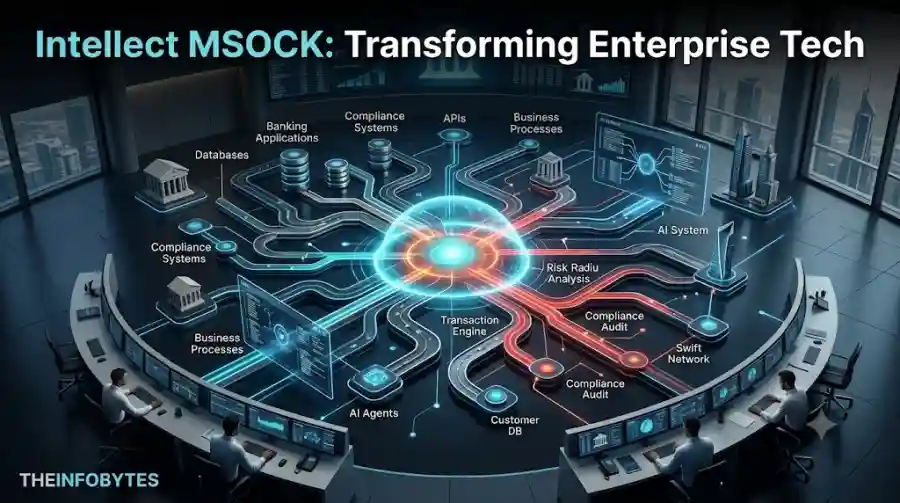
Intellect Design Arena is targeting that problem with MSOCK, short for Multidimensional Multilayer System of Connected Knowledge.
The company unveiled MSOCK at Global FinTech Fest 2026 as an AI-native engineering system designed to make enterprise knowledge connected, computable and visual.
Intellect says it has filed 39 patents related to the technology.
The central idea is straightforward:
Before AI changes enterprise software, it needs to understand the enterprise around that software.
What Is Intellect MSOCK?
MSOCK is an enterprise knowledge infrastructure designed specifically for complex financial-services environments.
According to Intellect, it connects knowledge across areas such as:
- Business processes
- Operations
- Compliance
- Technology
- Application architecture
- Software dependencies
- Institutional knowledge
- Change relationships
The system is designed to give AI a connected view of these relationships.
That means an AI system does not have to look at a piece of source code in isolation.
It can potentially understand the wider environment in which that code operates.
This is particularly important for banks because financial software often sits inside large interconnected systems.
A small software change can potentially affect several downstream processes.
Why Enterprise Context Is a Problem for AI
Generative AI has become very good at producing code.
Tools can generate functions, create APIs, write tests and modify files.
But enterprise software is rarely just a collection of independent files.
A banking application can involve:
- Customer accounts
- Payments
- Compliance systems
- Risk engines
- Databases
- Reporting systems
- APIs
- Authentication
- Regulatory workflows
- External services
Changing one component may affect several others.
A coding agent may understand the code it is editing but not necessarily the complete business relationship behind it.
This creates what Intellect describes as a major gap between AI-assisted coding and genuine AI-native engineering.
MSOCK is designed to address that gap.
MSOCK Creates a Connected Enterprise Knowledge Layer
The company's approach is to create a structured representation of enterprise knowledge.
Instead of keeping information separated across documents, source code, diagrams and business processes, MSOCK attempts to connect those pieces.
The resulting environment can represent relationships between:
Business intent → applications → components → dependencies → operations → compliance
That creates a much richer context for AI systems.
An AI agent can potentially reason about a proposed change using more than the immediate codebase.
It can consider the surrounding enterprise structure.
21-Dimensional Visual Spatial Intelligence
One of the key technologies highlighted by Intellect is what it calls 21-Dimensional Visual Spatial Intelligence.
The concept is intended to represent enterprise relationships across multiple dimensions.
Instead of viewing an application as a flat collection of files, the system creates a broader spatial representation of how different elements connect.
This could include relationships involving:
- Business functions
- Applications
- Data
- Technology
- Users
- Processes
- Compliance
- Dependencies
- Operational relationships
The goal is to make those connections understandable to both humans and AI systems.
This is important because enterprise software problems are often relationship problems rather than individual coding problems.
The "What Will Break?" Problem
One of the most interesting ideas behind MSOCK is its focus on change impact.
Imagine a bank wants to modify a core application.
A traditional engineering team might need to investigate dozens of dependencies before making the change.
With an AI-native system, the ideal workflow would be different.
A developer could ask:
If I change this component, what will be affected?
The system could then analyze the connected enterprise knowledge and identify the potential impact.
Intellect calls this the "Precise Blast Radius" concept.
The objective is to identify what a proposed change could affect before the code is modified.
Why Blast Radius Matters in Banking
In a small application, breaking one feature may be inconvenient.
In banking infrastructure, the consequences can be much larger.
A change could potentially affect:
- Customer transactions
- Payment processing
- Regulatory reporting
- Risk calculations
- Internal operations
- Authentication
- Data flows
That makes impact analysis extremely important.
An AI system that can understand those relationships could potentially help engineering teams identify risks earlier.
The goal is not to remove human oversight.
Instead, AI can provide a deeper analysis before engineers approve a change.
MSOCK Moves Beyond AI Coding Assistants
The launch represents an important distinction.
An AI coding assistant generally helps developers write code.
MSOCK is designed around helping AI understand the environment in which that code operates.
That creates a different model.
Traditional workflow:
Developer → AI coding assistant → Code
MSOCK's proposed workflow:
Enterprise knowledge → AI understanding → Impact analysis → Engineering action
This could make AI systems more useful for large-scale software modernization.
From Coding-Led Engineering to Cognitive Engineering
Intellect describes the shift as moving from coding-led software engineering to cognitive engineering.
The idea is that software transformation should begin with understanding business intent and enterprise relationships.
Only after that understanding is established should an AI system start changing software.
For example, a bank might want to modernize a legacy module.
The AI should first understand:
- What the module does
- Which customers depend on it
- Which systems connect to it
- Which regulatory requirements apply
- Which data flows through it
- Which downstream applications could be affected
Only then can it safely recommend or implement changes.
This is the type of workflow MSOCK is designed to support.
MSOCK Targets Financial Services
Intellect is specifically positioning MSOCK for financial institutions.
That focus makes sense because banks operate some of the most complicated software environments in the world.
They also operate under strict regulatory requirements.
Enterprise AI in this environment cannot simply optimize for speed.
It also needs:
- Accuracy
- Traceability
- Governance
- Risk management
- Context
- Explainability
- Controlled change
A system that helps AI understand those requirements could become valuable for large-scale digital transformation.
An Open Challenge for Financial Institutions
As part of the launch, Intellect is inviting financial institutions to participate in an open challenge.
According to the company, organizations can bring a complex application module to Intellect.
MSOCK will then map the application's connected knowledge, allowing the institution to investigate the impact of proposed changes.
Intellect says the challenge is designed to demonstrate whether MSOCK can identify dependencies and determine the potential blast radius before software is modified.
This is an interesting approach because it puts the technology into a practical enterprise environment rather than relying only on demonstrations.
MSOCK Could Help With Legacy Modernization
Legacy modernization is one of the biggest problems facing financial institutions.
Banks often operate software that has been developed over many years.
Replacing those systems completely can be risky and expensive.
AI could potentially make modernization faster.
But an AI agent cannot safely modernize a legacy system if it does not understand how the system works.
MSOCK is designed to provide that missing context.
The system could potentially help teams understand:
- Legacy application dependencies
- Business rules
- Architecture
- Data relationships
- Integration points
- Change risks
That could make incremental modernization easier.
AI Agents Need More Than Large Language Models
The MSOCK launch also highlights an important trend in enterprise AI.
A powerful language model is not enough to solve every enterprise problem.
An AI agent may have excellent reasoning capabilities but still lack access to the organization's internal context.
That context could be spread across:
- Databases
- Documents
- Source code
- Enterprise applications
- Business processes
- Employee knowledge
- Compliance systems
The next generation of enterprise AI may therefore depend heavily on infrastructure that connects models to this information.
MSOCK is one example of that approach.
MSOCK Could Complement OpenAI and Anthropic Models
Intellect says MSOCK is designed to make AI systems from companies such as OpenAI and Anthropic more accurate in financial-services environments.
This is significant because the company is not necessarily trying to build another general-purpose foundation model.
Instead, MSOCK can act as an enterprise intelligence layer around existing AI models.
That architecture could look like:
Foundation model
↓
MSOCK enterprise knowledge layer
↓
Banking systems and business context
↓
AI engineering agent
This approach allows organizations to use powerful general AI models while adding specialized enterprise context.
Enterprise Knowledge Could Become an AI Infrastructure Layer
This is potentially one of the bigger implications of MSOCK.
As AI agents become more capable, the limiting factor may increasingly shift from model intelligence to information access.
An agent may know how to perform a task.
But it needs to know:
Which task should it perform?
What systems does it need to touch?
What rules apply?
What could break?
Who needs to approve the change?
Enterprise knowledge infrastructure can provide those answers.
That means systems like MSOCK could become an important layer between AI models and real-world business applications.
Why Banking Is a Difficult AI Environment
Banks are different from many other software companies.
They operate mission-critical systems where failures can have financial and regulatory consequences.
A typical banking platform may involve multiple generations of technology.
Some systems may be modern cloud applications.
Others may depend on older infrastructure.
These systems often interact in ways that are difficult to document completely.
That makes context particularly valuable.
AI may be able to read millions of lines of code.
But understanding the business meaning behind that code is a different challenge.
MSOCK Could Reduce the Gap Between Business and Technology
Another potential benefit is connecting technical systems with business requirements.
Business teams may think in terms of:
Customer onboarding
Loan processing
Payments
Risk management
Compliance
Engineers may think in terms of:
APIs
Services
Databases
Modules
Dependencies
MSOCK attempts to connect these different views.
That can give AI a better understanding of what the software is actually supposed to accomplish.
The Technology Still Needs Independent Validation
It is important to separate Intellect's claims from independently demonstrated results.
The company has announced MSOCK, filed 39 patents related to the technology and is using an open challenge to demonstrate its capabilities.
However, broader independent testing will be needed to determine how effectively the system performs across different banks and complex enterprise environments.
Questions that will matter include:
- How accurate are its dependency maps?
- How well does it understand undocumented systems?
- How does it handle changing enterprise environments?
- How reliable are its impact predictions?
- How does it integrate with existing AI agents?
- How much engineering time does it actually save?
These questions will become easier to answer as more organizations test the system.
MSOCK and the Future of AI Engineering
The launch comes at a time when AI coding agents are rapidly becoming more capable.
The industry is moving from simple code completion toward agents that can:
- Read repositories
- Plan tasks
- Modify multiple files
- Run tests
- Debug applications
- Use tools
- Deploy software
The next challenge is making those agents safe and useful inside complicated organizations.
Enterprise context could be the missing layer.
An agent that understands both code and business relationships could potentially operate much more effectively than one that only understands source files.
What MSOCK Means for Developers
For developers working in financial technology, MSOCK represents a different way of thinking about AI-assisted development.
Instead of asking:
"Can AI write this code?"
the more important question becomes:
"Does AI understand what this code is connected to?"
That distinction becomes increasingly important as AI agents receive more authority to make changes.
The more autonomous the agent becomes, the more important its understanding of the environment becomes.
What MSOCK Means for Banks
For banks, the potential benefit is not simply faster coding.
It is potentially safer and more informed software transformation.
If AI can understand enterprise relationships before making changes, organizations may be able to modernize systems while reducing the risk of unexpected downstream effects.
That could be particularly valuable for large institutions with decades of accumulated technology.
The Bigger Enterprise AI Trend
MSOCK represents a broader shift in enterprise AI.
The first generation of enterprise AI focused heavily on:
Chatbots and copilots
The next generation moved toward:
AI agents
Now the industry is increasingly focusing on:
AI agents + enterprise context + governance
That combination could determine whether autonomous AI becomes genuinely useful in mission-critical environments.
A powerful model without context can make mistakes.
A powerful model connected to structured enterprise knowledge has a better chance of making informed decisions.
Intellect MSOCK is an interesting new entry in the enterprise AI infrastructure market because it focuses on a problem that becomes more important as AI agents become more autonomous: understanding the environment before taking action.
The company says MSOCK connects business, operational, compliance and technology knowledge into a computable and visual enterprise structure. It is designed to help AI understand dependencies and evaluate the potential impact of software changes before engineers modify critical systems.
Its 21-dimensional approach and Precise Blast Radius concept are aimed particularly at financial institutions, where a seemingly small software change can have consequences across multiple systems.
The technology is also notable because it is not positioned as another general-purpose AI model.
Instead, MSOCK is designed to sit around existing AI models and provide them with deeper enterprise context.
That could become an increasingly important architecture for enterprise AI.
The biggest question now is practical performance.
Intellect's open challenge for financial institutions should provide an opportunity to see whether MSOCK can translate its enterprise knowledge model into measurable improvements in real banking environments.
If it can, the technology could represent an important step toward AI systems that do more than write code.
They could begin to understand the organizations behind that code.
FAQs
What is Intellect MSOCK?
MSOCK stands for Multidimensional Multilayer System of Connected Knowledge. It is an enterprise AI knowledge system from Intellect Design Arena designed to connect business, operational, compliance and technology information for AI-native engineering.
What probleAm does MSOCK solve?
MSOCK is designed to address the lack of enterprise context available to AI systems. It aims to help AI understand software dependencies, business relationships and potential risks before making changes.