How to Earn More Coins Fast in Grow a Garden 2 With Smarter Farming, Better Crop Management and Market Timing
Whether you're a beginner trying to establish a reliable income stream or a dedicated player aiming to dominate the leaderboards, these proven strategies can help you maximize crop yields, improve farm efficiency, and dramatically increase your earnings.
Highlights
- Understand the soil depletion and crop rotation system.
- Maintain maximum crop productivity with proper nutrient management.
- Design a farm layout that minimizes wasted movement.
- Take advantage of market fluctuations for larger profits.
- Choose the best crops for every stage of progression.
- Unlock powerful companion planting bonuses.
- Convert basic harvests into high-value artisan products.
- Create a self-sustaining farm that generates consistent income.
Why Yield Optimization Matters in Grow a Garden 2
A common misconception among new players is that planting the most expensive crop repeatedly will automatically produce the highest profits.
That strategy may have worked in the original game, but Grow a Garden 2 introduces several new systems designed to reward strategic planning and punish repetitive farming habits.
The game's economy revolves around multiple interconnected mechanics:
- Soil quality
- Nutrient management
- Crop categories
- Seasonal demand
- Market fluctuations
- Processing systems
- Farm efficiency
Players who learn to balance these systems gain a major financial advantage over those who simply plant whatever seems valuable at the moment.
The result is faster progression, larger harvests, better equipment, and access to premium farm expansions much earlier than expected.
Master Crop Rotation and Soil Quality
Understanding Dynamic Soil Depletion
One of the most significant changes introduced in Grow a Garden 2 is the dynamic soil depletion system.
Unlike the previous version, repeatedly planting the same valuable crop in a single plot causes soil quality to deteriorate over time. As nutrients become depleted, yield percentages begin to drop, reducing overall profitability.
Many players overlook this mechanic until they notice harvest numbers declining despite using the same seeds.
The key to avoiding this problem is proper crop rotation.
Focus on Soil Nitrogen and Moisture
Every crop affects soil chemistry differently.
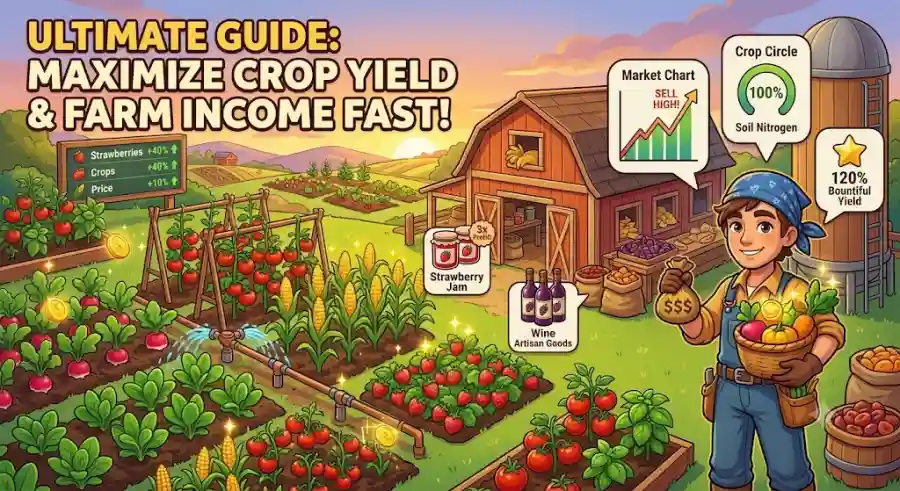
To consistently achieve the highly desirable 120% "Bountiful" yield status, you must actively manage nutrient levels and moisture balance throughout your farm.
Use Nitrogen-Fixing Crops
Certain crops naturally replenish soil nutrients.
Examples include:
- Beans
- Spinach
- Other leafy greens
- Legumes
These crops restore nitrogen levels and prepare the soil for more demanding plants.
Follow With Heavy Feeders
After restoring nutrients, switch to crops that generate larger profits but consume more resources.
Examples include:
- Melons
- Pumpkins
This rotation keeps productivity high while preventing long-term soil degradation.
The Golden Rule of Crop Rotation
One simple rule can dramatically improve your farm's output:
Never plant the same crop category in the same plot twice in a row.
Following this guideline helps preserve soil health, maintain high yields, and ensure consistent profits over time.
Invest in Organic Fertilizer Early
Once you reach Level 5, purchasing Organic Fertilizer should become a priority.
Although it requires a small initial investment, the benefits quickly outweigh the cost.
Benefits of Organic Fertilizer
- Guarantees a minimum 15% yield increase.
- Improves harvest consistency.
- Generates additional income with every collection cycle.
- Pays for itself after only a few harvests.
For players focused on long-term profitability, Organic Fertilizer is one of the smartest early-game purchases available.
Optimize Your Farm Layout for Maximum Efficiency
Every Second Matters
Time management plays a surprisingly important role in Grow a Garden 2.
Many farmers lose valuable productivity because they spend too much time moving between storage buildings, water sources, crop fields, and processing stations.
A poorly organized farm can slow down harvesting, planting, watering, and transportation.
The solution is creating a streamlined layout that minimizes travel time.
Recommended Farm Structure
[Well / Water Source] ───► [Automated Sprinkler System]
                                  │
       ┌──────────────────────────┴──────────────────────────┐
       ▼                                                     ▼
[Plot A: Cash Crops]                                  [Plot B: Fast Crops]
       │                                                     │
       └──────────────────────────┬──────────────────────────┘
                                  ▼
                        [Processing Shed / Barn]
This arrangement allows resources, crops, and processing facilities to remain within easy reach.
The Hub-and-Spoke Method
One of the most efficient layouts in Grow a Garden 2 is the Hub-and-Spoke model.
Key Placement Strategy
Position these structures at the center of your farming area:
- Seed storage
- Shipping bins
- Resource containers
By centralizing essential structures, you reduce unnecessary travel and improve workflow efficiency.
Use the Well Placement Trick
Watering remains one of the most frequent tasks throughout the game.
For plots that are not automated, place water sources within three tiles of growing areas whenever possible.
This simple adjustment can significantly reduce maintenance time and improve daily productivity.
Prioritize Tool Upgrades
Many players spend early earnings on decorative items or rare seeds.
A better investment is upgrading farming tools.
First Major Upgrade
Upgrade your watering can to the Copper tier as soon as possible.
Benefits include:
- Waters a 3x3 area simultaneously.
- Reduces manual labor dramatically.
- Cuts maintenance time by roughly two-thirds.
- Allows more crops to be managed within a single cycle.
This upgrade directly increases earning potential by enabling larger-scale farming operations.
Learn How to Profit From Market Cycles
Stop Selling Everything Immediately
One of the most expensive mistakes beginners make is selling crops as soon as they harvest them.
Grow a Garden 2 features a dynamic market system influenced by seasonal trends and special events.
Prices fluctuate regularly, creating opportunities for savvy players to earn significantly more money.
Monitor Weekly Forecasts
Every in-game Monday, visit the town bulletin board and review the Weekly Forecast.
This feature provides valuable clues about upcoming demand shifts.
For example:
If the forecast mentions an approaching Summer Festival, sweet crops such as:
- Berries
- Corn
often experience substantial price increases later in the week.
Farmers who prepare ahead of time can capitalize on these demand spikes.
Build Storage Facilities Early
To maximize profits from market fluctuations, construct storage infrastructure as soon as possible.
Recommended options include:
Silo
Ideal for bulk storage and long-term inventory management.
Cold Storage Unit
Perfect for preserving valuable harvests during unfavorable market conditions.
When prices drop, hold your inventory.
When market multipliers reach 1.5x, sell everything at once for a substantial profit boost.
This strategy often generates far more income than continuous selling.
Best Crops for Every Stage of the Game
Selecting the right crops is one of the fastest ways to accelerate progression.
Different growth stages require different approaches.
Early Game (Level 1-10)
Best Crops: Radishes and Turnips
Growth Time: Very Fast (2–4 Minutes)
Why They Work
- Extremely inexpensive seeds.
- Rapid harvest cycles.
- Excellent for generating starting capital.
- Allows fast reinvestment into upgrades.
During the opening levels, speed matters more than individual crop value.
Mid Game (Level 11-25)
Best Crop: Strawberries
Growth Time: Medium (Regrowable)
Why They Work
- Multiple harvests from a single planting.
- Reduced seed expenses.
- Reliable income source.
- Naturally resistant to many pests.
Strawberries become one of the most efficient profit generators available during the middle stages of progression.
Late Game (Level 26+)
Best Crops: Golden Orchids and Truffles
Growth Time: Slow
Why They Work
- Exceptional selling prices.
- Required for premium crafting recipes.
- Essential for advanced economic growth.
- Provide some of the largest payouts in the game.
Although patience is required, the long-term rewards are enormous.
The Hidden Power of Regrowable Crops
Regrowable crops represent one of the strongest financial strategies in Grow a Garden 2.
Unlike traditional crops, these plants continue producing harvests after collection.
Examples include:
- Strawberries
- Tomatoes
- Blueberries
Most remain productive for three to five harvest cycles.
Why Regrowable Crops Are So Profitable
After the initial planting cost:
- No additional seeds are required.
- Operating expenses drop dramatically.
- Profit margins increase significantly.
In many situations, nearly 90% of the revenue generated becomes pure profit.
For players seeking efficient long-term income, regrowable crops should form the backbone of their farming operation.
Don't Ignore Companion Planting Bonuses
Understanding Botanical Synergy
One of the most overlooked systems in Grow a Garden 2 is companion planting.
Certain crops provide hidden benefits when grown next to specific neighbors.
These bonuses can:
- Increase growth speed.
- Improve crop quality.
- Reduce pest problems.
- Enhance overall productivity.
When used correctly, companion planting can increase total farm income by as much as 25%.
Tomato and Basil Combination
Benefits
- Improves final tomato quality.
- Produces more Gold Star variants.
- Produces more Purple Star variants.
- Increases overall crop value.
This pairing is particularly effective for players focused on premium harvest quality.
Carrots and Onions Combination
Benefits
- Onions naturally deter carrot fly pests.
- Reduces crop damage.
- Eliminates reliance on expensive chemical pesticides.
- Improves profit margins through lower maintenance costs.
Simple placement changes can save significant resources over time.
The Three Sisters Method
One of the most powerful companion planting setups in the game combines:
- Corn
- Beans
- Squash
Why It Works
Corn acts as a natural support structure.
Beans replenish nitrogen levels within the soil.
Squash provides ground cover that helps retain moisture.
Together, these crops create a highly efficient and sustainable growing system.
Transform Basic Crops Into Valuable Artisan Goods
Raw Harvests Leave Money on the Table
Many players focus solely on growing crops and overlook processing opportunities.
Selling unprocessed potatoes, apples, strawberries, and other produce may provide steady income, but it rarely maximizes profitability.
The real money begins once you unlock the Artisan Processing Station
Understanding Artisan Profit Margins
Consider a simple example.
A standard Strawberry sells for approximately 15 coins.
Process that same strawberry into Strawberry Jam using a Preserves Jar and its value jumps to 45 coins.
Even after accounting for production time, the profit potential increases dramatically.
Best Processing Equipment
Preserves Jar
Ideal for:
- Fruits
- Vegetables
Produces high-demand artisan products with strong profit margins.
Keg
Perfect for:
- Hops
- Grapes
Produces:
- Ale
- Wine
Although processing times are longer, these products generate some of the highest single-item profits available in Grow a Garden 2.
Dehydrator
Best used for:
- Herbs
- Mushrooms
Creates lightweight premium snacks frequently requested in town quests.
These processed goods often command much higher prices than their raw ingredients.
Industry Impact: Why Advanced Farming Systems Matter
The popularity of Grow a Garden 2 reflects a broader trend within modern farming simulation games.
Players increasingly seek experiences that reward planning, optimization, and economic decision-making rather than simple repetitive grinding.
By introducing systems such as:
- Dynamic soil depletion
- Market forecasting
- Companion planting
- Artisan production
Grow a Garden 2 creates a deeper gameplay experience that appeals to both casual players and strategy enthusiasts.
The result is a farming simulator that feels rewarding long after the early-game excitement fades.
Why These Strategies Matter
Many players spend hours farming without seeing meaningful growth because they focus only on short-term harvests.
The most successful farms are built around efficiency and sustainability.
When you combine:
- Crop rotation
- Soil management
- Smart layouts
- Market timing
- Companion planting
- Artisan processing
you create a farming ecosystem that continually generates larger profits with less effort.
That efficiency becomes increasingly important as expansion costs and advanced upgrades become more expensive.