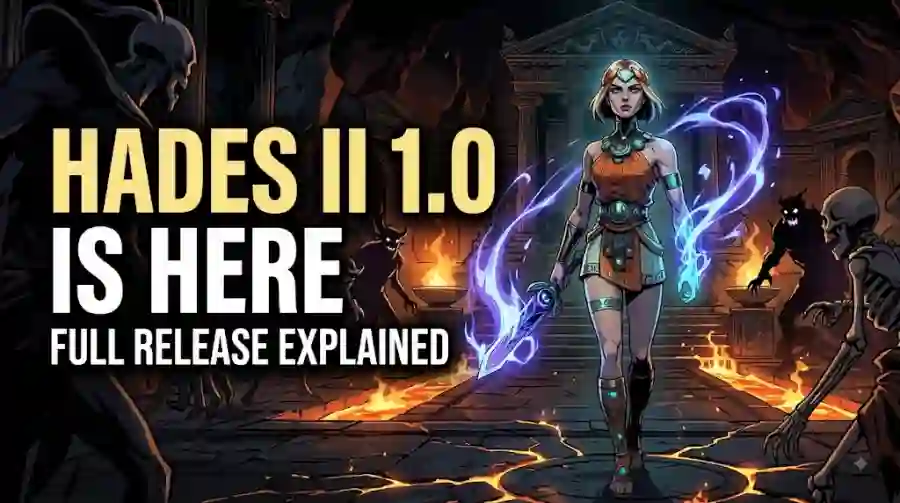
Supergiant Games’ Roguelike Sequel Leaves Early Access With New Content, Story Updates and Its Full Ending
The Early Access version already offered a large amount of content, but the 1.0 release takes the game much further by completing its story, adding the long-awaited conclusion and bringing the development team’s planned major content into the finished version.
For players who have been waiting to start, this is arguably the best time to jump in.
For Early Access players, meanwhile, version 1.0 provides the final pieces of the journey they have been following.
What Is Hades II?
Hades II is the sequel to Supergiant Games’ critically acclaimed Hades.
Rather than simply repeating the original game's formula, the sequel introduces a new protagonist, a new central conflict and a different style of combat.
You play as Melinoë, a witch and princess of the Underworld who uses magic, weapons and powerful Boons to fight through dangerous regions.
The game retains the core roguelike structure that made the first Hades so popular.
Each attempt is different.
You enter a dangerous area, defeat enemies, collect upgrades, choose between different rewards and eventually face powerful bosses.
When the run ends, you return to your base and use what you've learned and collected to improve future attempts.
That cycle is the heart of Hades II.
What Changed With the 1.0 Release?
The biggest difference between Early Access and version 1.0 is completion.
During Early Access, players could experience a large portion of the game but were still waiting for the final story developments.
The 1.0 version brings the story to its intended conclusion.
That means players can now experience the complete narrative rather than stopping at an unfinished point in Melinoë's journey.
The final release also includes additional content and refinements designed to make the overall experience feel like a finished game rather than an evolving Early Access project.
For new players, this removes one of the biggest reasons to wait.
You no longer need to worry about starting the game and reaching a point where the story suddenly stops.
Who Is Melinoë?
Melinoë is the protagonist of Hades II and one of the biggest differences between the sequel and the original.
While Zagreus relied heavily on fast melee combat and his familiar arsenal, Melinoë has a more magical and strategic fighting style.
Her abilities make Omega attacks, magic and positioning important parts of combat.
This changes the rhythm of a run.
Instead of simply charging into every enemy group, players often need to think about where they stand, when to use their magic and which abilities work best with the current build.
The result is a character who feels familiar to Hades players while still providing a different gameplay experience.
How Hades II’s Roguelike System Works
The basic loop is easy to understand.
You start a run.
You enter a series of rooms.
Each room contains enemies or another challenge.
After clearing it, you select a reward.
Then you continue deeper.
Eventually, you face a boss.
If you lose, the run ends.
But losing is not necessarily failure.
Every attempt teaches you something.
You learn enemy patterns, discover better combinations, understand which Boons work well together and gradually improve your decision-making.
That is why Hades II can feel addictive even when you repeatedly fail.
Every run contributes to your next attempt.
Boons Are Still Central to Building Your Character
One of the most important systems in Hades II is the selection of Boons.
These abilities come from the gods and can dramatically change how a run plays.
A good build can turn an average weapon into an extremely powerful setup.
But choosing Boons randomly is not always the best strategy.
Players should consider how different effects interact.
For example, if your build focuses on fast attacks, you may want abilities that reward repeated hits.
If you're relying heavily on magic, abilities that improve your Omega attacks or mana economy may be more useful.
This makes each run feel like a small experiment.
You start with a general idea and gradually discover whether the build actually works.
Why Builds Matter More in Hades II
The sequel gives players plenty of opportunities to experiment.
Your weapon choice, Boons, Arcana, upgrades and other systems can all influence how a run develops.
That means there is rarely a single perfect build.
A setup that works beautifully against one collection of enemies may feel terrible in another run.
This is part of what keeps Hades II replayable.
Instead of memorizing one strategy and using it forever, players are encouraged to adapt.
New Players Should Not Chase Perfect Runs
One of the biggest mistakes beginners make in roguelike games is trying to play perfectly from the beginning.
Hades II does not require that.
Your first few runs should be about learning.
Pay attention to enemy attacks.
Learn when to dash.
Understand how your weapon behaves.
Experiment with Boons.
Try different rooms.
Don't become frustrated when a run ends early.
The game is designed around repeated attempts.
A failed run still gives you information that can help make the next attempt better.
Hades II Is More Than Just Combat
Although combat is the center of the game, the story and characters are just as important.
Between runs, Melinoë can interact with characters, unlock new conversations and gradually learn more about the conflict surrounding Chronos.
This is one of the reasons Hades II stands apart from many other roguelikes.
The narrative continues even when you fail.
You are not simply replaying the same dungeon.
The world changes as your journey progresses.
Characters react to your actions, new dialogue appears and additional systems gradually become available.
The Story Is Finally Complete
For many players, the most important part of version 1.0 is the story.
Early Access allowed players to experience Melinoë's journey while Supergiant Games continued development.
The final release completes that journey.
Players can now experience the narrative in its intended form, including the conclusion that Early Access players had been waiting for.
That makes the 1.0 version particularly attractive to people who intentionally avoided the game during Early Access.
Instead of following development updates for months, new players can start now and play through the entire experience.
Should Early Access Players Start Over?
Not necessarily.
If you already played Hades II during Early Access, there is no universal reason to throw away your progress simply because version 1.0 has launched.
Your existing save and progression can be useful when exploring the new content.
However, some players may choose to begin a fresh run simply because they want to experience the completed story from the beginning.
That is a personal choice.
Players who already understand the systems can continue from their existing progression, while newcomers can experience everything naturally from the start.
Why Hades II Is Important for Roguelike Fans
Hades II is important because it demonstrates how a sequel can expand a successful formula without abandoning what made the original special.
The original Hades became known for combining:
- Fast combat
- Strong character writing
- Meaningful progression
- Repeated runs
- Build variety
- Excellent presentation
- A story that responds to failure
Hades II builds on those ideas while introducing its own mechanics and protagonist.
The result is not simply “Hades with a different character.”
It is a larger and more ambitious version of the concept.
Is Hades II Worth Playing in 2026?
For fans of roguelikes, action games and story-driven indies, Hades II is an easy recommendation.
The 1.0 release is especially appealing because the game can now be experienced as a complete package.
You don't have to wait for future story updates.
You don't have to worry about an unfinished ending.
And you can experience the entire journey at your own pace.
Players who disliked the repetitive structure of the first Hades may still find the roguelike format challenging.
But if you enjoy games where every attempt teaches you something new, Hades II offers a very strong gameplay loop.
Tips for Starting Hades II
If you're opening Hades II for the first time, keep these tips in mind.
Experiment With Weapons
Don't immediately decide that one weapon is your permanent choice.
Try different weapons and learn how each changes your movement and attack range.
Learn Enemy Patterns
Many enemies look dangerous but become predictable once you understand their attacks.
Watch first.
Attack second.
Don't Ignore Defensive Options
Damage is exciting, but surviving longer can sometimes be more valuable.
A build that deals slightly less damage but keeps you alive can be much stronger than an aggressive setup that collapses quickly.
Try Different Boon Combinations
Don't automatically choose the biggest-looking number.
Think about whether the Boon fits your weapon and current build.
Use Every Run to Learn
A failed attempt is still progress.
Remember what killed you and change your strategy during the next run.
What Makes the Full Release Different From Early Access?
The biggest difference is confidence.
Early Access is designed around ongoing development.
Features can change.
Balance can change.
The story can remain incomplete.
Version 1.0 is different.
The game has reached the point where Supergiant Games considers the major development work complete enough for the full release.
For players who prefer finished games, that is a major advantage.
You can begin Hades II knowing you're playing the complete version rather than an unfinished build.
Hades II has finally reached the point many players have been waiting for: the full game is here.
The sequel takes the successful foundation of the original Hades and expands it with Melinoë, new weapons, new powers, new characters and a larger story.
Its roguelike structure remains central, but that is exactly what makes the game so replayable.
Every failed run gives you another lesson.
Every successful run gives you a new idea.
And every new combination of weapons and Boons can change the way you approach the next attempt.
For anyone who skipped Early Access because they wanted to experience the finished story, now is the perfect time to enter the Underworld.
Hades II is no longer simply a promising sequel.
It is the complete next chapter of Supergiant Games' roguelike series.
FAQ
Is Hades II fully released?
Yes. Hades II has reached its full 1.0 release after its Early Access period.
Who is the main character in Hades II?
The main protagonist is Melinoë, the Princess of the Underworld.
Is Hades II similar to the first Hades?
Yes, it retains the core roguelike structure, but it introduces a new protagonist, combat systems, weapons, abilities and story.
Do you have to play Hades before Hades II?
No. New players can start with Hades II, although playing the original can provide additional context for the world and characters.
Is Hades II a roguelike?
Yes. Each run features changing encounters, rewards and builds, while permanent progression and story development continue between runs.
Is Hades II worth playing after the 1.0 release?
Yes, particularly for players who prefer to experience the complete story rather than an Early Access version.
What is the main goal in Hades II?
Melinoë's main objective is connected to defeating Chronos and confronting the forces threatening the Underworld and Olympus.