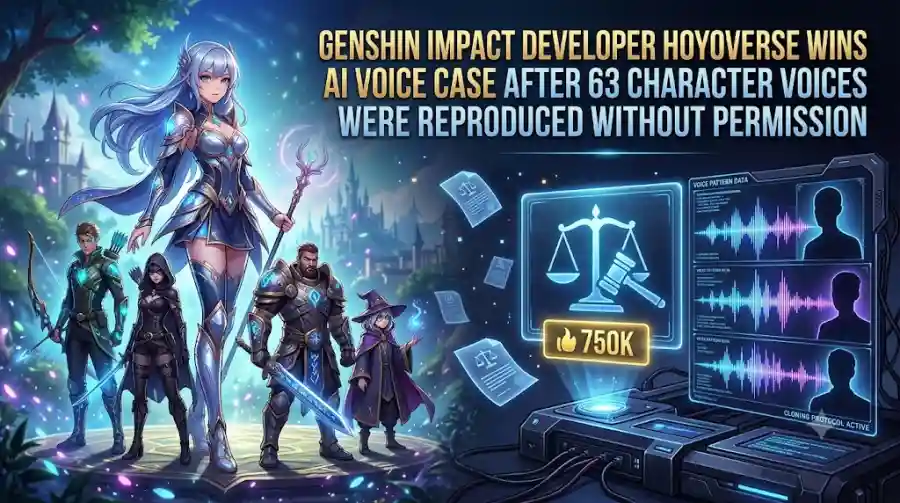
Shanghai Court Orders AI Voice Company to Pay HoYoverse 750,000 Yuan Over Genshin Character Voice Packs.
Instead, the judgment found that the recognizable voices of established Genshin Impact characters had become an important commercial identifier for the game and its operator. The court concluded that the defendant's conduct went beyond reasonable AI voice imitation and constituted unfair competition.
The decision has also become final.
What Happened to the 63 Genshin Impact Voices?
The dispute began after HoYoverse discovered an AI voice-changing application that offered users paid voice packs corresponding to 63 Genshin Impact characters.
Users could purchase those packs and use them to transform their voices during real-time conversations.
According to the Shanghai court's published case summary, the company also used Genshin Impact character artwork and animation in promotional material. It modified character images for use as voice-pack avatars and provided samples containing recognizable character dialogue.
HoYoverse argued that the service was creating a misleading commercial connection with Genshin Impact while using the game's intellectual property without authorization.
The company sought 5 million yuan in damages plus an immediate injunction.
The court ultimately awarded 750,000 yuan and ordered the infringing activity to stop.
The AI Company Argued That the Voices Came From AI Training
The defendant reportedly argued that the voice-changing effects were produced through an AI model and that the resulting sound could vary according to a user's input.
It also argued that voice-related rights should be associated with the individual voice actors rather than HoYoverse.
That argument became one of the central issues in the case.
The court's reasoning took a different approach.
The question was not simply whether a human voice actor owned their own voice.
The court examined whether the recognizable vocal characteristics of fictional game characters had acquired independent commercial significance within the Genshin Impact property.
Voice Identification Evidence Played an Important Role
A judicial voiceprint examination became important during the case.
According to the published court reporting, the examination found that sample voices generated by the disputed service were inclined to be identified as the same as the corresponding voices from the Genshin Impact characters.
The case therefore was not based only on a subjective claim that the AI voices “sounded similar.”
There was expert identification evidence supporting the connection between the generated voices and the original character voices.
That helped strengthen HoYoverse's argument that the service was not merely using a generic anime-style voice.
The Company Also Admitted Using Genshin Audio for Training
Another important detail came from the defendant's own statements during the proceedings.
According to reports of the case, the company acknowledged that it had used approximately one minute of audio from a Genshin Impact character without authorization, mixing it with other sound material to train its AI voice-conversion model.
That admission was particularly significant.
The defendant's argument that the system simply produced variable AI-generated results became harder to separate from the underlying source material once unauthorized Genshin audio had been acknowledged as part of the training process.
The case therefore involved both the use of protected game material and the commercial presentation of the resulting voice products.
Why the Court Treated Character Voices as Commercially Important
One of the most notable parts of the judgment is the court's reasoning about character identity.
The court said the distinctive sound characteristics of a game character are influenced by the character's predetermined attributes, abilities and personality rather than being solely a matter of an individual performer's personal interpretation.
Because those vocal characteristics had become recognizable to the public, they could function as part of the commercial identity of the game and its characters.
That is a significant distinction.
A random imitation of a broad vocal style is not automatically the same thing as reproducing a highly recognizable fictional character's established voice identity and then selling it as a commercial product.
The court found that the latter could cross the line into unfair competition.
The Case Also Involved Genshin Character Images
The voice packs were not the only issue.
The AI service reportedly used Genshin Impact character images and story animation in promotional videos.
It also modified game-character images for use as avatars associated with its voice products.
The court separately found those uses to infringe HoYoverse's copyright interests in the game materials.
That made the case broader than an AI voice dispute alone.
It combined questions surrounding:
AI-generated voice reproduction
Game-character identity
Copyrighted visual content
Commercial association
Unfair competition
The combination is what makes the case particularly relevant to the gaming industry.
This Was Not a Case About AI Being Illegal
It is important not to overstate the ruling.
The court did not decide that AI voice technology itself is illegal.
The issue was how that technology was used.
The Shanghai court explicitly described a boundary between legitimate technological innovation and commercial conduct that creates unauthorized association with someone else's established game property.
The judgment therefore leaves room for AI companies to develop voice technologies while making clear that they cannot automatically use recognizable commercial character identities as marketable products.
That distinction could become increasingly important as AI voice systems improve.
HoYoverse Did Not Receive the Full Amount It Requested
HoYoverse originally requested 5 million yuan, or roughly $745,000, in damages and sought an immediate injunction.
The court awarded 750,000 yuan, or about $112,000, plus the order to stop the infringing conduct.
The difference is significant.
The ruling does not represent a $745,000 payout to HoYoverse.
Instead, the company received a smaller monetary award while obtaining an order requiring the defendant to stop the disputed behavior.
From a business perspective, the injunction may be just as important as the financial award because it directly affects whether the infringing service can continue operating in the same manner.
The Judgment Is Now Final
The case went through the first-instance stage before the defendant appealed.
After filing the appeal, the defendant subsequently withdrew it, and the withdrawal was accepted.
As a result, the judgment is now effective.
That matters because this is not merely an initial court opinion that could still be overturned through the ordinary appeal process.
The legal outcome described by the Shanghai court has become final in this case.
Why This Is Important for Game Developers
The ruling has implications far beyond Genshin Impact.
Video-game characters are increasingly built around highly recognizable identities.
That identity can include:
Character design
Voice
Personality
Catchphrases
Visual presentation
Music
Animation
In a successful live-service game, those elements can become valuable commercial assets.
AI makes it easier to reproduce parts of those identities at scale.
That creates a new problem for publishers.
Traditional copyright systems are generally easier to apply when someone copies an image, soundtrack or piece of recorded dialogue.
AI-generated outputs can be more complicated because the final output may be newly generated while still being unmistakably associated with an existing character.
This case shows one way courts may approach that problem.
The Ruling Recognizes a Commercial Identifier in Character Voice
The most useful concept for the gaming industry is the court's treatment of character voice as a form of commercial identification.
The court concluded that Genshin Impact character voices had, through long-term exposure to the public, become capable of identifying the source of the related game services and products.
That means a character's recognizable sound can have value beyond the underlying audio file.
The voice becomes part of the identity consumers associate with the game.
This reasoning could potentially influence future disputes involving AI-generated versions of famous game characters.
The Case Comes as China Tightens AI-Related Judicial Rules
The timing is also notable.
On September 7, 2026, China's Supreme People's Court published its Opinions on the Adjudication of Disputes Involving Artificial Intelligence.
The court says the document establishes guidance for handling disputes involving AI-related infringement, including issues involving personal rights, generative AI, intellectual property and other areas.
The document also addresses the use of people's voices as AI training material.
According to the Supreme People's Court, where a person's voice is used without consent as training material to imitate recognizable aspects of that person's voice, legal protection may apply under the applicable circumstances.
That broader judicial framework helps explain why AI-generated voice disputes are receiving increased attention in China.
Character Voice and Voice Actor Rights Are Not Exactly the Same Question
An important nuance is that this case centered on fictional game-character voices and the commercial identity of those characters.
That does not mean a game publisher automatically owns every possible legal right connected to a human voice actor's voice.
Those can be separate legal questions.
The Shanghai ruling focused on the particular circumstances of Genshin Impact's characters, the recognizable sound characteristics associated with them, the unauthorized use of game materials and the commercial presentation of the resulting service.
That distinction is important for anyone discussing the case outside China.
It should not be simplified into “game studios own every voice” or “AI can never imitate a human voice.”
The actual legal reasoning was more specific.
Could This Affect AI Voice Companies?
Potentially, yes.
The case creates another warning for companies that build commercial voice products around recognizable fictional characters.
A company could potentially face greater legal risk when several elements appear together:
Unauthorized training material
Highly recognizable character voices
Character images or animation used in marketing
Commercial sale of voice packs
Presentation that implies a connection with the original property
The Shanghai ruling does not automatically establish the outcome of every future AI voice dispute, but it demonstrates that these factors can be important in court.
What Does This Mean for Genshin Impact Players?
For ordinary Genshin Impact players, the most immediate effect is limited.
The case does not change the game's normal voice acting system, characters or gameplay.
Instead, it concerns a third-party AI voice service operating outside the official game.
Players will not see a new in-game restriction because of this judgment.
The larger impact is on the wider ecosystem of unofficial AI-generated Genshin content.
Services that attempt to commercially reproduce recognizable character identities now have a clearer example of the legal risks involved.
Could Similar Cases Happen With Other Games?
Very likely.
The technology behind AI voice conversion is increasingly accessible.
Game companies have large libraries of recorded dialogue, recognizable characters and enormous fan communities.
That creates attractive targets for third-party services looking to sell themed voice packs.
Potential disputes could involve:
RPG characters
Anime-style games
Live-service titles
Virtual assistants based on game characters
Fan voice tools
AI-generated advertisements
Unofficial character chatbots
Whether a particular case succeeds will depend on its facts and the laws of the relevant country.
The Genshin case therefore should be viewed as an important example, not a universal rule for every jurisdiction.
Why the Case Matters for the Future of Gaming AI
AI-generated voices are likely to become increasingly common in games.
Developers can use them for temporary dialogue, localization experiments, procedural characters and interactive systems.
At the same time, fans can use AI tools to create character-like voices for videos, mods and community projects.
The legal challenge is determining where experimentation ends and commercial exploitation begins.
The Shanghai judgment provides a useful signal.
AI technology can be innovative, but using it to recreate a recognizable commercial character and then sell that identity as a product can create legal problems.
That will be an increasingly important issue as game characters become more interactive and AI-powered.
Genshin Impact AI Voice Case Key Details
Company: HoYoverse
Game: Genshin Impact
Court: Shanghai Pudong New Area People's Court
Defendant: Unnamed Shanghai AI technology company
Characters Involved: 63 Genshin Impact characters
Disputed Product: Commercial AI voice packs
AI Use: Real-time voice transformation
First-Instance Judgment: June 30, 2026
Compensation: 750,000 yuan
Approximate USD Value: $112,000
Original Claim: 5 million yuan
Additional Finding: Unauthorized use of Genshin character images and animation infringed copyright
Legal Finding: Unfair competition and copyright infringement
Appeal: Withdrawn
Current Status: Judgment effective
HoYoverse's victory in the Shanghai AI voice case is one of the more important recent developments at the intersection of gaming, artificial intelligence and intellectual property.
The dispute involved an AI voice-changing service that sold voice packs based on 63 Genshin Impact characters without authorization. The service also used Genshin character images and animation in promotional material.
The Shanghai Pudong court ordered the company to stop the infringing conduct and pay 750,000 yuan to HoYoverse.
More importantly, the court recognized that the recognizable voices of established Genshin characters had developed a commercial identification function and that reproducing those voices through AI for commercial use, together with the broader promotional conduct, went beyond acceptable competition.
The case became final after the defendant withdrew its appeal.
The timing gives the decision even more significance.
China's Supreme People's Court published broader AI-dispute judicial guidance just days earlier, including provisions dealing with AI-generated voices and the unauthorized use of human voice data.
For the gaming industry, the message is increasingly clear.
AI does not erase intellectual-property boundaries simply because the final output was machine-generated.
At the same time, the case does not mean AI voice technology itself is prohibited.
The real issue is how recognizable creative identities are obtained, reproduced and commercially presented.
As games become more closely integrated with AI systems, this distinction is likely to become even more important.
FAQs
How much did HoYoverse receive in the Genshin AI voice case?
The Shanghai court ordered the defendant to pay 750,000 Chinese yuan, approximately $112,000.
How many Genshin Impact character voices were involved?
The case involved voice packs based on 63 Genshin Impact characters.