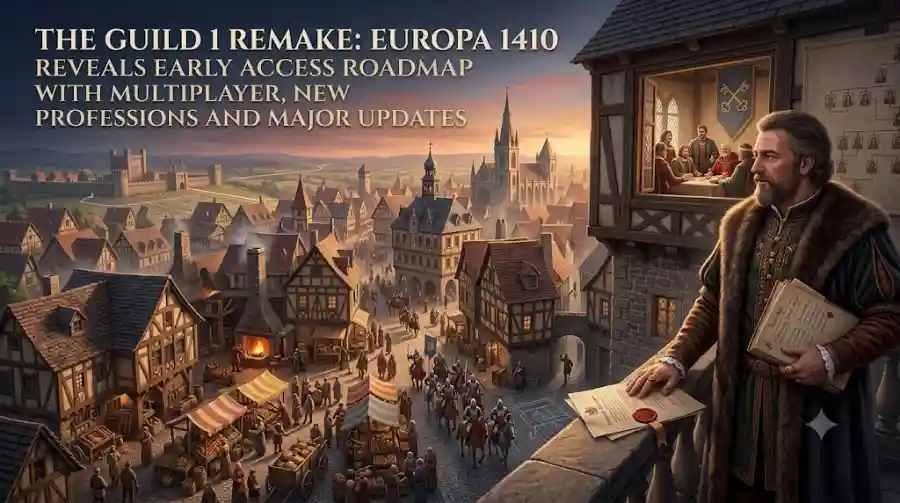
The Guild 1 Remake Europa 1410 Launches September 17 With Six Cities and Eight Professions, Then Adds Multiplayer and More
The game launches for PC via Steam on September 17, 2026, and the newly announced roadmap outlines not only the content available at launch but also several major updates planned before the eventual version 1.0 release.
At Early Access launch, players will have six cities, eight professions, two launch languages, dynasty progression, workshops, politics and multiple-generation campaigns.
But the more interesting part comes later.
Ashborne Games plans a major combat-focused Stabby Update, followed by the Backstabby Update, which will introduce multiplayer for up to 12 players, rivalries, alliances, expanded economic systems and another city.
The game has also passed 300,000 wishlists, showing that there is already significant interest ahead of launch.
What Is The Guild 1 Remake: Europa 1410?
The Guild 1 Remake: Europa 1410 is a medieval economic and social simulation inspired by Europa 1400: The Guild, the original game in the series.
The project was previously known simply as The Guild – Europa 1410, but THQ Nordic and Ashborne Games changed the name to make its connection to the first game clearer. The developers say this is intended as a spiritual successor to Europa 1400 rather than a continuation of the life-simulation direction associated with The Guild 2 and The Guild 3.
The basic idea is simple:
Start with a small business.
Build a successful enterprise.
Gain social influence.
Create a family and secure an heir.
Enter politics.
Compete with rival dynasties.
And attempt to build a legacy that survives multiple generations.
The game combines business simulation, strategy, politics, social progression and medieval role-playing.
Early Access Begins September 17
The Guild 1 Remake: Europa 1410 enters Early Access on September 17, 2026 through Steam.
The Early Access launch is intentionally not the final version.
Ashborne Games says the game will continue to receive major content updates, feature expansions, balance improvements and stability fixes during development.
Steam also confirms that the developers expect the community to play an active role in shaping the game through feedback during Early Access.
This approach is particularly relevant for a complex simulation.
Economic systems, politics, AI behavior and social mechanics can be difficult to balance without large-scale player feedback.
Six Cities Will Be Available at Launch
The initial Early Access version contains six cities, giving players several distinct locations in which to build their medieval dynasties.
The confirmed launch cities are:
Graz
Graz provides one of the main European settings available at launch and forms part of the game's broader medieval economic world.
Kuttenberg
Kuttenberg adds another urban center to the campaign, giving players a different environment in which to build businesses and social influence.
Nuremberg
Nuremberg is another major city included from day one.
Freiburg
Freiburg joins the launch roster and provides another location for business and political progression.
Wrocław
Wrocław is the fifth full city available at Early Access launch.
Landsfort Herle
Landsfort Herle serves as the game's tutorial town and helps new players understand its complex systems.
The six-city launch gives Europa 1410 a substantial starting map, although Ashborne Games has already confirmed that the world will expand beyond it.
Eight Professions Are Playable at Launch
The Early Access version also includes eight professions.
Players can choose from:
Smith
Tailor
Joiner
Stonemason
Priest
Innkeeper
Alchemist
Perfumer
These professions form the foundation of the game's economy.
Each provides a different route toward building wealth and influence.
A player might focus on manufacturing and trade, while another chooses a socially influential profession and uses politics to expand a dynasty's power.
This flexibility is one of the reasons Europa 1410 is being positioned as a sandbox rather than a linear campaign.
Build a Medieval Business Empire
Business management is one of the game's central systems.
Players begin with a relatively modest enterprise and gradually expand their workshops and operations.
That involves hiring workers, managing production and building an increasingly profitable business.
The objective is not simply to accumulate money.
Economic success can create opportunities elsewhere.
More wealth can support political ambitions.
Political influence can open additional opportunities.
A strong family can preserve the business across generations.
The game therefore links its economic systems rather than treating them as isolated mechanics.
Your Campaign Can Span Multiple Generations
One of the most interesting features is the dynasty system.
Europa 1410 allows a campaign to continue across multiple generations, meaning the character you eventually control may not be the person with whom the campaign began.
Players can:
Court potential partners.
Marry.
Have children.
Produce heirs.
Protect the future of the family.
That means failure can have long-term consequences.
A successful character may build wealth but still leave behind an unstable succession.
Likewise, a well-managed dynasty can gradually become more powerful as generations pass.
This makes the game closer to a long-form historical simulation than a typical strategy title.
Politics Is a Core Part of the Experience
Economic power is only one way to influence medieval society.
Players can also become involved in politics.
The roadmap explains that players can apply for offices, build relationships, use blackmail or bribery and influence city development.
This creates several possible paths to power.
You do not necessarily need to become the richest merchant in town.
You can instead build alliances.
You can develop political influence.
You can manipulate rival characters.
Or you can combine business success with political power.
The game is designed to let players choose the strategy that best fits their long-term ambitions.
City Construction Can Become Part of Your Strategy
Players who rise far enough through the political system can gain influence over the development of their city.
The Early Access roadmap says powerful characters can help expand city walls, improve infrastructure and enact laws.
That gives political success a concrete gameplay effect.
You are not simply earning a title.
You can influence the environment in which your business and dynasty operate.
This also creates opportunities for strategic manipulation.
Improving one part of a city may help your business.
A new law might benefit your profession.
A rival could potentially be weakened through a political decision.
That connection between economics and politics is one of Europa 1410's most interesting design ideas.
The Stabby Update Will Add Thieves, Robbers and Guards
The first major update on the roadmap is called the Stabby Update: Knives and Swords.
Its focus is combat and combat-related professions.
Ashborne Games plans to add:
Thief
Robber
Guard
The update will also allow players to equip guards for patrols, while thieves and robbers gain new options for attacking businesses, homes and carts.
This substantially broadens the ways players can interact with the medieval city.
Until that update arrives, the launch version is focused much more heavily on economic and social gameplay.
Combat Will Be Reworked
The Stabby Update is not simply adding three professions.
Ashborne Games says combat itself will be vastly improved, including a major overhaul for duels.
That could change how players interact with the world.
A rival is no longer just someone to outcompete economically.
They could eventually become a physical threat.
Players could also use criminal activity to damage competitors.
That adds another layer of risk to the economic simulation.
The exact details of the new combat system have not yet been revealed, so players should not assume specific mechanics before the developer provides more information.
The Backstabby Update Will Add Multiplayer
The biggest planned expansion is the Backstabby Update: Multiplayer.
Ashborne Games says this update will introduce one of the most requested features from the community: multiplayer.
The system will support up to 12 players.
Players will be able to compete against each other or cooperate while pursuing their own goals.
This could dramatically change the game.
A rival dynasty controlled by another human player is likely to behave very differently from an AI-controlled competitor.
Players can form alliances.
They can compete for political influence.
They can cooperate economically.
Or they can actively sabotage one another.
Rivalries and Alliances Will Expand Multiplayer
The multiplayer update also introduces rivalries and alliances between dynasties.
This fits naturally with the game's long-term dynasty structure.
Players are not just competing as individuals.
They are building family empires.
A temporary alliance between two dynasties could make sense when facing a stronger competitor.
But those relationships can change.
A former ally could eventually become the biggest threat in the city.
This creates the possibility of a more dynamic social and political environment than the single-player campaign.
Multiplayer Will Also Expand the Economy
The Backstabby Update is planned to make the city's economic needs much more important.
According to the roadmap, players will be able to help supply a city or withhold certain goods if doing so benefits their strategy.
That creates a potentially powerful economic weapon.
A player could intentionally manipulate supply.
Another could build a business around fulfilling city demand.
A third might use shortages to force political changes.
These mechanics could make multiplayer much more strategic than simply racing to accumulate wealth.
A New City Will Arrive With the Multiplayer Update
The Backstabby Update will also introduce another city to the game.
Ashborne Games has not yet revealed the city's name or complete layout.
That means the game's world will expand beyond the six cities available during the initial Early Access phase.
For a simulation like Europa 1410, additional cities are important because they provide new markets, political environments and places to establish competing dynasties.
Version 1.0 Will Add Two More Professions
The full-release milestone will add Moneylender and Trader professions.
These are designed to work together with the expanded economy introduced in the multiplayer update.
The Trader
Traders will focus on acquiring rare and valuable goods, moving them between cities and profiting from regional differences.
That expands the economy beyond local production.
The Moneylender
Moneylenders will provide loans and financial services.
Players can use loans to accelerate development, but they will also need to repay their debts on time.
This introduces another layer of risk and reward.
Version 1.0 Will Bring a New Map
The final launch will also introduce a brand-new map along with additional Guild gameplay.
This is particularly important because it confirms that the game's eventual 1.0 version will be significantly larger than the initial Early Access package.
The roadmap is therefore not simply a list of bug fixes.
It represents a substantial expansion of the game's systems and overall playable world.
Early Access Is Starting With Two Languages
The initial version will support German and English.
Ashborne Games says additional languages are planned for the Early Access period, including French, Spanish, Polish, Czech, Simplified Chinese and Russian.
This means the localization scope is expected to expand substantially over time.
For a historically themed simulation with complex menus and systems, localization can be particularly important because players need to understand economic and political mechanics clearly.
The Guild 1 Remake Has Passed 300,000 Wishlists
The developer also announced another milestone alongside the roadmap.
More than 300,000 people have wishlisted The Guild 1 Remake: Europa 1410.
That gives the game a substantial audience before Early Access even begins.
Wishlists do not guarantee commercial success, but the figure indicates significant interest in the project.
It also suggests that the original Guild community remains interested in the franchise's return to its historical strategy roots.
Why the Name Change Matters
Some players may be confused because older trailers and announcements used a different title.
The project was previously called The Guild – Europa 1410.
THQ Nordic and Ashborne Games changed the name to The Guild 1 Remake: Europa 1410 to make the project's relationship with the original Europa 1400 clearer.
The developers specifically explain that they want to distinguish the game from the different life-simulation direction taken by The Guild 2 and The Guild 3.
So the title change is not merely cosmetic.
It communicates the game's intended design lineage.
What Makes Europa 1410 Different?
The strongest feature of the game is its interconnected systems.
A profession affects your economy.
The economy affects your wealth.
Wealth can affect your politics.
Politics can influence the city.
Marriage affects your dynasty.
Your dynasty determines succession.
And rival dynasties can eventually threaten everything you built.
This creates a simulation in which individual choices can have consequences far beyond a single character.
That is what makes Europa 1410 different from a standard medieval strategy game.
It Is More Than a Business Simulator
Calling Europa 1410 a business simulator would miss much of the experience.
The game also contains:
Dynasty management
Politics
Social relationships
Succession
Economic strategy
City development
Diplomacy
Future combat
Multiplayer competition
The systems are designed to interact.
A successful business can create wealth.
Wealth can help win political office.
Political influence can change laws.
Those laws can affect businesses.
A marriage can strengthen the dynasty.
An heir can continue the family after the current character dies.
That interconnected structure is the core of the experience.
What Players Should Expect on September 17
The Early Access build should be viewed as a substantial but incomplete foundation.
Players will have six cities and eight professions.
They will be able to build workshops, hire workers, develop businesses, marry and produce heirs, while also climbing the political ladder.
But some of the systems that will eventually define the full package will not be available immediately.
Combat professions come later.
Multiplayer comes later.
Additional economic roles come at 1.0.
And the final map expansion comes later as well.
That makes the Early Access roadmap particularly important for potential buyers.
The Roadmap Gives Players a Reason to Follow Development
Many Early Access games provide only vague promises about future content.
Europa 1410 is taking a more structured approach.
Ashborne Games has identified major milestones and explained what each update is intended to accomplish.
The Stabby Update is focused on combat.
The Backstabby Update is focused on multiplayer and economy.
The 1.0 release expands professions, the map and Guild gameplay.
That does not guarantee every feature will arrive exactly as described or on a fixed schedule.
But it gives players a clearer picture of the development direction than a simple “more content coming soon” statement.
The Guild 1 Remake: Europa 1410 Release Details
Game: The Guild 1 Remake: Europa 1410
Developer: Ashborne Games
Publisher: THQ Nordic
Genre: Strategy / Simulation / Sandbox
Early Access: September 17, 2026
Platform: PC via Steam
Launch Cities: Six
Launch Professions: Eight
Launch Languages: German, English
Planned Multiplayer: Up to 12 players
Major Planned Updates: Stabby Update, Backstabby Update
Full Release: TBA
Wishlists: More than 300,000
Original Inspiration: Europa 1400: The Guild
The Guild 1 Remake: Europa 1410 is shaping up to be a particularly ambitious Early Access simulation.
The September 17 launch already includes six cities, eight professions, dynasty progression, workshops, politics and multi-generational campaigns, giving players a substantial foundation from day one.
But the roadmap is where the project becomes much more interesting.
The upcoming Stabby Update will introduce thieves, robbers and guards while rebuilding combat and duels.
The Backstabby Update will then add multiplayer for up to 12 players, rivalries, alliances, deeper economic interactions and another city.
Finally, the 1.0 release is planned to add the Moneylender and Trader professions, a new map and additional gameplay around the Guild system.
With more than 300,000 wishlists already recorded, there is clear interest in seeing whether Ashborne Games can successfully revive the original Guild formula for a modern audience.
The biggest attraction is not any one feature.
It is the way the systems connect.
You are building a business, but you are also building a family.
You are pursuing wealth, but you can also pursue political power.
You can create alliances, compete with rivals and eventually fight for control.
That combination gives Europa 1410 the potential to become a deeply replayable medieval sandbox.
The key word is still potential, because Early Access will determine how well those ambitious systems work together.
For players interested in medieval strategy, dynasty simulation and economic management, however, September 17 is an important date to watch.
FAQs
When does The Guild 1 Remake: Europa 1410 enter Early Access?
The game launches into Early Access on September 17, 2026 for PC via Steam.
How many cities are available at Early Access launch?
The initial version contains six cities: Graz, Kuttenberg, Nuremberg, Freiburg, Wrocław and the tutorial town of Landsfort Herle.