Master Ink Game’s Deadliest Challenges With Smart Timing, Patience

 and Winning Strategies

At first glance, both challenges may appear to depend heavily on luck. Red Light, Green Light seems like a simple reaction test, while Glass Bridge looks like a complete guessing game where players must choose between safe and dangerous panels.

However, experienced players know that winning is not just about luck.

Highlights: The Key Strategies Behind Winning Ink Game

Before jumping into individual game tactics, successful Ink Game players follow a few basic principles:

  • Never rush without a reason.
  • Learn the timing patterns of each challenge.
  • Use sound cues instead of depending only on visuals.
  • Let other players take unnecessary risks.
  • Prioritize survival over finishing first.
  • Stay calm when pressure increases.

Many players lose because they panic. They see others moving ahead and feel forced to take risky actions. But Ink Game is not about being the fastest player — it is about being the player who makes the fewest mistakes.

Now, let’s break down the first major challenge.

Mastering Red Light, Green Light in Ink Game: Precision Beats Speed

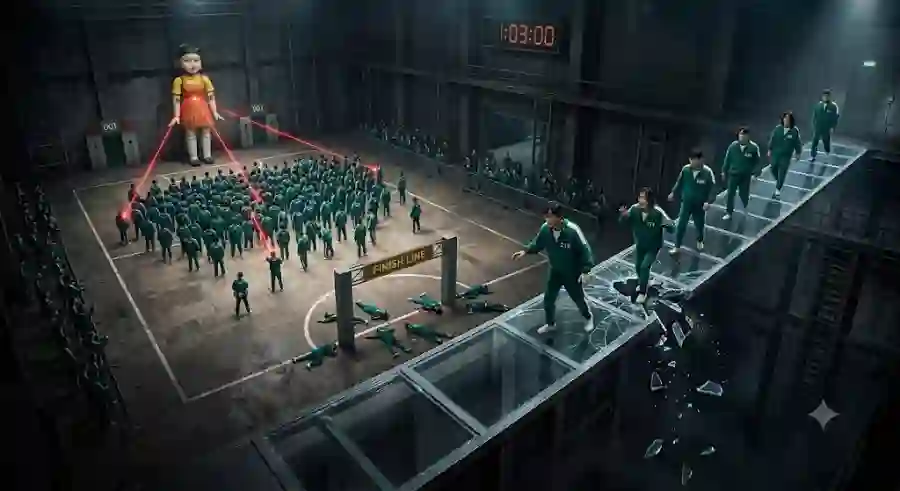
Red Light, Green Light is usually the first major elimination round, and it often becomes a complete disaster for inexperienced players.

The biggest mistake beginners make is trying to win through aggressive movement. They hold their movement button, sprint forward, and hope they can reach the finish line before getting detected.

This strategy usually fails.

The game does not reward the fastest player. It rewards the player who understands movement control.

The goal is simple:

Move when you are allowed to move. Stop completely when danger arrives.

Small details decide survival.

1. Master the “Tapping” Movement Technique

One of the most effective techniques for Red Light, Green Light is controlled tapping.

Instead of continuously holding your movement key, use short and careful movements.

Avoid constantly pressing:

  • W key or forward movement
  • Sprint controls
  • Long movement bursts

during uncertain moments.

Why Does Tapping Work?

When you hold movement continuously, your character may continue moving slightly even after you release the button. This small movement can be enough for the detection system to eliminate you during Red Light.

This happens because your character has momentum.

A player who looks completely still on their screen may still register movement because of delayed input or server synchronization.

Using short taps gives you much better control.

You can instantly stop your character when the warning signal appears.

Professional Tip:

Keep your fingers relaxed instead of pressing aggressively.

The moment you notice the audio signal changing, immediately remove your fingers from movement controls.

Do not try to squeeze out one extra step.

That final unnecessary movement is responsible for many eliminations.

2. Trust Audio Signals More Than Visual Animation

One of the most important secrets in Red Light, Green Light is understanding that visual information is not always reliable.

The Giant Doll’s turning animation can sometimes feel delayed because of:

  • Server connection differences
  • Frame drops
  • Network latency
  • Device performance issues

The animation you see may not perfectly match the exact moment the detection system activates.

However, audio signals are often much more dependable.

How to Use Sound Cues Correctly

Increase your game volume and carefully listen to:

  • The chant rhythm
  • Music changes
  • Warning sounds
  • Movement transition cues

The sound pattern gives you valuable information about when to move and when to stop.

As the rhythm changes, adjust your movement speed.

Avoid waiting until the very last second.

Many players lose because they become greedy and attempt to gain an extra half-second of progress.

That small advantage is rarely worth the risk.

A smart player stops slightly early and survives.

3. Use Other Players as a Strategic Advantage

In the beginning moments of Red Light, Green Light, many players make the same mistake: they immediately rush forward.

Instead of copying them, use their aggression to your advantage.

Allow overly confident players to move ahead first.

This creates two benefits.

Better Visibility and Control

When too many players move together, the screen becomes chaotic.

A large crowd makes it harder to judge:

  • Your exact position
  • Your stopping distance
  • Other player movements

By staying slightly behind, you gain a clearer view of the battlefield.

Avoid Accidental Collisions

Crowded areas create another problem: player interference.

Other players can accidentally:

  • Block your movement
  • Push your character
  • Force unexpected movement
  • Cause mistakes during Red Light

Maintaining a small distance from the main group reduces these risks.

The smartest survivors often stay near the middle or slightly behind the crowd instead of becoming the first target.

4. The Final Stretch Strategy: Slow Down Near Victory

Many players survive most of Red Light, Green Light but fail near the finish line.

Why?

Because they become too confident.

After reaching close to the end, players often:

  • Sprint unnecessarily
  • Jump randomly
  • Ignore stopping signals
  • Try to finish before everyone else

This creates avoidable mistakes.

The detection area near the finish line can feel surprisingly strict.

Your best strategy is simple:

Take short movements.

Stop completely during Red Light.

Cross the finish area calmly.

Remember:

A safe finish is always better than a fast elimination.

The player who reaches the finish line first does not automatically win the entire match.

The player who survives the round does.
Conquering Glass Bridge in Ink Game: Strategy, Patience, and Psychological Warfare

While Red Light, Green Light tests your reaction speed and movement discipline, the Glass Bridge challenge pushes a completely different skill set.

This round is not just about quick decisions. It is a battle of patience, observation, risk management, and mental control.

Players must cross a long elevated bridge where each step can determine their fate. Some panels are strong enough to support your character, while others are fragile and break instantly when stepped on.

The biggest challenge is uncertainty.

You do not know which glass panel is safe.

At first, the Glass Bridge appears to be a simple 50/50 guessing game. Every jump feels like a gamble, and the first player in line seems almost guaranteed to lose.

However, skilled players understand that the bridge is not just about luck.

By watching other players, remembering safe paths, and controlling your movement, you can turn an unpredictable challenge into a calculated survival strategy.

1. Let Risk-Takers Go First: The Patience Strategy

One of the strongest Glass Bridge tactics is also one of the hardest for impatient players to follow:

Do not rush to be the first person across.

If you start at the front of the line, every decision becomes a blind guess. Your chances are basically a coin flip with dangerous consequences.

Instead, allow aggressive players to test the path first.

Every mistake they make gives you valuable information.

Every successful jump reveals a safe route.

Learn From Other Players’ Mistakes

If the game allows you to control your position in the queue, staying slightly behind can dramatically increase your survival chances.

Watch carefully as players ahead jump.

Do not only focus on where they land.

Pay attention to the complete sequence:

  • Which side they choose
  • Which panels break
  • Which path remains available
  • How many safe steps appear ahead

Create a mental map of the bridge.

For example:

  • Left panel
  • Right panel
  • Right panel
  • Left panel

Remembering the sequence gives you a major advantage when your turn arrives.

The key is not simply watching.

The key is actively analyzing.

2. Study Glass Break Effects and Player Reactions

The Glass Bridge provides important visual and audio information.

Many players ignore these details, but experienced players use them as clues.

When someone chooses the wrong panel, the game usually provides clear signs:

  • A breaking animation
  • A glass-shattering sound
  • A falling player animation

These reactions help identify dangerous sections.

If a player lands on a panel and stays alive, remember that location.

That panel becomes a confirmed safe option for future movement.

However, there is an important detail to consider.

Not every fall means the glass was fake.

Sometimes players are eliminated because another player pushes them.

You need to understand the difference between:

  • Falling through a broken panel
  • Being pushed away by another player

Mistaking one for the other can destroy your strategy.

Observation is your strongest weapon.

3. Protect Yourself From Trolls and Push Players

Many players assume the biggest danger in Glass Bridge is the fragile glass.

Experienced players know the truth:

Other players can sometimes be more dangerous than the bridge itself.

Some players intentionally wait on safe panels and use push mechanics to eliminate others.

This creates a completely different challenge.

You are not only fighting the game mechanics.

You are also dealing with unpredictable opponents.

Maintain Safe Distance

Never stand directly behind another player on a single glass panel if you can avoid it.

Crowding creates opportunities for accidental or intentional pushes.

Give yourself enough space to react.

A little distance can protect your entire run.


Force Troll Players to Move

If someone is standing on a safe tile and waiting to push incoming players, do not immediately rush toward them.

Instead:

  • Wait briefly
  • Observe their movement
  • Avoid giving them an easy opportunity

Sometimes impatient players reveal their intentions when they realize others are not approaching.

The bridge timer creates pressure, but controlled movement is still better than a careless jump.


Use Corner Landing to Avoid Collisions

When jumping onto a confirmed safe tile where another player is standing, avoid landing directly in the center.

Aim toward the edge or corner of the panel.

This reduces the chance of:

  • Getting pushed
  • Colliding with another player
  • Losing balance after landing

Small positioning improvements often decide whether you survive or restart.

4. What to Do When You Are First in Line

Sometimes strategy cannot save you.

You may simply become the first player on the bridge.

When that happens, panic is your biggest enemy.

You cannot completely remove the risk, but you can improve your survival odds.


Do Not Freeze Completely

Many players stand still because they are afraid of choosing the wrong panel.

This feels safe, but it creates another problem.

The timer continues running.

If you wait too long, everyone loses.

You need to balance caution with action.

Analyze quickly and commit.


Make Clean Decisions

When choosing a panel, avoid hesitation.

A common mistake is changing direction in the middle of a jump.

This often causes players to miss the intended platform completely.

Once you choose a direction:

Commit fully.

A confident mistake is usually better than a confused movement.

Avoid Fake Pattern Predictions

Human brains naturally search for patterns.

After seeing several choices, players often think:

“It must be the right side because the last three safe panels were left.”

This is a dangerous mindset.

Glass Bridge layouts are randomized.

Previous choices do not guarantee future results.

Treat every jump as an individual decision.

Do not trust imaginary patterns.


General Settings and Habits That Improve Your Ink Game Win Rate

Winning individual rounds requires skill, but your game setup also matters.

Small adjustments to your settings can improve reaction speed and reduce mistakes.

AreaRecommended Setting / StrategyWhy It Helps
Graphics SettingsLow to MediumReduces frame drops and improves input response during important moments
Camera ViewShift-Lock Enabled / Third-PersonGives better awareness and more accurate movement control
AudioSound Effects Turned UpHelps detect Red Light signals and glass-breaking sounds
MindsetHigh PatienceSurvival matters more than reaching the finish line first

Why These Strategies Matter for Ink Game Players

Ink Game is designed around pressure.

The game creates situations where emotions take control.

Players rush because others are moving.

Players panic because the timer is decreasing.

Players take unnecessary risks because they want to look faster than everyone else.

But consistent winners understand something important:

Survival comes from discipline, not desperation.

The best players are not always the fastest.

They are the players who:

  • Understand the mechanics
  • Control their movement
  • Read opponents
  • Stay calm under pressure
  • Make smart decisions

This mindset applies beyond Ink Game.

Modern multiplayer survival games increasingly reward strategic thinking rather than simple speed.

Players who learn patience and observation usually perform better across different competitive experiences.

Industry Impact: Why Survival Strategy Games Continue Growing

Games like Ink Game have become popular because they combine simple rules with intense psychological challenges.

The formula works because players immediately understand the objective, but mastering the game requires deeper skill.

Similar survival-style experiences continue attracting players because they create:

  • High replay value
  • Competitive moments
  • Unexpected outcomes
  • Social interaction
  • Exciting player stories

Every match feels different because human decisions change the experience.

One player’s mistake can completely change another player’s strategy.

That unpredictability keeps players returning.