INTO THE RADIUS 2 Gets Its Full Quest 3 Launch With New Content, Survival Improvements and More
On PC, the game has already received its full release and currently supports single-player and online co-op for up to four players. The Steam listing describes it as an immersive VR survival shooter with realistic weapons, weapon maintenance, customizable loadouts and dangerous anomalies.
The standalone Quest version has been following its own development path.
Now that the full Quest release is approaching, Into the Radius 2 is ready to introduce its larger experience to more VR players.
What Is Into the Radius 2?
Into the Radius 2 is a first-person VR survival shooter set inside the strange and dangerous Pechorsk Anomaly.
The game combines several genres.
It has the tension of a survival game, the weapon handling of a tactical shooter and the exploration of an atmospheric adventure.
Players enter dangerous areas filled with hostile entities and anomalies.
The objective isn't simply to eliminate everything in sight.
Exploration is just as important.
You need to manage your equipment, monitor your resources, maintain your weapons and decide how much risk you are willing to take.
The official game description emphasizes realistic weapons, dangerous anomalies, changing environments and customizable equipment.
That combination gives Into the Radius 2 a much slower and more deliberate pace than many traditional VR shooters.
When Does Into the Radius 2 Leave Quest Early Access?
The biggest piece of news is the full-release date.
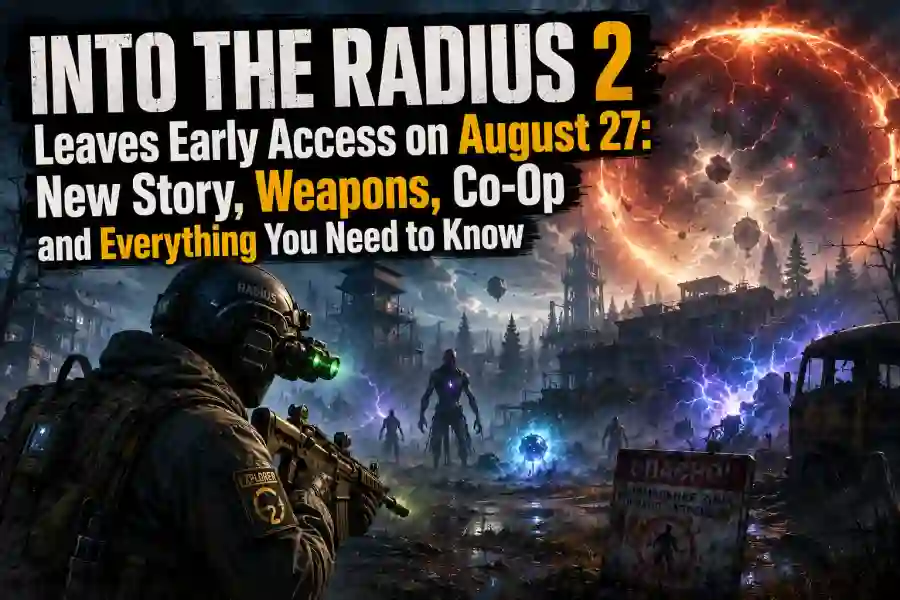
Into the Radius 2 leaves Early Access on Meta Quest on August 27, 2026.
The release applies to Meta Quest 3 and Quest 3S. Current reporting from Road to VR confirms that the game is leaving Quest Early Access on that date with additional content arriving as part of the full release.
The developer's previously published development information also confirmed that the Quest version was being prepared for a full release after its Early Access period.
For Quest owners who have been waiting for version 1.0, this is the most important milestone yet.
What Is New in the Full Quest Release?
The full release is not just about removing the Early Access label.
The game is receiving additional content and improvements.
One of the biggest additions is a more complete story experience.
The full version includes a complete story introduction with fully voiced characters, along with subtitles and notes left behind by previous explorers. The game also introduces voiced Guide statues and destructible figures in its locations.
These additions should make the world feel more alive.
Instead of relying primarily on environmental clues, players will have more direct narrative information to follow.
That is especially useful for a survival game where exploration can otherwise become difficult for newcomers to understand.
A Bigger Story Experience
Story has always been an important part of the Into the Radius universe.
The player is not simply dropped into an abandoned environment without context.
The world has its own mystery.
The Pechorsk Anomaly contains strange phenomena, hostile entities and locations that encourage players to investigate what happened.
The full Quest release expands the narrative presentation.
Fully voiced characters should make important story moments easier to follow while playing in VR.
This matters because VR can make reading traditional text more cumbersome than on a monitor.
Having characters communicate directly can make the experience more immersive.
New Exploration Challenges
The full release also introduces additional challenges for players exploring the Radius.
Among the changes are new transition zones, exploration fog and unfamiliar anomaly types.
These systems can make exploration more unpredictable.
The fog is particularly interesting because visibility is a major factor in survival games.
When you cannot clearly see what is ahead, every movement becomes more dangerous.
You may hear something before you see it.
You may have to decide whether to continue forward or retreat.
And in VR, these moments can feel much more intense because the player is physically surrounded by the game environment.
Night Exploration Is Becoming More Important
Night operations are also receiving additional support.
The full version adds tools such as night vision devices and flares, allowing players to operate more effectively when visibility becomes limited.
This could change how players approach nighttime missions.
Rather than simply avoiding dark areas, players can prepare for them.
That creates another layer of equipment management.
You have to think about what you are carrying before leaving your base.
Do you bring extra ammunition?
Do you carry additional medical supplies?
Do you need night vision?
Should you leave some equipment behind to reduce your weight?
These decisions are central to Into the Radius 2.
New Weapons Are Coming
Weapons are one of the strongest features of Into the Radius 2, and the full Quest release expands the arsenal.
New weapons include:
- G3 rifle
- MP5 SMG
- GP-34 underbarrel launcher
- VOG-25 grenades
- Additional hand grenades
The announced grenade selection includes the F-1, M67, RGD-5, RGN and RGO.
The additional arsenal gives players more options when planning their loadouts.
The G3 can provide a different approach to longer-range encounters, while the MP5 offers a more compact option for close-range combat.
The GP-34 underbarrel launcher adds another tactical option.
However, the game isn't designed around simply collecting as many weapons as possible.
Every piece of equipment contributes to the player's overall survival strategy.
Realistic Weapon Handling Is a Major Part of the Game
One of the biggest differences between Into the Radius 2 and a traditional shooter is how weapons work.
The game focuses heavily on realistic interaction.
The Steam version highlights detailed weapon handling, modular customization and weapon maintenance.
That means players have to actually interact with their equipment rather than simply pressing a reload button.
Magazines, ammunition, attachments and weapon condition can all become part of the experience.
This creates a slower style of combat.
Instead of constantly running and shooting, players have to prepare.
Weapon Maintenance Matters
Survival doesn't end when you acquire a powerful weapon.
Weapons need care.
The game's systems are designed around maintaining firearms and managing equipment.
This is important because the Radius is not a safe environment.
If your equipment is poorly maintained, your next mission can become much more difficult.
That creates an interesting risk-reward loop.
You can spend resources maintaining your equipment at base.
Or you can take the risk of entering the Radius with what you already have.
For experienced players, this creates another strategic layer beyond simple combat.
Customizing Your Loadout
Into the Radius 2 also gives players significant control over their equipment.
The official game description highlights customizable loadouts and modular weapon systems.
Your gear can be adjusted according to the mission.
You might want a lighter setup for exploration.
Another mission might require heavier protection.
A night operation could require additional visibility equipment.
A combat-heavy mission could justify bringing more ammunition.
The ability to adjust your loadout means there isn't necessarily one perfect setup.
Players can experiment and develop their own survival style.
Co-Op Makes the Radius More Interesting
One of the biggest differences between Into the Radius 2 and its predecessor is its multiplayer focus.
The PC version supports online co-op for up to four players.
That means players can enter the Radius with friends instead of facing every threat alone.
Communication becomes important.
One player might scout ahead.
Another can manage equipment.
A third can watch for enemies.
A fourth can carry additional supplies.
This changes the atmosphere considerably.
A terrifying area can feel slightly more manageable when you have friends beside you.
But multiplayer also introduces new risks.
If one player attracts an enemy, everyone can become involved.
If the team becomes separated, communication becomes essential.
The Radius remains dangerous even when you aren't alone.
Quest Co-Op Has Different Limitations
There is an important distinction between the PC and Quest versions.
The developer previously explained that co-op on Meta Quest would remain capped at two players because of technical limitations.
This means Quest players shouldn't expect the same four-player co-op experience available on PC.
For standalone VR hardware, maintaining performance while rendering a large environment, enemies, weapons and multiplayer interactions is technically demanding.
The two-player limit allows the developers to target the capabilities of Quest hardware more realistically.
The Pechorsk Anomaly Is the Real Star
The setting is arguably as important as the weapons.
The Pechorsk Anomaly is a surreal environment filled with dangerous phenomena.
The official description highlights anomalies that can explode, discharge electricity, suppress light, attach themselves to players or push them away while causing damage.
That variety means players cannot rely on one strategy.
An enemy may be easy to defeat with a weapon.
An anomaly may require a completely different response.
Some threats are best avoided.
Others need to be studied.
Some can become dangerous simply because the player is moving too quickly through an unfamiliar area.
Exploration Is About Risk and Reward
Every trip into the Radius is essentially a gamble.
You leave your base with equipment.
You enter a dangerous area.
You search for valuable items and complete missions.
Then you need to make it back alive.
The deeper you go, the greater the potential rewards.
But the risks also increase.
This creates a classic survival-game question:
How much are you willing to risk before returning home?
If your backpack is full, you may have enough resources.
But continuing deeper could produce something even more valuable.
On the other hand, one mistake could cost you everything you are carrying.
That tension is a major part of the game's identity.
New Transition Zones Could Change Exploration
The addition of new transition zones is particularly interesting.
Transition areas can change how players move between different sections of the Radius.
Instead of treating each location as an isolated space, these areas can create a stronger sense of a connected world.
They also provide opportunities for new encounters.
A route that feels safe one day may become dangerous after environmental changes.
This can encourage players to learn the world rather than simply memorizing one route.
Exploration Fog Adds More Tension
Fog is another important addition.
Visibility can fundamentally change how a survival game feels.
In clear weather, players can scan the environment.
In heavy fog, the same area becomes unfamiliar.
Objects can appear suddenly.
Enemies may be closer than expected.
Players may also become disoriented.
That is particularly effective in VR because the player has a much stronger sense of physical presence inside the environment.
Why the Full Release Matters
Leaving Early Access is important for any game.
But it matters even more for a VR survival title.
Early Access is useful for testing performance, controls and gameplay systems across different hardware configurations.
Standalone VR has strict performance limitations.
Developers have to balance graphical quality with frame rate and responsiveness.
That becomes especially important in a game where players can become physically uncomfortable if performance drops.
The transition to full release therefore suggests the developers believe the Quest version is ready for a wider audience.
What About the PC Version?
The PC version of Into the Radius 2 has already reached its full release.
Steam lists the game as released on April 23, 2026, with CM IMMERSIVE as developer and publisher.
The PC version supports:
- Single-player
- Online co-op
- Up to four players
- VR controllers
- Steam achievements
- Steam Cloud
- Multiple VR features
Steam currently lists the standard price at $39.99 USD.
That means Quest players are effectively receiving the game's standalone version later than PC players.
Why Quest 3 and Quest 3S Matter
The Quest platform has become one of the most accessible ways for players to experience VR.
Unlike PC VR, standalone Quest hardware does not require a gaming PC.
That significantly lowers the entry barrier.
A player can put on a headset and enter the Radius without building a powerful gaming computer.
For a game like Into the Radius 2, this could be important.
The survival atmosphere is one of its strongest selling points.
Making the experience accessible to more standalone players could help expand the game's audience.
What Players Should Expect From the Full Version
If you are coming to Into the Radius 2 for the first time, expect a game that rewards patience.
It is not designed to constantly throw enemies at you.
There are quieter moments.
You explore.
You search buildings.
You manage your equipment.
You prepare weapons.
Then suddenly something goes wrong.
That pacing is one of the reasons the game can feel more immersive than a conventional shooter.
The tension comes from anticipation.
Is Into the Radius 2 Worth Watching?
For VR players, absolutely.
The August 27 launch gives Quest owners a clear opportunity to experience the more complete version of the game.
The combination of:
- Survival
- Exploration
- Weapon realism
- Co-op
- Horror
- Science fiction
- Environmental storytelling
- Equipment management
makes it different from many other VR shooters.
It is particularly interesting for players who want something slower and more atmospheric.
Who Should Play Into the Radius 2?
VR Survival Fans
If you enjoy survival mechanics and resource management, the game is a natural fit.
Tactical Shooter Players
The detailed weapons and deliberate combat can appeal to players who prefer realism over arcade-style shooting.
Horror Fans
The anomalies and hostile environments create plenty of tension without turning the game into a traditional horror title.
Co-Op Players
PC players can experience the Radius with up to three friends, while Quest co-op supports two players.
Exploration Fans
The world encourages players to search locations and discover information rather than simply moving through a linear campaign.
Who Might Not Enjoy It?
Players looking for fast-paced action may find the game slow.
Inventory management is important.
Weapon maintenance is important.
Preparation is important.
Exploration takes time.
The game also expects players to learn its systems rather than immediately giving them everything they need.
That can be rewarding, but it may frustrate players who prefer instant action.
Into the Radius 2 vs Traditional VR Shooters
| Feature | Traditional VR Shooter | Into the Radius 2 |
|---|---|---|
| Fast-paced combat | Usually | Not the main focus |
| Survival systems | Limited | Major feature |
| Weapon maintenance | Rare | Important |
| Exploration | Varies | Central |
| Anomalies | Rare | Core mechanic |
| Resource management | Limited | Important |
| Co-op | Varies | Yes |
| Loadout customization | Usually | Extensive |
| Horror atmosphere | Sometimes | Strong |
| Story exploration | Varies | Important |
This is what makes Into the Radius 2 stand out.
It isn't trying to be another VR arena shooter.
It is trying to create a complete survival experience inside virtual reality.
The August 27 Release Could Be a Turning Point
The full Quest launch arrives at an interesting time for VR gaming.
The market is increasingly focused on standalone headsets and games that can provide deeper experiences without requiring expensive gaming PCs.
Into the Radius 2 is well positioned for that audience.
The game has already demonstrated its concept on PC.
Now the Quest release can introduce the experience to players who want standalone VR survival gameplay.
The addition of a fuller story, new weapons and expanded exploration systems gives the launch a stronger reason to pay attention than a simple Early Access update.
What Comes Next?
The August 27 launch probably won't be the end of the game's development.
The PC version has already received updates after launch.
Official announcements show that the developers have continued to add weapons, improve co-op and make gameplay adjustments.
The developer has also discussed additional lore materials and potential ports in its development updates.
That suggests the team is still interested in expanding the world.
For players, that could mean more content and improvements after the Quest launch.
Final Thoughts
Into the Radius 2 is entering an important new phase.
The game has already established itself on PC, but the upcoming August 27, 2026 Quest 3 and Quest 3S launch could significantly expand its audience.
The full release is more than an Early Access label disappearing.
Players are getting a more complete narrative experience, fully voiced characters, additional environmental details, new weapons, new exploration challenges, night-vision tools and more.
The game's strongest feature remains its atmosphere.
The Radius feels dangerous because players have to think about almost everything.
Where should you go?
What should you carry?
Which weapon should you use?
How much ammunition is enough?
Should you continue deeper?
Should you return to base?
Those decisions make the game feel more like a survival expedition than a traditional shooter.
The addition of new transition zones, exploration fog and unfamiliar anomalies could make the full Quest experience even more unpredictable.
Meanwhile, realistic weapon handling and customizable equipment provide enough depth for players who enjoy tactical gameplay.
The co-op system also gives the game another dimension, although Quest players should remember that standalone co-op is limited to two players while the PC version supports up to four.
For anyone with a Quest 3 or Quest 3S who enjoys survival games, VR shooters or atmospheric horror, August 27 is a date worth watching.
The Radius is about to open its doors fully.
And once players step inside, surviving may be much harder than simply finding the way back out.
11. Frequently Asked Questions
When does Into the Radius 2 leave Early Access on Quest?
Into the Radius 2 leaves Early Access on August 27, 2026, for Meta Quest 3 and Quest 3S.
What is Into the Radius 2?
It is a VR survival shooter set in the dangerous Pechorsk Anomaly, featuring exploration, realistic weapons, survival mechanics and hostile anomalies.