Minecraft Classic Explained Why Millions Still Return to the Free Browser Version After 15+ Years
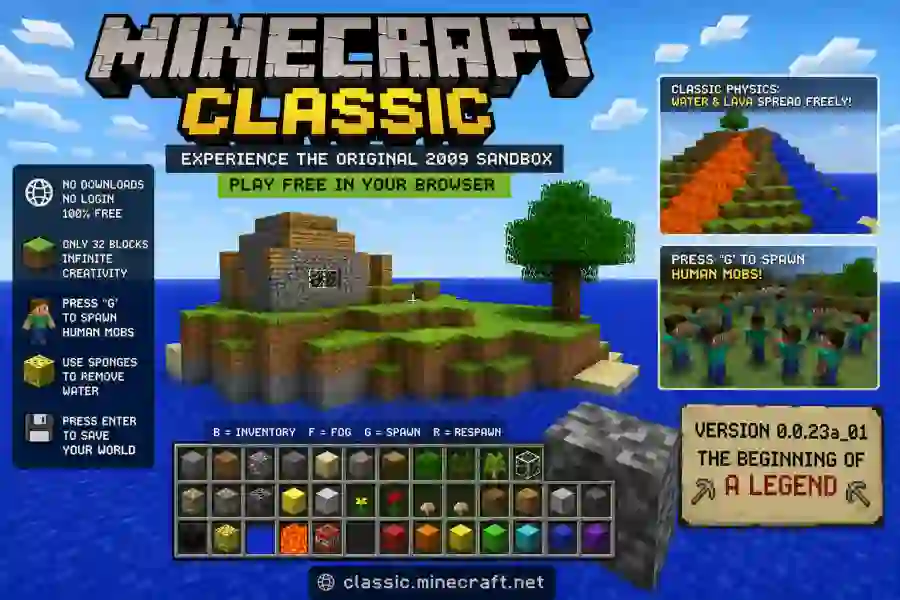
Travel back more than 15 years to May 2009, and you'll discover a version of Minecraft that feels charmingly basic, wonderfully experimental, and surprisingly relaxing. Instead of hundreds of blocks and countless gameplay systems, players were given just 32 building blocks and complete freedom to create whatever they imagined.
Highlights
- Play the original Minecraft Classic (version 0.0.23a_01) directly in your browser.
- Released by Mojang in 2019 to celebrate Minecraft's 10th anniversary.
- No launcher, installation, login, or payment required.
- Features only 32 original blocks with unlimited quantities.
- Pure creative gameplay with no Survival Mode mechanics.
- Includes several iconic early-game quirks and experimental features.
- Runs smoothly on almost any modern computer using lightweight browser technology.
What Is Minecraft Classic?
In 2019, Mojang quietly surprised fans by making the original 2009 Minecraft build (version 0.0.23a_01) publicly available through classic.minecraft.net.
Unlike the modern Java or Bedrock Editions, Minecraft Classic is incredibly accessible.
Players simply open the website using browsers like Google Chrome, Mozilla Firefox, or Safari, generate a world, and immediately spawn on a small floating island surrounded by an endless ocean.
There are no downloads.
There is no launcher.
There are no accounts to create.
There is also no cost.
Within seconds, you're standing inside a tiny digital world that perfectly captures Minecraft's earliest days.
However, it's important to understand what this version actually offers.
Minecraft Classic isn't a survival experience. There are no health bars, hunger meters, hostile mobs waiting to attack, armour progression, or crafting recipes. Instead, the game focuses entirely on creative building, offering players unlimited access to every available block from the very beginning.
It represents Minecraft at its purest and simplest.
Only 32 Blocks: The Original Building Experience
One of the biggest surprises for modern players comes when they press the B key to open the inventory.
Instead of scrolling through hundreds of decorative blocks, Redstone components, ores, plants, furniture, and construction materials, the inventory contains only 32 different blocks.
That small collection includes everything players could build with in 2009.
Natural Terrain Blocks
The original natural landscape consisted of:
- Dirt
- Grass
- Gravel
- Sand
- Stone
- Cobblestone
These blocks formed the foundation of nearly every early Minecraft creation.
Basic Building Materials
Players also received several construction essentials, including:
- Wood Logs
- Leaves
- Saplings
- Glass
Although limited by today's standards, these blocks allowed surprisingly creative structures.
Original Ore Collection
Mining also looked very different.
The available ore blocks included:
- Gold Ore
- Iron Ore
- Coal Ore
- Solid Gold Blocks
- Solid Iron Blocks
Decorative Blocks
Even the earliest versions included a handful of decorative items, such as:
- Dandelion
- Rose
- Brown Mushroom
- Red Mushroom
These simple additions helped make builds feel more alive.
Coloured Cloth
Modern Minecraft players know wool blocks.
Back then, they were called Cloth, and only a small selection of primary colours existed.
Utility Blocks
The remaining utility items completed the original block palette:
- Obsidian
- Sponge
- Water
- Lava
- TNT
Every one of these blocks was available in unlimited quantities from the moment the game began.
No Crafting, No Progression—Just Pure Creativity
Perhaps the biggest adjustment for modern players is the complete absence of crafting.
There isn't a crafting table.
There isn't even a crafting grid.
Everything you could ever need is already sitting inside your inventory with infinite supply.
Breaking blocks takes just a single left click.
Placing them requires a simple right click or control toggle.
Without recipes, resource gathering, or survival mechanics, Minecraft Classic becomes something closer to a digital LEGO set than an adventure game. The focus shifts entirely toward imagination rather than progression.
The Strange Features That Make Minecraft Classic So Memorable
Returning to Minecraft Classic after years of playing modern editions creates immediate culture shock.
Many of its mechanics follow rules that feel completely different today.
Water and Lava Behave Wildly
Modern Minecraft carefully limits how liquids spread across the landscape.
That wasn't the case in 2009.
Place a single lava source on top of a hill, and it continuously pours downward, covering huge sections of the world unless blocked by terrain or stopped with sponges.
Water behaves similarly, creating wonderfully chaotic landscapes that can quickly become difficult to manage.
The Legendary "G" Key Mystery
One of Minecraft Classic's most famous hidden features appears when players press the G key.
Instead of opening a menu, the game spawns frantic human-like characters, usually wearing the classic Steve appearance.
These strange mobs don't attack.
They don't speak.
They don't collect resources.
They simply run around wildly while waving their arms.
For many longtime players, filling a tiny house with dozens of these wandering characters became an unforgettable rite of passage.
Tiny Worlds With Strict Boundaries
Infinite procedural generation hadn't arrived yet.
Minecraft Classic maps are surprisingly small.
Players can walk from one edge of the world to the other in less than a minute.
Digging downward also reveals another limitation—the world eventually ends, resting above an endless layer of static water.
Compared to today's practically limitless landscapes, Classic feels remarkably compact.
Fog Controls Everything
Instead of modern graphics settings packed with render distance sliders and performance options, Minecraft Classic offers one incredibly simple solution.
Pressing the F key cycles through different fog densities.
If performance drops, increasing the fog reduces visible distance to only a handful of blocks, helping weaker hardware maintain smoother gameplay.
It's a wonderfully simple solution from an era before advanced graphics settings became standard.
Why Players Still Love Minecraft Classic Today
Considering how much modern Minecraft has evolved, why do people continue returning to a version released over 15 years ago?
The answer lies in three major strengths.
Incredible Accessibility
Minecraft Classic runs entirely inside a web browser using lightweight code adapted through modern WebGL technologies, including frameworks such as Babylon.js.
As a result, it performs exceptionally well on older devices.
School Chromebooks.
Office laptops.
Budget notebooks.
Older family computers.
Systems that struggle with heavily modded Java Edition or demanding shaders can often run Minecraft Classic effortlessly.
A Peaceful Creative Escape
Modern Minecraft offers incredible depth, but it also asks players to manage numerous systems.
Villager trading.
Enchantments.
Armour trims.
Massive cave exploration.
Complex Redstone automation.
Resource farming.
Constant updates.
For many players, all of those mechanics create a rewarding but mentally demanding experience.
Minecraft Classic removes every distraction.
There are no hostile mobs interrupting your builds.
No durability concerns.
No hunger.
No survival pressure.
It's simply you, a handful of blocks, and an empty landscape waiting to become something creative.
That simplicity creates an almost meditative experience rarely found in modern games.
Pure Nostalgia
For players who discovered Minecraft during its earliest years, Classic is far more than an old browser game.
It's a time capsule.
The bright green grass.
The dark shadows.
The blocky textures.
The absence of ambient music.
Together, these details instantly transport longtime fans back to an era when Minecraft spread across indie gaming forums through word of mouth before becoming a worldwide phenomenon.
Helpful Tips Before You Start Building
Although Minecraft Classic is simple, a few hidden shortcuts make the experience much smoother.
Use the R Key as a Quick Return
There are no beds.
There are no coordinates.
If you become lost while exploring or tunnelling underground, pressing R instantly returns you to your original spawn point.
It's an invaluable shortcut for navigating the small map.
Sponges Are Surprisingly Powerful
Sponges behave very differently from their modern counterparts.
If water accidentally floods your build, simply place a Sponge nearby.
Rather than absorbing a limited amount of water, these classic sponges instantly remove surrounding water blocks, acting like powerful vacuum cleaners for your world.
Save Your Progress Carefully
Minecraft Classic stores data using your browser's local cache.
Players should remember two important shortcuts:
- Enter saves the current game state.
- A loads the saved state.
If browser cookies are cleared or the tab closes without saving properly, your creations may disappear permanently.
Taking a few seconds to save can prevent hours of building from being lost.
Industry Impact: The Game That Changed Everything
It's difficult to overstate Minecraft's influence on the gaming industry.
What began as a small weekend project created by a single developer in 2009 eventually grew into one of the best-selling and most influential video games ever made.
Its open-ended sandbox design inspired countless survival, crafting, and creative games over the following decade. Today, Minecraft is used not only for entertainment but also for education, architecture, programming lessons, collaborative learning, and digital creativity across the world.
Minecraft Classic serves as a reminder that revolutionary ideas don't always begin with massive development teams or cutting-edge technology. Sometimes, all it takes is a simple mechanic that encourages imagination.
Why Minecraft Classic Still Matters
Minecraft Classic isn't designed to replace your carefully crafted survival world or your favourite multiplayer server.
Instead, it offers something completely different.
It provides a rare opportunity to experience gaming history exactly as it existed during Minecraft's earliest public days.
The limited tools encourage creativity rather than complexity.
Its rough edges showcase how far game design has evolved.
Most importantly, it proves that the core gameplay loop of placing and breaking blocks was compelling enough to capture millions of players long before today's expansive updates arrived.