Beyond Simple Placement How Modern Roblox Tower Defense Players Use Upgrade Paths and Team Synergy to Defeat Impossible Waves
For many Roblox players, Tower Defense games started with a simple formula. Pick a tower, place it near the enemy path, wait for waves of enemies to arrive, and keep upgrading until victory. For years, that basic strategy was enough.Players could win by understanding simple numbers: where to place damage dealers, how much money to save, and when to press the upgrade button. A strong tower in the right location could carry an entire match.
Highlights: What Changed in Modern Roblox Tower Defense?
The biggest evolution in Roblox Tower Defense is the move away from simple linear progression.
Older TD games usually followed a predictable pattern:
- Upgrade tower level one
- Upgrade tower level two
- Upgrade tower level three
- Repeat the same process for every unit
The strategy was mostly about saving enough money to unlock stronger versions of towers.
Modern games have introduced much more complicated progression systems where every upgrade decision matters.
Players now have to consider:
- Damage type
- Enemy health scaling
- Armor resistance
- Crowd control abilities
- Support effects
- Cooldown management
- Team composition
A single wrong upgrade choice during a difficult match can decide whether your team survives or gets destroyed.
The Death of the Linear Upgrade System
From Simple Damage Boosts to Branching Upgrade Trees
In classic Roblox Tower Defense games, tower upgrades were predictable.
A basic upgrade might provide:
- Level 1: Small damage increase
- Level 2: Better attack speed
- Level 3: Improved range or appearance
- Level 4: Stronger attack power
The progression was basically a straight road.
There were no difficult choices. Players simply upgraded until reaching the strongest version.
Modern Roblox TD games completely changed this approach by introducing branching upgrade trees.
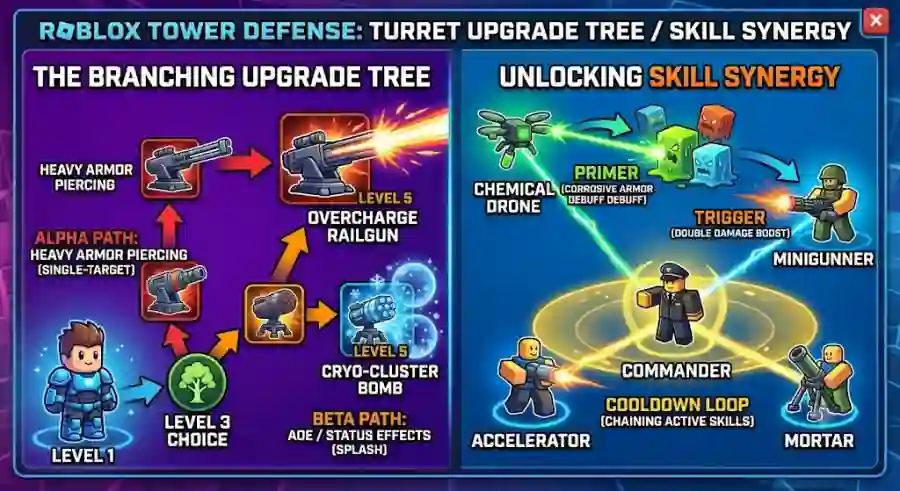
Instead of following one fixed path, towers often split into specialized upgrade directions around Level 3 or Level 4.
These paths usually create different strategic roles.
Understanding Tower Upgrade Paths
Path A: Alpha or Top Path — Maximum Single Target Damage
The Alpha path usually focuses on destroying powerful enemies.
Common features include:
- Higher single-target damage
- Armor penetration
- Stronger boss damage
- Improved attack power
- Heavy weapon upgrades
However, this path often sacrifices speed or crowd control.
A tower following this route may destroy a massive boss but struggle against hundreds of smaller enemies.
Example:
Level 5: Railgun Overcharge
A final upgrade focused on extremely high damage output against strong targets.
Path B: Beta or Bottom Path — Crowd Control and Status Effects
The Beta path focuses on controlling large groups of enemies.
Common upgrades include:
- Area-of-effect damage
- Faster attack speed
- Burning effects
- Freezing abilities
- Slowing effects
- Damage-over-time abilities
This path is excellent against swarm waves but may struggle against enemies with huge health pools.
Example:
Level 5: Cryo-Cluster Bomb
A powerful upgrade designed to slow and damage multiple enemies at once.
Why Upgrade Decisions Matter
Branching upgrade systems create real-time decision-making.
A player who immediately invests all resources into a heavy single-target tower might dominate early bosses but become overwhelmed by large enemy waves.
On the other hand, a player who builds only area damage towers may easily clear normal enemies but fail when a powerful boss appears.
The best players understand balance.
They know when to:
- Continue upgrading one path
- Stop investing in a tower
- Create different roles across multiple units
- Combine different upgrade paths together
This decision-making separates beginner players from experienced endgame competitors.
Decoding Skill Synergy: The Hidden Power Behind Winning Strategies
Having strong towers is no longer enough.
In difficult raids, events, and late-game modes, raw statistics alone cannot guarantee success.
A maximum-level Railgun tower might deal 1,000 damage per second. That sounds powerful, but against an endgame boss with millions of effective health points, that damage may not be enough.
This is where skill synergy becomes important.
Skill synergy refers to the mathematical relationship between different tower abilities, player skills, and enemy effects.
A beginner thinks:
Tower A + Tower B = More Damage
Experienced players understand:
Tower A + Tower B + Correct Timing = Massive Damage Increase
The difference is that good combinations multiply effectiveness rather than simply adding numbers together.
Instead of:
1 + 1 = 2
Strong synergy creates:
1 × 1 = 5
This concept defines much of the current Roblox TD meta.
Three Powerful Skill Synergy Types Dominating Roblox TD
1. Primer and Trigger Combo: The Power of Status Stacking
The Primer and Trigger strategy is one of the most common and effective combinations used by advanced players.
The idea is simple:
One tower creates a weakness.
Another tower exploits that weakness.
The first tower acts as the Primer.
The second tower becomes the Trigger.
For example:
A Pyromancer or Chemical Drone may apply a Corrosive Armor effect that reduces enemy damage resistance by 40%.
Once the enemy becomes vulnerable, a high-speed damage tower like a Minigunner or Accelerator attacks the weakened target.
Because the enemy’s armor has been reduced, every bullet deals much higher effective damage.
The result?
Players can nearly double their real DPS without placing an additional damage tower.
This strategy proves that smart combinations often outperform simply adding more units.
2. Aura Chaining and Cooldown Loops: Creating Permanent Power Boosts
Support towers were once considered secondary units in Roblox Tower Defense games. Many players viewed them as simple money generators or basic range boosters that existed only to help stronger damage towers.
That mindset has changed.
In modern Roblox TD games, support units have become some of the most important parts of a successful strategy. Their active abilities, cooldown management, and team-wide bonuses can completely transform a match.
Many advanced players build entire strategies around keeping support abilities active as often as possible.
A great example is the Commander-style support system.
A Commander-type tower may provide an active ability similar to a "Call to Arms" effect, increasing attack speed for nearby towers. Instead of activating this ability randomly, experienced players create carefully timed cooldown loops.
The goal is simple:
Keep powerful buffs active almost permanently.
When players combine multiple support systems, the results become extremely powerful.
For example:
- A Commander ability increases firing speed.
- A DJ or Audio-style tower increases range.
- A skill-tree upgrade reduces ability cooldowns by 15%.
Together, these effects create an almost permanent overcharged state where main damage towers operate far beyond their normal limits.
This strategy shows why support towers are no longer optional. In difficult raids and leaderboard events, the right support combination can provide more value than another damage unit.
3. Pathfinding Manipulation: Turning Enemy Movement Into Your Advantage
Damage numbers are important, but damage means nothing if enemies move too quickly for your towers to hit them.
This is where crowd control synergy becomes one of the most powerful strategies in Roblox Tower Defense.
Experienced players understand that controlling enemy movement can be just as valuable as increasing damage.
The goal is not only to attack enemies.
The goal is to control:
- Where enemies move
- How fast they move
- How long they remain inside attack zones
A perfect example is combining different upgrade paths that serve opposite purposes.
Imagine combining:
- A Branch B Freeze Tower that reduces enemy movement speed by 60%
- A Branch A Mortar or Swarmer tower that relies on slow, heavy splash attacks
The freeze effect keeps enemies trapped inside the attack area, giving delayed projectiles enough time to land accurately.
Without crowd control, powerful attacks may miss fast-moving enemies.
With proper synergy, dangerous bosses become predictable targets.
This strategy is especially useful during:
- Hardcore modes
- Event challenges
- Boss waves
- High-level raids
The strongest players do not simply increase damage.
They create situations where every attack has maximum impact.
How to Build the Ultimate Synergistic Roblox TD Loadout
Many beginner players make one common mistake:
They fill every loadout slot with damage towers.
While having powerful attackers sounds smart, a team without balance often struggles during difficult matches.
A successful endgame loadout needs different roles working together.
A complete five-slot strategy usually includes:
1. Early-Game Carry: The Foundation Unit
Purpose:
Provide cheap and reliable defense during the opening waves.
The first 10 waves are extremely important because they determine your economy and future upgrade options.
The ideal early-game tower should have:
- Low placement cost
- Fast attack speed
- Efficient damage output
Recommended upgrade focus:
Branch B / Fast Attack Path
These towers help players survive early pressure while saving money for stronger units later.
A strong early-game carry prevents unnecessary spending and creates a smooth transition into late-game strategy.
2. Economy Unit: The Money Generator
Purpose:
Create income that supports expensive upgrades.
Many players underestimate economy towers because they do not directly damage enemies.
However, strong economies create stronger late-game positions.
An economy-focused tower allows players to:
- Upgrade faster
- Purchase expensive final upgrades
- Recover after difficult waves
Recommended upgrade focus:
Economy or Cash-per-Wave Path
A small financial advantage early in the game can become a massive advantage later.
3. Primer or Debuffer: The Enemy Weakener
Purpose:
Reduce enemy strength and increase team damage.
Debuff towers are the backbone of many professional strategies.
They provide effects such as:
- Armor reduction
- Burning
- Slowing
- Stunning
- Damage vulnerability
Recommended upgrade focus:
Area Effect / Status Duration Path
A longer-lasting debuff means damage towers get more time to destroy enemies.
4. Support Buffer: The Team Accelerator
Purpose:
Improve the performance of every nearby tower.
Support towers are force multipliers.
They can provide:
- Increased attack speed
- Larger range
- Lower upgrade costs
- Reduced cooldowns
Recommended upgrade focus:
Aura Radius and Active Ability Path
A strong support player can improve the entire team’s performance.
5. Boss Shredder: The Endgame Destroyer
Purpose:
Eliminate high-health enemies.
Every serious loadout needs a tower designed specifically for bosses.
These towers usually focus on:
- Massive single-target damage
- Armor penetration
- High critical damage
- Long-range attacks
Recommended upgrade focus:
Branch A / Heavy Damage Path
This unit becomes the final weapon against nightmare bosses with millions of health points.
Player Skill Trees: The Hidden Meta Behind Roblox Tower Defense
Tower upgrades are only one part of modern Roblox TD strategy.
Many newer games now include account-wide skill trees that permanently improve a player's entire collection.
These systems are often unlocked through:
- Match coins
- Gems
- Account levels
- Progression rewards
Unlike normal tower upgrades, player skill trees provide permanent bonuses that affect every match.
A typical skill tree contains three major categories:
Offensive Skill Tree
Focused on increasing direct combat power.
Common upgrades include:
- Increased turret damage percentage
- Higher critical hit chance
- Stronger attack abilities
This path is ideal for players who prefer aggressive strategies.
Economic Skill Tree
Focused on improving resource management.
Common upgrades include:
- Lower tower placement costs
- Higher wave income
- Faster economy growth
This path is extremely valuable for players who prefer solo gameplay.
Tactical Skill Tree
Focused on strategic advantages.
Common upgrades include:
- Reduced ability cooldowns
- Longer status effects
- Better support performance
This path is highly effective for team-based matches.
How to Choose the Right Skill Tree
One of the biggest mistakes new players make is spreading skill points equally across every category.
While balanced upgrades may seem safe, specialization usually creates stronger results.
The best choice depends on your playstyle.
Solo Players: Focus on Economy
Players who regularly play alone should prioritize the Economic Tree.
A small advantage at the beginning of a match can create a powerful snowball effect.
For example:
A 5% discount on early tower placement may allow you to place an income-generating tower one wave earlier.
That earlier investment creates:
- More money
- Faster upgrades
- Stronger late-game defenses
Small advantages become huge over time.
Squad Players: Focus on Tactical Support
Players who regularly join teams should invest in Tactical or Support-focused upgrades.
Why?
Because team benefits multiply across all players.
Increasing:
- Debuff duration
- Support range
- Ability effectiveness
can improve the performance of every teammate on the map.
A skilled support player may not always have the highest damage numbers, but they can become the most valuable person in the match.
Industry Impact: Why Roblox Tower Defense Became More Strategic
The evolution of Roblox Tower Defense reflects a larger trend across the gaming industry.
Modern players expect deeper progression systems, more customization, and meaningful choices.
Games are moving away from simple upgrade systems and introducing:
- Branching builds
- Strategic customization
- Team-based mechanics
- Long-term progression
- Competitive optimization
Roblox TD games now share similarities with traditional strategy games, RPG systems, and competitive multiplayer experiences.
Players are not only collecting towers anymore.
They are creating unique strategies.
Why Skill Synergy Matters More Than Rare Towers
A common misconception among Roblox players is that owning the rarest or most expensive tower automatically guarantees victory.
That is rarely true.
A powerful tower placed incorrectly can perform worse than a cheaper tower used with the right strategy.
Endgame success depends on:
- Smart placement
- Upgrade timing
- Team composition
- Ability management
- Enemy understanding
The strongest players are not simply collecting powerful units.
They are mastering how those units work together.