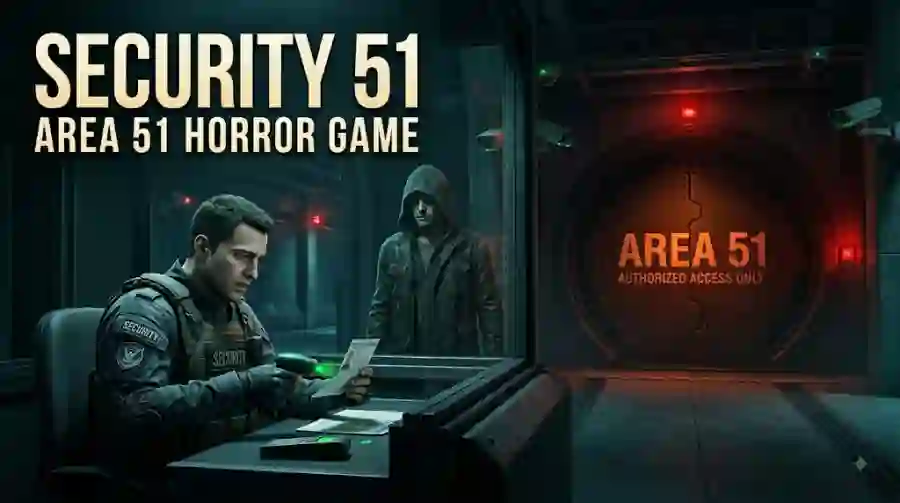
This New Psychological Horror Simulator Turns You Into an Area 51 Security Officer Where One Wrong Decision Could Let Something Dangerous Through
Security 51 has officially launched on Steam on August 12, 2026, giving PC players a chance to step behind the gates of the infamous secret facility. The game is developed and published by Alawar and combines simulation, adventure and horror elements.
At first, the job sounds simple.
Check someone's documents.
Verify their clearance.
Decide whether they can enter.
But things quickly become much more complicated when you realize that not everyone standing in front of you is necessarily human.
That simple idea is what makes Security 51 one of the more unusual horror games arriving this week.
Security 51 Is Out Now
The official Steam listing confirms that Security 51 released on August 12, 2026 for PC.
The game is currently available through Steam, with an introductory launch discount listed on the store page.
Security 51 falls into several categories, including:
- Adventure
- Indie
- Simulation
- Psychological horror
- Inspection-based gameplay
Unlike traditional horror games where players spend most of their time running from monsters, Security 51 puts the player behind a security desk.
Your decisions are the main mechanic.
What Is Security 51?
Security 51 is a checkpoint security simulation with a horror twist.
You play as a security officer stationed deep inside Area 51.
Your responsibility is to inspect employees and visitors before allowing them deeper into the facility.
That means checking things such as:
- Identification
- Documents
- Security clearance
- Appearance
- Behavior
- Suspicious details
- Possible anomalies
The official Steam description makes the central mystery clear: as you go deeper into the facility, it becomes increasingly difficult to know whether the person standing in front of you is actually human.
That creates a very different kind of horror.
You aren't simply fighting monsters.
You are trying to recognize them before they get inside.
Security 51 Gameplay Explained
The core gameplay loop appears straightforward.
A person arrives at the checkpoint.
You inspect their information.
You compare their credentials with what the facility expects.
Then you make a decision.
Allow them through or stop them.
The challenge comes from identifying inconsistencies.
A small mistake could have consequences later.
This makes Security 51 feel closer to an interactive inspection game than a traditional first-person survival horror title.
The horror comes from uncertainty.
You never know when an ordinary-looking visitor could be hiding something much worse.
Why Area 51 Makes the Perfect Horror Setting
Area 51 has been surrounded by conspiracy theories and UFO stories for decades.
That makes it an obvious setting for a game built around secrecy and paranoia.
Security 51 takes that familiar concept and puts the player inside the facility rather than simply telling a story about aliens from the outside.
The deeper you go, the stranger the situation becomes.
Instead of asking:
“Are aliens real?”
the game effectively asks:
“Can you tell who is human?”
That small change makes the premise much more interesting.
The Game Is Inspired by Inspection-Based Horror
Players who enjoy games where seemingly ordinary tasks become increasingly disturbing may find Security 51 particularly interesting.
The basic job resembles a normal security checkpoint.
But the environment gradually introduces supernatural and unexplained elements.
This creates a tension between routine and horror.
At the beginning, you might concentrate on checking paperwork.
Later, you may start questioning whether the person you're looking at is even real.
That gradual escalation is one of the game's strongest ideas.
What Happens When You Make a Mistake?
Security 51 is built around decision-making.
Every visitor represents a potential problem.
If you allow the wrong person inside, the consequences can affect what happens later.
This means players have to pay attention rather than simply clicking through every interaction.
The game rewards careful observation.
You need to notice details that might otherwise seem insignificant.
That could include inconsistencies in documentation, unusual behavior or other clues suggesting that something isn't right.
Security 51 Is More Than an Alien Horror Game
It would be easy to describe Security 51 simply as an Area 51 alien game.
But that doesn't really capture its gameplay.
The stronger comparison is a security-checkpoint simulator mixed with psychological horror.
The simulation element gives you a repetitive job.
The horror elements gradually make that job uncomfortable.
And the mystery gives you a reason to continue.
That combination creates a gameplay structure that is very different from games built around constant combat.
You Don't Know Who You Can Trust
Trust is one of the biggest themes in Security 51.
Every person entering the facility could be completely normal.
Or they could be something else.
The game therefore encourages players to question what they're seeing.
A friendly-looking employee isn't automatically safe.
A suspicious-looking visitor isn't necessarily dangerous.
That uncertainty forces you to make decisions based on evidence rather than assumptions.
Security 51 Release Date and Platform
Security 51 officially released on:
August 12, 2026
The confirmed platform is:
PC via Steam
The Steam page lists Alawar as both the developer and publisher.
At launch, the game is being offered with an introductory discount, with the Steam listing showing a regular price of $9.99 and a temporary 10% launch discount.
Regional pricing can vary.
Is There a Security 51 Demo?
Yes.
A Security 51 demo was released on Steam before the full game's launch.
The demo gives players an opportunity to experience the checkpoint concept and investigate the Area 51 facility before purchasing the full game.
That is especially useful for this type of game because its appeal depends heavily on whether you enjoy inspection-based gameplay.
If you like slowly building tension instead of constantly fighting enemies, the demo can help you decide whether the full experience is worth playing.
Security 51 vs Traditional Horror Games
Security 51 takes a different approach from games such as traditional survival horror titles.
| Feature | Security 51 |
|---|---|
| Main gameplay | Inspection and decision-making |
| Setting | Area 51 |
| Genre | Horror simulation |
| Combat focus | Not the main attraction |
| Main challenge | Identifying suspicious visitors |
| Perspective | Security checkpoint experience |
| Platform | PC |
| Release | August 12, 2026 |
The important difference is that the player is responsible for preventing danger rather than simply escaping it.
Why Security 51 Could Become a Viral Horror Game
There is a simple reason games with this type of gameplay can attract attention online.
They create moments that are easy to share.
Imagine recording a playthrough where everything appears normal, you approve a visitor, and then something completely unexpected happens inside the facility.
That creates natural content for:
- YouTube
- Twitch
- TikTok
- Gaming Shorts
- Horror reaction videos
The combination of Area 51 and decision-based gameplay also gives the game an immediately understandable premise.
You don't need a complicated explanation to understand what you're supposed to do.
Security 51 Has a Strong “Papers, Please” Hook
One of the easiest ways to explain Security 51 is to imagine an inspection-based game placed inside Area 51.
The comparison isn't about copying another game's story or mechanics.
It's about the basic appeal of making document checking and decision-making the center of gameplay.
Security 51 then adds supernatural paranoia to that formula.
Instead of worrying only about whether someone's paperwork is correct, you have to wonder whether the person themselves is legitimate.
That makes every interaction more stressful.
What Makes the Horror Effective?
The strongest horror games don't always need to show monsters constantly.
Sometimes the fear comes from waiting for something to happen.
Security 51 uses that idea.
You may spend several minutes performing ordinary security checks before noticing something strange.
That normality makes the unusual moments more effective.
The player starts becoming suspicious of everything.
And once that happens, even a completely ordinary visitor can feel threatening.
Is Security 51 Worth Playing?
If you enjoy psychological horror, simulation games, mystery games and unusual indie concepts, Security 51 is worth checking out.
Its low launch price also makes it an accessible experiment for PC players.
However, players looking for a combat-heavy horror game should understand what they're getting into.
The central gameplay isn't about collecting weapons and fighting monsters.
It's about observing, checking and making decisions.
That will either be the game's biggest strength or its biggest limitation depending on what type of horror you enjoy.
Security 51 is now available on Steam, giving PC gamers a new horror experience set inside the mysterious world of Area 51.
Its biggest idea is simple but effective: you're a security officer responsible for deciding who can enter a secret facility.
The problem is that some of the people you're checking may not be human.
That transforms an ordinary security job into a psychological horror experience where observation and decision-making matter more than traditional combat.
With its Area 51 setting, inspection mechanics, supernatural mystery and relatively low launch price, Security 51 is one of the more unusual indie games arriving this week.
If you enjoy horror games that make you question what you're seeing rather than simply throwing enemies at you, Security 51 deserves a spot on your Steam wishlist—or your current download list.
FAQ
When did Security 51 release?
Security 51 released on August 12, 2026.
What platforms is Security 51 available on?
The game is currently available on PC through Steam.
What is Security 51 about?
You play as an Area 51 security officer who must inspect visitors, verify their clearance and determine whether they should be allowed into the facility.