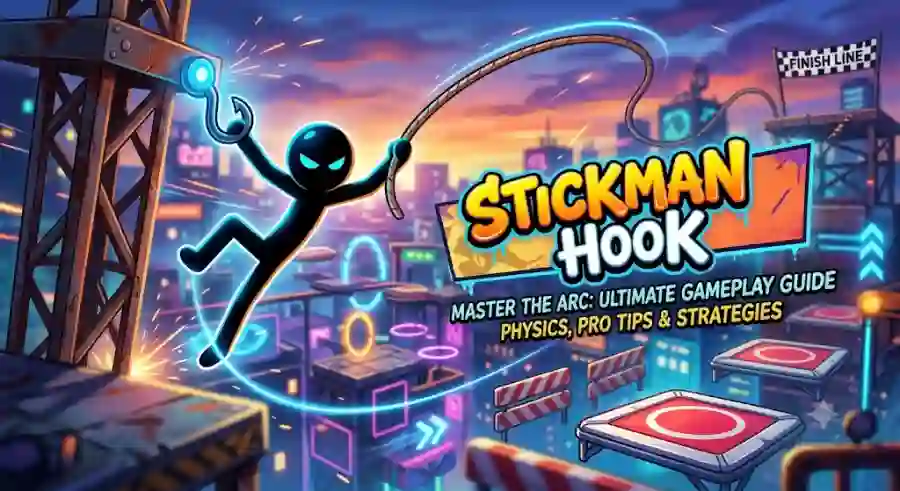
How to Control Momentum, Perfect Your Hook Timing, Unlock Skins and Become a Stickman Hook Master
Behind the minimal design is a carefully balanced physics system where every movement matters. A single mistake in timing can send your stickman crashing into walls, falling into endless gaps, or losing the momentum needed to complete the level. On the other hand, one perfectly timed release can create a smooth, powerful swing that launches your character across the entire stage.
What Is Stickman Hook?
Developed by MadBox, Stickman Hook is an arcade-style physics game built around movement, timing, and momentum. Instead of controlling a character who walks or runs, players control an acrobatic stickman who travels through obstacle-filled courses using a grappling hook.
The main objective is simple:
Reach the finish line at the end of each level without falling or hitting dangerous obstacles.
However, reaching that goal requires much more than simply attaching your hook to every available point.
The entire gameplay experience depends on understanding movement physics. Players must decide when to attach the hook, when to release it, and how to use environmental objects like trampolines to gain maximum speed.
Every level becomes a small physics puzzle where players experiment with timing, angles, and momentum.
The game’s biggest strength is that anyone can understand the controls instantly, but mastering the perfect swing requires patience and practice.
Main Highlights of Stickman Hook Gameplay
Grapple Points: The Foundation of Movement
The most important objects in Stickman Hook are the grapple points.
These fixed points appear throughout each level and allow your stickman to attach an elastic rope. Once connected, your character begins swinging around that point like a pendulum.
Players must carefully judge:
- When to attach the rope
- How long to stay connected
- The best moment to release
- The direction of the next movement
A poorly timed hook can completely destroy your momentum, while a perfectly timed release can create a powerful launch.
Momentum and Gravity: The Heart of the Game
The real engine behind Stickman Hook is momentum.
Your character’s movement is controlled by a combination of:
- Gravity
- Swing speed
- Release timing
- Entry angle
- Environmental objects
Every swing follows natural physics rules. When your stickman moves downward, gravity increases speed. When you release at the correct moment, that stored energy transforms into forward movement.
Understanding this relationship between gravity and momentum is what separates casual players from skilled ones.
Trampolines and Bouncers: Hidden Speed Boosters
Many levels include red and white trampoline-style surfaces placed on walls or floors.
At first, new players often see these objects as emergency tools used only when they miss a grapple point. However, experienced players understand that trampolines are often part of the intended route.
A well-timed bounce can:
- Increase your speed
- Change your direction
- Help you skip difficult sections
- Carry you across large gaps
Sometimes the fastest path is not through the grapple points but through a carefully planned bounce.
The Finish Line: The Ultimate Goal
Every Stickman Hook level ends with a checkered finish area.
Reaching this point activates victory and allows players to continue progressing through the game’s many stages.
Although the goal remains the same throughout the game, the challenge increases as levels introduce:
- Smaller spaces
- More complex layouts
- Difficult angles
- Additional obstacles
The later stages require much stronger control over movement and timing.
The Secret Behind Stickman Hook’s Popularity: Simple Controls, Advanced Physics
The biggest reason Stickman Hook feels so satisfying is its balance between simplicity and depth.
The controls are extremely easy:
- Tap or click to connect the hook
- Release to let go
- Use physics to control movement
Anyone can perform these actions within seconds.
However, becoming good at the game requires understanding the hidden mechanics behind every swing.
When your hook connects to a point, your character immediately enters a pendulum-like movement pattern. The swing direction depends on several factors, including your speed before attachment and the angle of your approach.
The most important skill is learning when to release.
A player who releases too early may not travel far enough. A player who releases too late may lose momentum or swing backward.
The perfect release point usually happens when the character reaches the upward part of the swing arc. At this moment, the stored energy creates maximum forward movement.
This mechanic creates the same satisfying feeling found in other physics-based games where simple controls create surprisingly deep gameplay.
Games such as Flappy Bird and Angry Birds became popular because players could immediately understand them while still needing skill and precision to master them.
Stickman Hook follows the same philosophy.
The game proves that a simple idea, when supported by polished physics and responsive controls, can create an unforgettable gaming experience.
Understanding the Swing Arc: The Core Skill Every Player Needs
To consistently complete challenging Stickman Hook levels, players must develop a strong understanding of swing arcs.
The movement of your character is not random. Every swing follows predictable physical behavior.
Learning these patterns allows players to control speed, distance, and direction more effectively.
1. The Pendulum Effect
When your rope attaches to a grapple point, your stickman swings around that point like a traditional pendulum.
Gravity pulls your character downward while the rope keeps the connection stable.
During this movement:
- Speed increases while falling
- Direction changes naturally through the arc
- Momentum builds before release
Holding the hook for too long can create problems. Your character may complete a full loop, lose forward speed, or begin moving in the wrong direction.
Successful players understand that the hook is not meant to stay attached forever.
It is a temporary tool designed to create the perfect launch.
2. Upward Release Timing
The timing of your release is one of the most important mechanics in Stickman Hook.
The ideal moment usually happens when your stickman passes the lowest point of the swing and begins moving upward toward the target area.
At this point:
- Gravity has increased your speed
- The swing has generated maximum momentum
- Releasing converts that energy into forward movement
This technique allows players to clear larger gaps and reach distant platforms more easily.
Advanced Stickman Hook Strategies to Clear Difficult Levels
As players move deeper into Stickman Hook, the game gradually transforms from a simple swinging experience into a serious test of timing, prediction, and movement control.
Early levels allow players to succeed through basic reactions, but advanced stages demand a better understanding of physics. The placement of grapple points becomes more challenging, spaces become tighter, and mistakes become more costly.
To overcome these obstacles, players need more than quick taps. They need smart strategies.
Below are some expert techniques that can help you complete even the most difficult Stickman Hook levels.
Build Momentum Before Making Your First Move
One of the biggest mistakes beginners make is attaching to the first grapple point immediately after starting a level.
While this may seem like the safest option, it often limits your speed.
A better approach is to study your starting position and allow your stickman to fall slightly before connecting the hook.
This small delay creates a stronger swing angle and gives your character additional momentum.
The opening seconds of a level are extremely important because they determine the speed of your entire run.
A player who starts with strong momentum usually has more control throughout the rest of the course.
Professional players often focus on creating the best possible first swing because it can make the difference between a smooth completion and a failed attempt.
Avoid Over-Hooking: Less Can Be More
A common beginner habit is constantly using the hook whenever a grapple point appears.
Many players believe more hooks mean more control, but this approach often creates the opposite effect.
Using too many hooks can interrupt your natural movement and reduce your speed.
Sometimes the best strategy is to ignore certain grapple points completely.
By skipping unnecessary hooks, your character can maintain a cleaner movement path and carry more momentum through the air.
Experienced players carefully choose which grapple points actually improve their trajectory instead of automatically connecting to every available option.
The goal is not to use more hooks.
The goal is to use the right hooks at the right time.
Master the Short-Swing Technique
Large swinging movements are useful when crossing wide open areas, but they can become dangerous in narrow sections.
Tight corridors, small spaces, and vertical areas require a different approach.
This is where the short-swing technique becomes valuable.
Short swinging involves:
- Quickly attaching to a grapple point
- Immediately releasing the rope
- Creating a small but controlled movement boost
Instead of creating a huge pendulum motion, this technique produces short bursts of speed and direction control.
It allows players to:
- Avoid hitting ceilings
- Navigate narrow spaces
- Adjust position quickly
- Maintain better control
Mastering short swings is one of the biggest differences between casual players and advanced Stickman Hook users.
Use Trampolines as an Offensive Strategy
Many players misunderstand trampoline pads.
They see them as backup options when something goes wrong.
However, in many levels, trampolines are actually the fastest route available.
These bounce surfaces can launch your stickman much farther than a normal swing if used correctly.
The key is understanding the angle of impact.
A high-speed collision with a trampoline can create a powerful launch that sends your character across huge distances.
Instead of avoiding these objects, skilled players actively search for opportunities to use them.
A successful trampoline strategy requires:
- Approaching with enough speed
- Hitting the correct angle
- Predicting the bounce direction
- Combining the bounce with future hooks
When mastered, trampoline movement can completely change how you approach levels.
Customization and Skins: Adding Personality to the Experience
While Stickman Hook’s physics system is the main reason players stay engaged, customization adds another layer of enjoyment.
As players complete levels, achieve milestones, and progress through the game, they can unlock different character skins.
These cosmetic rewards allow players to personalize their stickman and make their gameplay experience feel unique.
The available skins include different styles such as:
- Funny animal characters
- Superhero-inspired designs
- Colorful costumes
- Creative and unusual character variations
These skins do not change gameplay performance.
They do not increase speed, improve jumping ability, or modify physics.
Instead, they provide visual variety and create an additional reward system that encourages players to continue progressing.
Ways to Unlock Stickman Hook Skins
Level Progression Rewards
One of the easiest ways to unlock new skins is simply by continuing to play.
As players complete certain numbers of levels, the game automatically rewards them with exclusive character designs.
This encourages consistent progression and gives players something new to look forward to.
Daily Challenges
Daily challenges provide another opportunity to earn special cosmetic rewards.
By completing specific tasks, players can unlock themed skins and additional customization options.
These challenges add variety because they encourage players to experience different parts of the game instead of repeating the same style of play.
Bonus Achievements
Special milestones can also unlock unique cosmetic items.
These achievements reward players for reaching important goals and provide extra motivation beyond simply finishing levels.
For completion-focused players, collecting every available skin becomes an enjoyable secondary challenge.
Why Stickman Hook Remains a Favorite in Casual Gaming
The mobile gaming industry is filled with thousands of new releases every year. Many games compete through complicated systems, expensive graphics, and aggressive monetization strategies.
However, Stickman Hook succeeds because it focuses on something much simpler:
Pure gameplay satisfaction.
The game removes unnecessary complexity and delivers immediate fun from the first interaction.
Players do not need to spend hours learning complicated controls or reading instructions.
They can start playing instantly.
This simplicity has helped Stickman Hook maintain popularity among casual gamers who want quick entertainment without a major time commitment.
Key Reasons Behind Stickman Hook’s Success
Instant Accessibility
One of the strongest features of Stickman Hook is how quickly new players understand the concept.
Within seconds, anyone can learn:
- How to attach the hook
- How to release it
- How to reach the finish line
The game welcomes beginners while still offering enough depth for experienced players.
A Surprisingly Deep Skill System
Although the controls appear simple, mastering the perfect swing requires real skill.
Players must understand:
- Timing
- Momentum
- Angles
- Gravity
- Speed control
This creates a high skill ceiling where advanced players can improve continuously.
The difference between a beginner and an expert is not the controls they use, but how well they understand the physics behind them.
Perfect for Short Gaming Sessions
Modern players often prefer games that fit into busy schedules.
Stickman Hook is designed perfectly for quick sessions.
Most levels can be completed within approximately:
5 to 30 seconds
This makes it ideal for:
- Short breaks
- Travel time
- Waiting periods
- Quick entertainment moments
Despite the short level design, the replay value remains high because players constantly try to improve their performance.
Smooth Animation and Satisfying Physics
The visual experience is another major strength.
The game’s smooth animations make every movement enjoyable.
Whether your stickman:
- Successfully launches through the air
- Bounces from a trampoline
- Misses a hook
- Crashes into an obstacle
The physics-based reactions feel entertaining and natural.
The ragdoll-style movement adds personality and makes failure feel less frustrating.
Industry Impact: Why Simple Physics Games Still Matter
Stickman Hook represents an important trend in modern gaming: the return of simple but highly polished gameplay.
While large-budget games continue to focus on advanced graphics and complex systems, casual physics games prove that strong mechanics can create long-term engagement.
The success of games like Stickman Hook shows that players still value:
- Easy-to-learn gameplay
- Instant rewards
- Skill-based improvement
- Replayability
- Creative challenges
The game follows a design philosophy where the quality of interaction matters more than visual complexity.
This approach continues to influence mobile game developers who focus on creating experiences that are accessible but meaningful.
Why Stickman Hook Matters for Modern Gamers
Stickman Hook is more than just a simple arcade game.
It represents how a small idea can become highly engaging when developers focus on the right details.
The game does not rely on complicated stories, massive worlds, or advanced systems.
Instead, it creates excitement through one perfectly designed mechanic:
The feeling of controlling a swinging arc.
Every successful jump feels earned.
Every failed attempt teaches players something new.
Every completed level creates a small but satisfying achievement.
That emotional connection is what keeps players returning.