Microsoft’s New Xbox Feature Could Make Physical Game Libraries Easier to Carry Into the Next Generation
The feature is designed around a simple problem.
Millions of players have built Xbox libraries over many years, but those libraries can contain a mixture of physical discs and digital purchases. As Microsoft moves toward future generations of Xbox hardware and increasingly flexible ways of playing games, physical ownership can become more complicated.
The new system is Microsoft's attempt to make that transition easier.
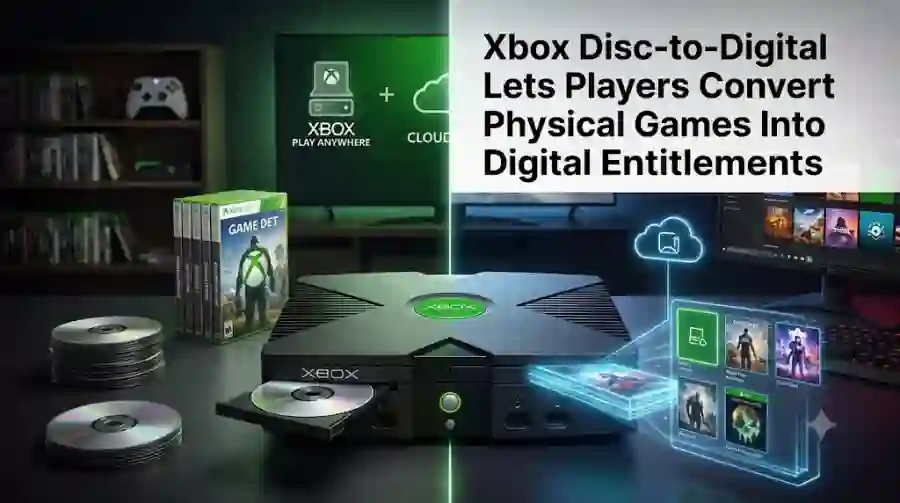
According to Xbox, players will be able to insert a supported Xbox One or Xbox Series X disc into a compatible console and claim a digital entitlement. Once claimed, the game can gain access to digital features such as Xbox Play Anywhere and Xbox Cloud Gaming, where supported.
The program begins testing with Xbox Insiders on August 31, 2026.
What Is Xbox Disc-to-Digital?
Disc-to-Digital is essentially a bridge between physical game ownership and Microsoft's digital Xbox ecosystem.
Normally, owning a game on disc means the disc remains an important part of accessing that copy.
Microsoft's new system allows an eligible physical copy to be associated with a digital entitlement.
The process starts by inserting a supported disc into an Xbox One or Xbox Series X console and launching the game.
Microsoft says that once the entitlement is claimed, players can receive the benefits associated with digital ownership while their physical disc continues to work normally.
That last point is particularly important.
The feature isn't designed to make physical discs obsolete immediately.
Instead, it gives players an additional way to use games they already own.
Thousands of Games Are Expected to Be Supported
Microsoft says the program will begin with thousands of titles.
The company also says that most Xbox One and Xbox Series X disc-based games support the new feature, although not every game will necessarily be available at launch.
That distinction matters.
Players should not assume that inserting every Xbox disc will automatically produce a digital entitlement.
Publishers and individual game availability can affect whether a title participates.
Microsoft plans to expand the supported catalog over time.
This means the program could become substantially more useful as additional games are added.
How the Process Works
The basic process is designed to be straightforward.
A player with an eligible physical game inserts the disc into an Xbox One or Xbox Series X console.
The console recognizes the supported title and allows the player to claim the corresponding digital entitlement.
After that, the digital benefits become available where supported.
The physical disc itself remains usable in the same way it was before.
Microsoft's goal is therefore not to replace the physical copy.
It is to give that physical purchase a digital layer.
Xbox Play Anywhere Could Make the Feature More Valuable
One of the biggest benefits is potential access to Xbox Play Anywhere.
Xbox Play Anywhere allows eligible games to work across supported Xbox consoles and Windows PCs using a single digital purchase.
For a physical-game owner, the new Disc-to-Digital system could therefore make an eligible title more flexible than it was previously.
Instead of treating the disc as a console-only object, players may be able to access the supported digital version across Microsoft's broader ecosystem.
However, Xbox explicitly qualifies this benefit with “where supported.”
That means Play Anywhere support is determined on a game-by-game basis.
Cloud Gaming Is Another Major Benefit
Microsoft also highlights Xbox Cloud Gaming.
Where a converted game supports cloud gaming, players can potentially stream it rather than relying entirely on local installation.
This is an important development for Xbox's broader strategy.
Microsoft has spent years expanding Xbox beyond a single physical console.
Game Pass, cloud gaming, PC support and cross-device libraries have all pushed Xbox toward a more flexible ecosystem.
Disc-to-Digital adds another piece to that strategy.
A physical game purchased years ago can potentially become part of that more flexible digital environment.
Your Physical Disc Still Works
One of the most important details in Microsoft's announcement is that the original disc does not stop working.
Once the digital entitlement has been claimed, Microsoft says the physical disc continues to work exactly as it always has.
This matters for collectors.
Some players prefer physical games because they want to maintain a tangible library.
The new system does not require them to abandon that collection.
Instead, an eligible disc can potentially provide both traditional physical access and additional digital functionality.
That could make the feature especially attractive to players who have accumulated large Xbox libraries.
What Happens If You Sell the Disc?
This is an important area where players should pay attention to Microsoft's wording.
The announcement describes the digital entitlement as being connected to the physical disc.
Xbox says players can claim the entitlement by inserting a supported disc and that the physical disc continues to work normally.
Because the program is still entering Insider testing, players should wait for Microsoft's complete rules around transfers, resale and account behavior before assuming that digitizing a disc creates an independent digital license that can be kept after selling the physical copy.
In other words, Disc-to-Digital should not automatically be interpreted as “convert a disc into a permanently independent digital purchase.”
The official announcement does not establish that interpretation.
This Is About Game Preservation
Microsoft specifically connects Disc-to-Digital with game preservation.
That is arguably the most important part of the announcement.
Games are increasingly dependent on online services, storefronts, compatibility layers and changing hardware.
A physical disc can preserve access to the software, but future hardware may not include a disc drive or may handle physical media differently.
Microsoft says its broader goal is to give players more confidence that the games they buy remain with them for years.
Disc-to-Digital fits directly into that philosophy.
Why the Timing Is Significant
Microsoft's announcement comes at a time when the gaming industry is having a much larger conversation about physical media.
Players are increasingly concerned about what happens to physical libraries when console manufacturers move toward digital distribution.
Xbox's solution takes a different approach from simply abandoning physical games.
Instead, Microsoft is attempting to connect existing physical purchases with its digital ecosystem.
That could become particularly important as the company develops future Xbox hardware.
Could This Help the Next Xbox?
Microsoft has not said that Disc-to-Digital exists specifically because the next Xbox will be digital-only.
That should be treated as speculation.
However, the feature clearly makes physical libraries easier to carry forward into future hardware ecosystems.
If future Xbox hardware changes how physical media works, a system that allows existing discs to receive digital entitlements could reduce friction for longtime players.
That is one reason the announcement has attracted attention beyond the immediate Insider test.
The feature could become a foundation for Xbox's approach to backward compatibility and library preservation.
Not Every Physical Game Will Automatically Work
Players should keep expectations realistic.
Microsoft says most Xbox One and Xbox Series X disc-based games support the feature, but it also says not every title will be available at launch.
There can be several reasons for that.
Games may have licensing limitations.
Publishers may need to participate.
Some older titles may have unusual technical requirements.
Online services can also affect how certain games operate.
Microsoft says it will start with thousands of supported games and continue adding more over time.
That suggests the catalog will evolve.
Xbox Insiders Get First Access
The first testing phase begins on August 31, 2026.
Xbox Insiders will be able to test the feature and provide feedback before the broader rollout.
This means the system is not yet available to every Xbox owner.
The Insider phase will likely allow Microsoft to identify problems with compatibility, licensing and account behavior before expanding the feature.
That is particularly important for a system that potentially affects thousands of games.
What Xbox Players Should Watch During the Test
The Insider rollout will be important because Microsoft's initial announcement leaves several practical questions open.
Players will want to know:
- Exactly which games qualify
- Whether every physical edition is supported
- How account ownership works
- What happens when discs are resold
- How entitlements behave across consoles
- Which games support Play Anywhere
- Which games support Cloud Gaming
- Whether Xbox 360 titles will eventually participate
- How publishers can add or remove support
Microsoft has confirmed the overall concept but has not provided a complete catalog or every rule surrounding the program.
Those details should become clearer as testing expands.
Xbox 360 Games Are Not Confirmed for the Program
Another point worth making is that Microsoft specifically describes the initial system around Xbox One and Xbox Series X disc-based games.
Therefore, players should not assume that Xbox 360 discs will automatically be converted through the same system.
Microsoft has not confirmed that every generation of physical Xbox software will participate in the initial rollout.
Future support could change, but it should not be presented as confirmed.
The Feature Could Become Important for Collectors
Physical game collectors may be among the biggest beneficiaries.
A collector can continue maintaining a physical shelf while potentially gaining access to digital features.
That is particularly useful when a game is playable across multiple Microsoft platforms.
Instead of choosing between physical ownership and digital convenience, Disc-to-Digital attempts to combine the two.
For players with dozens or hundreds of physical Xbox games, that could eventually represent a meaningful improvement.
It Also Fits Microsoft's Broader Xbox Strategy
Disc-to-Digital doesn't exist in isolation.
Microsoft is already connecting Xbox consoles, Windows PCs, cloud gaming and Game Pass through a shared ecosystem.
The company is also increasingly focused on making Xbox games available across different devices.
Disc-to-Digital extends that philosophy to physical purchases.
It says, in effect, that a game bought on a disc should have a path toward the same ecosystem as a game bought digitally, where licensing and technical support allow it.
That is a significant shift in how physical ownership can work.
Confirmed Information
Microsoft has confirmed:
- Xbox Disc-to-Digital is a new feature.
- Xbox Insiders begin testing on August 31, 2026.
- The system initially targets most Xbox One and Xbox Series X disc-based games.
- Players claim the digital entitlement by inserting a supported disc.
- Thousands of titles are expected to be supported initially.
- More titles will be added over time.
- Not every game will be available at launch.
- Supported games can receive digital benefits.
- Xbox Play Anywhere is available where supported.
- Xbox Cloud Gaming is available where supported.
- The physical disc continues to work normally after the entitlement is claimed.
- Microsoft describes the program as part of its broader game-preservation effort.
Rumors and Speculation
Microsoft has not confirmed that the next Xbox will be digital-only.
It has also not confirmed that every Xbox 360 disc will eventually qualify.
The company has not published a complete list of all supported games or finalized every rule surrounding disc resale and entitlement behavior.
Therefore, claims that Disc-to-Digital definitively proves the next Xbox will ship without a disc drive should be treated as speculation.
Why This Could Change Xbox Ownership
The biggest idea behind Disc-to-Digital is not simply convenience.
It is continuity.
Players have spent years building game libraries.
Those libraries contain physical games purchased under different generations of hardware.
Microsoft is now creating a mechanism that can potentially connect those older physical purchases to a modern digital ecosystem.
That could become increasingly important as consoles evolve.
The gaming industry has spent years debating whether physical games or digital games offer better long-term ownership.
Xbox's new approach suggests that the two models do not necessarily have to remain completely separate.
Conclusion
Microsoft's new Xbox Disc-to-Digital feature could become one of the company's most important platform changes for physical game owners.
The system allows players with supported Xbox One and Xbox Series X discs to claim digital entitlements while continuing to use their physical discs normally. Where supported, those digital versions can also provide access to Xbox Play Anywhere and Xbox Cloud Gaming.
The initial rollout is substantial, with Microsoft saying thousands of games will be supported and that more titles will be added over time.
For collectors, the feature could provide a way to preserve physical libraries while gaining digital flexibility.
For Microsoft, it reinforces the idea of Xbox as an ecosystem that stretches across consoles, PC and cloud gaming rather than being tied to one piece of hardware.
The feature enters Xbox Insider testing on August 31.
What happens during that testing period could determine just how powerful Disc-to-Digital becomes.
If Microsoft can build a large supported catalog and make the process simple, it could give physical Xbox owners a much easier way to carry their libraries into the next generation.
Frequently Asked Questions
What is Xbox Disc-to-Digital?
It is a new Xbox feature that allows owners of supported physical Xbox games to claim a digital entitlement by inserting the game disc into a compatible console.
When does Xbox Disc-to-Digital testing begin?
Xbox Insiders can begin testing the feature on August 31, 2026.