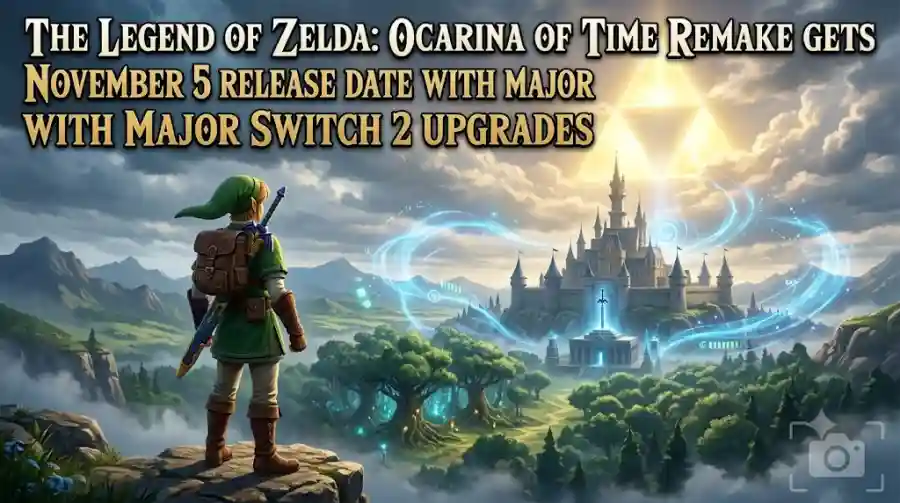
Nintendo Reveals First Gameplay, Modern Controls, Fully Overhauled Visuals and New Zelda Notes Features for Ocarina of Time on Switch 2
The release date was announced during Nintendo's special The Legend of Zelda 40th Anniversary Direct on September 8, alongside the first substantial gameplay footage.
This is more than a simple resolution upgrade.
Nintendo says the game has been rebuilt with completely overhauled visuals, smoother performance, improved camera controls, new movement options, expanded dialogue, voiced cutscenes and symphonic orchestral music.
For fans of the original Nintendo 64 classic, the changes represent a significant modernization while Nintendo says the remake remains a faithful interpretation of the original adventure.
When Does Ocarina of Time Remake Release?
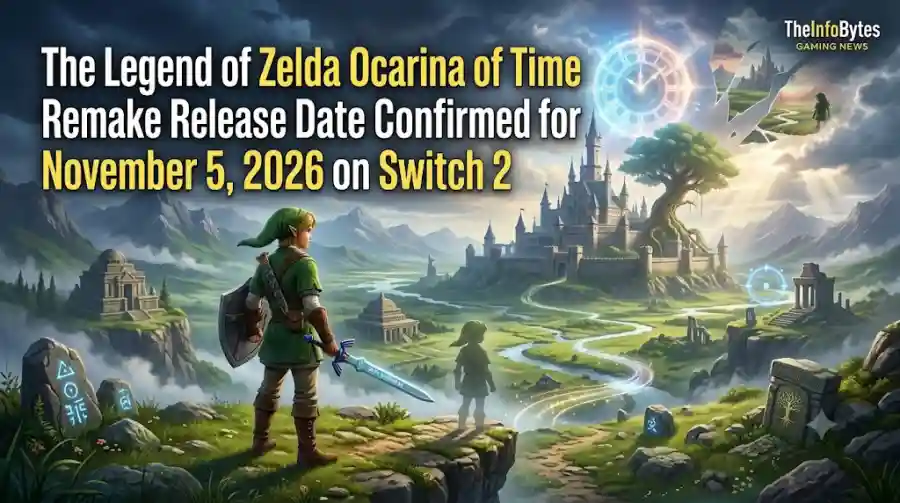
The Legend of Zelda: Ocarina of Time launches November 5, 2026.
The game is being released exclusively for Nintendo Switch 2.
Nintendo's official store listing confirms the November 5 release date and identifies Nintendo as both publisher and the developer behind the Switch 2 version.
The release also arrives just two weeks before Grand Theft Auto VI, which is scheduled for November 19.
That gives Nintendo one of its biggest releases of the year a remarkably prominent position in the November gaming calendar.
The Graphics Have Been Completely Rebuilt
The most immediately noticeable change is the visual presentation.
Nintendo says the remake features completely overhauled visuals, with improvements extending down to material textures.
Hyrule is being presented with substantially more detail than the original Nintendo 64 release.
Characters, environments and locations have been redesigned to take advantage of modern hardware.
The game also runs more smoothly, while load times have been reduced.
Nintendo has refreshed the sound presentation as well, with symphonic orchestral music replacing the limitations of the original hardware.
For a game originally released in 1998, these changes should make the world considerably more accessible to modern players.
Link Can Finally Jump With a Button
One of the most interesting gameplay changes is the addition of a dedicated jump command.
In the original Ocarina of Time, Link's movement was heavily tied to contextual actions and automatic jumps.
The Switch 2 version gives players a button command that allows Link to jump and move more freely.
Nintendo describes the new controls as making actions feel faster and more satisfying.
The remake also adds modern camera movement through the Right Stick, allowing players to control the camera more directly.
This is one of the changes that could have the biggest effect on how the classic adventure feels.
Rather than forcing modern players to adapt completely to 1998-era controls, Nintendo is bringing the basic movement system closer to contemporary action-adventure games.
The Camera Has Been Modernized
Camera control is another major area of improvement.
The original Ocarina of Time helped establish many of the conventions later used by 3D action-adventure games, but its camera system can feel dated to modern players.
The remake introduces more direct camera control.
Players can use the Right Stick to move the camera while exploring Hyrule.
Nintendo has also remodeled locations to make free camera movement more useful.
This means players can look around environments more naturally instead of relying as heavily on the original camera behavior.
For longtime fans, it could make familiar locations feel surprisingly different.
Hyrule Is More Detailed and More Dynamic
Nintendo is not only increasing the resolution of existing environments.
The company says locations have been fully remodeled with additional visual details.
One particularly interesting change involves the day and night cycle.
In the Switch 2 version, the day/night cycle continues even when Link is inside towns.
That should make Hyrule feel more like a continuously functioning world.
The effect may seem small, but it can change how players perceive the game's environments.
Instead of locations feeling like isolated areas that reset when Link enters them, the world should feel more connected.
Expanded Dialogue and Fully Voiced Cutscenes
Another major modernization involves the game's characters.
Nintendo says characters Link meets have expanded dialogue and that cutscenes are fully voiced.
This is a significant departure from the original game.
Ocarina of Time relied heavily on text boxes and sound effects to communicate conversations.
The remake is giving characters considerably more dialogue while adding voice performances to cutscenes.
Nintendo has not suggested that Link himself will suddenly become a fully voiced protagonist.
Instead, the focus appears to be on making the world and its characters more expressive while preserving Link's traditional role as the player's hero.
What Is Threads of Time?
The remake also introduces a new feature called Threads of Time.
This system is designed to help players keep track of their progress during the adventure.
Nintendo describes it as a way to see the progress made in the story and check the player's next objective at any point.
This could be particularly useful for newcomers.
Ocarina of Time was designed in an era when players were expected to remember more information and explore without modern quest-tracking systems.
Threads of Time should provide additional guidance without necessarily turning the game into a heavily automated experience.
Zelda Notes Adds New Ways to Play
Nintendo is also integrating the remake with ZELDA NOTES, a game-specific service available through the Nintendo Switch App.
The feature can help players track their adventure and offers additional activities.
Nintendo says players can use ZELDA NOTES for:
- Adventure progress tracking
- Location-finding challenges
- Hint images
- A virtual ocarina
- Daily quizzes
- More than 2,000 quiz questions
The integration is designed to complement the game rather than replace its normal progression.
The Ocarina Can Use Your Voice
One of the strangest and most interesting features involves the Switch 2's built-in microphone.
Players can hum one of Link's learned ocarina melodies while within range of the console's microphone.
Link will then perform the corresponding song in the game.
Nintendo is also releasing a playable Ocarina of Time ocarina later this year, alongside an electric version from HORI that can play notes or complete songs with the press of a button.
It is an unusual feature, but it fits perfectly with a game whose identity is so closely connected to music.
New Amiibo Are Coming
Nintendo also announced new Young Link and Young Zelda amiibo.
The figures are scheduled for 2027.
According to Nintendo, the new amiibo can unlock special in-game masks that evoke the original game's retro visual style.
That creates an interesting connection between the modern remake and its Nintendo 64 roots.
Players who want the nostalgic look will have an optional way to bring some of that visual identity back into the new version.
What Platforms Is Ocarina of Time Coming To?
The remake is currently confirmed exclusively for:
Nintendo Switch 2
Nintendo's official product page does not list the original Nintendo Switch as a supported platform.
The game supports handheld, TV and tabletop modes on Switch 2.
It is also a single-player game.
Nintendo is therefore treating this as a Switch 2 showcase rather than a cross-generation release.
Why This Remake Matters
Ocarina of Time is one of the most influential games in Nintendo's history.
The original helped establish how 3D action-adventure games could handle exploration, combat, targeting, puzzles and cinematic storytelling.
Bringing it to Switch 2 gives Nintendo an opportunity to introduce that experience to players who never played the original.
At the same time, longtime fans are getting a version that changes many of the mechanical limitations associated with the 1998 release.
The challenge for Nintendo is finding the right balance.
Modernizing the game too aggressively could disappoint fans who want the original experience.
Leaving too many systems untouched could make the game feel dated.
Based on Nintendo's announced features, the company appears to be aiming for a middle ground: preserve the original adventure while rebuilding the presentation and modernizing the controls.
Ocarina of Time vs. the Original
The differences go well beyond graphical improvements.
| Feature | Original Ocarina of Time | Switch 2 Version |
|---|---|---|
| Platform | Nintendo 64 | Nintendo Switch 2 |
| Visuals | Original 1998 graphics | Completely overhauled |
| Camera | Original control system | Right Stick camera |
| Jumping | Contextual | Button-based jumping |
| Cutscenes | Text-focused | Fully voiced |
| Dialogue | Original dialogue | Expanded character dialogue |
| Music | Original soundtrack | Symphonic orchestral music |
| Day/Night | Original behavior | Continues through towns |
| Progress tracking | Traditional exploration | Threads of Time |
| Ocarina interaction | Controller inputs | Additional microphone feature |
| Zelda Notes | Not available | Supported |
Nintendo's goal appears to be creating an experience that feels familiar while removing many of the barriers that could make the 1998 original feel difficult for newcomers.
What Players Should Expect at Launch
Players should expect a primarily single-player adventure centered on the original Ocarina of Time story.
The fundamental journey remains intact.
Link must once again become the Hero of Time and confront Ganondorf's plans for Hyrule.
However, the experience surrounding that story has been modernized.
The improved controls should make exploration more natural.
The upgraded visuals should make familiar locations feel new.
Expanded dialogue should give characters more personality.
Threads of Time should make progression easier to follow.
And ZELDA NOTES adds an optional layer of assistance and activities outside the core adventure.
That combination could make the remake attractive to both longtime Zelda fans and players experiencing Ocarina of Time for the first time.
Release Date, Price and Availability
Nintendo's official store confirms the game releases on November 5, 2026 exclusively for Nintendo Switch 2.
The official Nintendo listing confirms a single-player experience with handheld, TV and tabletop support.
Nintendo's announcement also confirms the broader 40th Anniversary celebration will continue beyond the game itself, including concerts, museum activities and new merchandise.
The Zelda 40th Anniversary Concert series will travel internationally in 2027, with tours planned for Japan, North America, Europe and Australia.
The Legend of Zelda: Ocarina of Time is shaping up to be one of Nintendo Switch 2's most important releases of 2026.
Nintendo is not treating the project as a simple graphical remaster.
The remake introduces modern camera controls, button-based jumping, completely rebuilt visuals, smoother performance, expanded dialogue, voiced cutscenes, orchestral music and the new Threads of Time progression feature.
ZELDA NOTES adds another layer through progress tracking, location challenges, quizzes and microphone-based ocarina interactions.
Most importantly, Nintendo has retained the original adventure at the center of the experience.
That balance could be the remake's biggest strength.
New players can experience one of gaming's most influential adventures with modern conveniences, while longtime Zelda fans can return to Hyrule with a presentation designed for today's hardware.
The Legend of Zelda: Ocarina of Time launches exclusively on Nintendo Switch 2 on November 5, 2026.
With GTA VI arriving only two weeks later, November is already shaping up to be one of the biggest periods of the gaming year.
FAQs
When does the Ocarina of Time remake release?
The Legend of Zelda: Ocarina of Time releases on November 5, 2026.
Is Ocarina of Time coming to the original Nintendo Switch?
Nintendo has confirmed the remake as a Nintendo Switch 2 exclusive.