Brave New Wonders Turns Factory Building Into a Command-Based Strategy Game Where Robots Understand Natural Language
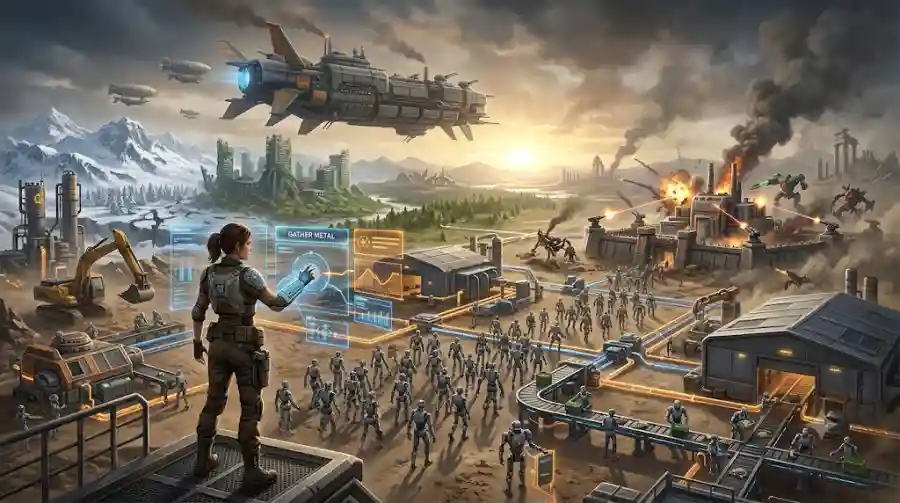
Players must also rebuild a civilization that collapsed thousands of years ago, gather resources, establish factories, explore the ruins of an unknown world, defend their settlements from hostile machines and eventually unlock a massive airship that functions as a mobile fleet of factories.
The result is a combination of factory automation, city building, exploration, resource management, light combat and science-fiction storytelling.
Brave New Wonders Release Date
Brave New Wonders is scheduled to launch on:
September 21, 2026
The full release is coming to:
PC via Steam
The developer is City From Naught Inc., with City From Naught Inc. and LoongGate listed as publishers on Steam.
The developers have been preparing the game through a public demo and playtest, with the team using player feedback to improve the experience ahead of the 1.0 release. The official Steam community announcement confirmed the September 21 launch date.
The Main Idea: Tell Robots What to Do
The biggest feature in Brave New Wonders is its command system.
Players can write instructions for their automatons in plain language.
That means the game does not require players to create every logistics rule through traditional coding.
The official Steam page gives examples such as ordering a robot to move between multiple locations or creating conditional behavior based on a signal.
A command could effectively tell an automaton to:
Move between several locations in a specific order.
Pick up one resource from a factory.
Deliver it to a warehouse.
React when a certain signal appears.
Continue following a set of conditions.
The game then converts the natural-language instruction into a behavior graph that the player can inspect and modify.
That is a very different approach to automation.
You Do Not Need to Write Traditional Code
Brave New Wonders specifically presents itself as a factory builder for players who want automation depth without conventional programming.
The game eliminates much of the need for manually constructing traditional conveyor networks.
Instead, players describe the desired behavior and then refine it through the game's behavior editor.
This does not mean there is no technical complexity.
In reality, players can create increasingly complicated instructions as their factories become larger.
The difference is that complexity is expressed through instructions rather than traditional programming syntax.
That could make advanced automation more accessible to players who enjoy systems and optimization but do not want to learn a programming language.
The AI System Has a Specific Job
There is an important distinction in how the developers describe the game's AI technology.
The visual assets, models, textures, animations, music and story content were not generated by AI, according to the official Steam page.
The AI model is used specifically to parse a player's plain-text command and transform it into a behavior graph for the robot.
That means the technology is functioning as an interface between the player's instructions and the game's automation system.
Players who do not want to use the AI-powered command system are not forced to use it.
The game also allows the behavior graph to be assembled manually.
That gives players two approaches.
They can describe the behavior they want in natural language.
Or they can work directly with the underlying graph.
Factories Replace the Conveyor-Belt Obsession
Brave New Wonders describes itself as an automation game for players who have moved beyond traditional conveyor belts.
The goal is not simply to create one efficient production line.
Players can build multiple connected factories, warehouses and logistics networks across a much larger world.
The production system begins with raw materials.
Players mine resources such as ore and crystals.
Those materials are processed into refined products and increasingly complicated components.
Factories can then pass those resources through larger production chains.
The challenge becomes optimizing the entire network.
Production Chains Can Become Huge
As a player's settlement grows, the production network becomes increasingly complicated.
Different factories can specialize in different resources.
Warehouses can act as storage hubs.
Logistics routes can connect distant parts of the settlement.
Buildings can communicate through colored signals.
That allows players to build automated systems that respond to events rather than simply performing one fixed task.
The system therefore moves beyond simple “mine, process and sell” gameplay.
A factory can become one component inside a larger industrial network.
One production chain can provide resources to another.
A signal can activate a different system.
An automaton can change its behavior depending on what is happening elsewhere in the base.
Blueprints Let Players Expand Faster
Large automation games often create another problem.
Once a perfect production layout has been created, rebuilding the same structure somewhere else can be tedious.
Brave New Wonders addresses this with a blueprint system.
Players can copy and paste large layouts, allowing whole production structures to be duplicated quickly.
The game also preserves the tasks assigned to cloned automatons.
That means a copied factory does not necessarily require every robot to be programmed again from scratch.
This becomes especially useful when players begin expanding across multiple regions.
Instead of rebuilding a successful production system manually, the player can reproduce the underlying structure and then adjust it to the new location.
The World Is Post-Apocalyptic
The factory-building mechanics are set inside a world that collapsed thousands of years ago.
Players take the role of a Pioneer exploring the ruins of a lost civilization.
The game presents these ruins as more than scenery.
They can contain resources, technologies and relics that help the player understand what happened to humanity.
Some ruins are abandoned.
Others are protected by hostile machines.
That means exploration is directly connected to progression.
The player cannot simply remain inside the factory forever.
Eventually, the settlement needs resources and discoveries from the outside world.
Hostile Machines Add Combat
Brave New Wonders is not a peaceful management simulation.
The ruins contain old machines that can attack the player.
Players can construct gun turrets to protect their factories and use dynamite to clear obstacles while expanding into new territory.
The combat system appears to be secondary to factory automation rather than the main focus.
The primary objective remains industrial expansion.
But hostile machines ensure that exploration and territory growth carry some risk.
Players have to defend the production networks they spend so much time building.
Relics Unlock More Than Resources
Exploration can also reward the player with relics.
These artifacts are connected to the mystery of the fallen civilization and can help unlock new technologies.
That creates a useful connection between the game's industrial and narrative systems.
A factory needs new technology.
New technology may require exploration.
Exploration reveals ruins.
Ruins contain relics.
Relics help the player understand the old world and advance the industrial network.
The result is a gameplay loop where exploration supports automation instead of existing separately from it.
The Sky Pillar Unlocks a Mobile Factory
One of the most interesting late-game systems is the Sky Pillar.
Once unlocked, it allows players to construct a massive airship that effectively becomes a floating fleet of factories.
This changes the scale of the game.
Players are no longer limited to developing one stationary settlement.
The industrial network can move with them.
The airship functions as a mobile base capable of supporting exploration across different islands and continents.
That means expansion is no longer only horizontal across one map.
The player can take the factory itself on the road.
Four Major Biomes and Continents
The full game is built around four unique biomes and continents.
The world stretches across different environments, including a snowy European region and other areas containing distinct resources, technological discoveries and environmental challenges.
That structure keeps the game from becoming a single repetitive factory map.
Each new region provides another reason to expand.
Different environments can contain different resources.
Different locations may require different production approaches.
And the player's airship allows them to move their industrial operation between these areas.
Exploration Continues Even After Building a Factory
The game's airship system is particularly important because it changes the relationship between automation and exploration.
In many factory games, exploration exists primarily to find a new resource deposit.
Brave New Wonders makes exploration a larger part of the overall progression.
Players can travel between islands, discover new continents, encounter ruins and search for technological breakthroughs.
The factory is therefore not the end goal.
It becomes the tool that allows further exploration.
Four Biomes Support Different Resources
The developer has designed the world around distinct biomes and resource environments.
That means players cannot necessarily use one production strategy everywhere.
A snowy region may have resources that are not available elsewhere.
Another region may provide materials required for a more advanced technology tree.
The player has to plan where factories should be established and how those resources should be transported.
The larger the industrial network becomes, the more important logistics become.
Civilization Is Being Rebuilt From Nothing
The story premise gives the factory-building system a broader purpose.
The player is not simply trying to become rich.
The objective is to rebuild civilization after humanity's collapse.
The game describes the new era as one in which people remember almost nothing about what came before.
That creates a mystery running alongside the management gameplay.
As the player explores ruins and recovers relics, they can uncover information about what caused the old civilization to disappear.
The factory is effectively the engine of humanity's revival.
Farming Is Also Part of the Simulation
Brave New Wonders is not limited to mining and manufacturing.
The Steam listing includes farming among its gameplay tags, showing that resource production extends beyond industrial materials.
That adds another economic layer.
A growing civilization needs more than factories.
It also needs resources to sustain itself.
The developers have not positioned farming as the game's dominant system, but it helps reinforce the idea that the player is rebuilding a complete settlement rather than operating a single industrial complex.
Your Factories Can Communicate Through Signals
One of the more advanced mechanics is the game's signal network.
Buildings and factories can broadcast colored signals.
Other structures can react to those signals, allowing the player to create automated chains across the settlement.
This adds an additional level of control beyond simple robot instructions.
Imagine one facility detecting that a warehouse has reached a certain state.
That signal can trigger another machine to start a new operation.
The player can therefore build systems that react to changing conditions.
This is where Brave New Wonders starts feeling more like a programming sandbox even though the game is specifically designed to avoid requiring traditional coding.
The Demo Save Carries Into the Full Game
Players who have already been experimenting with the demo receive a useful benefit.
The developer confirmed that demo and playtest save files carry over into the full version at launch.
That means players who have already established a production network do not necessarily have to restart when version 1.0 becomes available.
This makes the demo more useful than a temporary showcase.
Players can effectively begin learning the game's automation system before the full release and continue the same settlement afterward.
The Game Is Single-Player
Brave New Wonders is currently listed as a single-player game.
That means the factory, logistics network and exploration system are designed around one player's decisions.
There is no requirement to coordinate with other human players to keep the production chain running.
For players who enjoy spending hours optimizing systems without the pressure of multiplayer, that structure may fit naturally.
Why the Natural-Language System Matters
The most interesting part of Brave New Wonders is not simply that it uses AI.
It is the design philosophy behind that AI system.
Traditional automation games often reward players for learning the game's machinery.
Brave New Wonders asks players to explain their intended behavior.
Instead of thinking:
“Which combination of conveyor belts gets this material from A to B?”
The player can think:
“I want this robot to collect that material from this location and deliver it there whenever a condition is met.”
That changes the player's relationship with automation.
The system is closer to giving instructions to a workforce than physically constructing every movement path.
It Still Has Room for Manual Control
The developers have not removed the traditional engineering challenge completely.
Players can manually edit the behavior graph created from a natural-language command.
This is useful when the generated behavior is close to what the player wants but still needs refinement.
That hybrid approach is important.
The AI command system can make complicated behavior easier to describe.
The manual graph editor gives experienced players more precise control.
Players can therefore choose how deeply they want to interact with the underlying system.
Brave New Wonders System Requirements
The current Steam listing gives the following PC requirements:
Minimum
OS: Windows 10 64-bit
CPU: Intel Core i5-6400
RAM: 16 GB
GPU: NVIDIA GeForce GTX 1650
DirectX: Version 11
Storage: 27 GB
Network: Broadband Internet connection
Additional requirement: SSD
Recommended
OS: Windows 10/11 64-bit
CPU: Intel Core i7-7700
RAM: 32 GB
GPU: NVIDIA GeForce RTX 2080
DirectX: Version 12
Storage: 30 GB
Network: Broadband Internet connection
Additional requirement: SSD
These specifications come from the current Steam listing.
Brave New Wonders Release Details
| Detail | Information |
|---|---|
| Game | Brave New Wonders |
| Developer | City From Naught Inc. |
| Publisher | City From Naught Inc., LoongGate |
| Release Date | September 21, 2026 |
| Platform | PC via Steam |
| Genre | Factory Automation / Simulation / Strategy |
| Player Mode | Single-player |
| Setting | Post-apocalyptic future |
| Robot System | Plain-language commands |
| AI Use | Command parsing into behavior graphs |
| Major World Feature | Four biomes/continents |
| Late-Game Feature | Sky Pillar airship factory |
| Demo | Available |
| Save Carryover | Yes |
The developer's Steam announcement confirms the September 21 1.0 date, while the Steam store provides the game's feature and system information.
What Players Should Expect at Launch
Brave New Wonders is not trying to be a conventional factory simulator.
Its production systems are designed around intelligent automatons, plain-language instructions, signals and reusable blueprints.
At the same time, the player needs to explore a dangerous post-apocalyptic world to discover resources and relics.
Eventually, the factory grows into a mobile industrial network capable of traveling between continents.
That gives the game three connected goals:
Build
Automate
Explore
The player needs all three to keep progressing.
Brave New Wonders launches on Steam on September 21, 2026, introducing an unusual factory-building formula centered on natural-language robot commands instead of traditional conveyor-belt automation.
The game's biggest technical feature is its command system.
Players can tell automatons what they want them to do in plain language, and the game converts those instructions into behavior graphs.
The important detail is that the AI is being used as a command parser rather than as a content-generation tool. The developer explicitly states that its art, models, animation, music, story and other creative assets were not generated by AI.
Beyond that system, the game offers a much larger simulation.
Players mine resources, construct factories, link logistics networks, create conditional automation systems, defend settlements from hostile machines and explore the remains of a civilization that collapsed thousands of years ago.
The Sky Pillar eventually allows players to create a massive airship that works as a mobile fleet of factories, making it possible to travel between distinct continents without abandoning the industrial infrastructure that has already been built.
The demo and playtest also provide an unusually direct route into the full game because existing saves can carry over to the 1.0 release.
For players who enjoy factory optimization but find conventional conveyor-belt systems too restrictive, Brave New Wonders offers a genuinely different approach.
For players who enjoy strategy and exploration, its post-apocalyptic world provides a reason to expand beyond the factory floor.
And for players curious about practical AI applications inside games, the robot command system offers a clear example of AI being used as an interface between human instructions and game logic.
The final test will be how well that system handles increasingly complicated factories once players start creating truly massive industrial networks.
But on paper, Brave New Wonders is doing something much more interesting than simply adding AI to a factory game.
It is changing how players tell machines what to do.
FAQs
When does Brave New Wonders release?
Brave New Wonders launches on September 21, 2026 on Steam.
What is Brave New Wonders?
It is a single-player factory automation and base-building simulation set in a post-apocalyptic future.