WANE Takes Players Inside a Failing Archaeologist’s Mind With Three-Person Tactical Combat, Roguelite Runs and Relic Trading
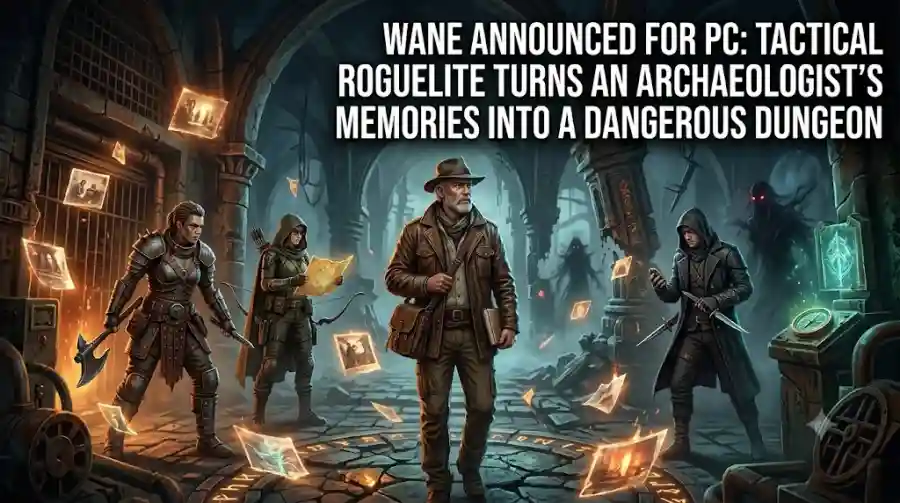
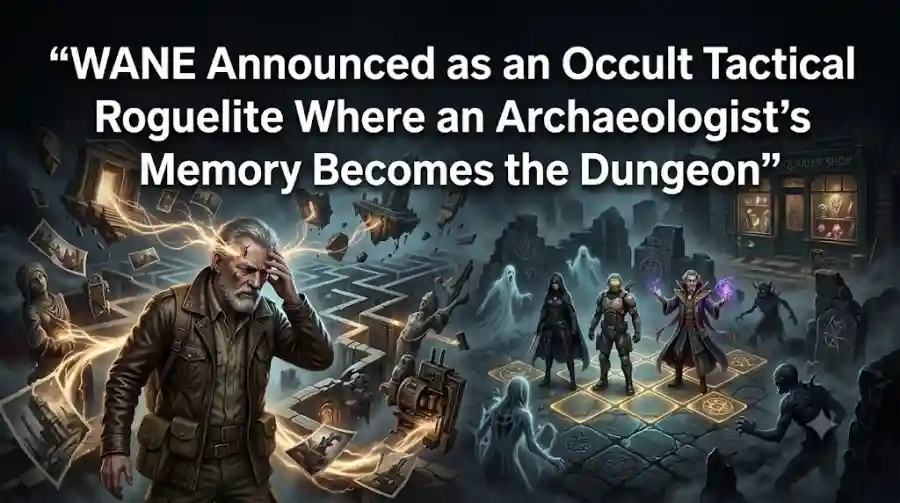
Declan once uncovered the ancient site of Ravelle, a place containing three dead civilizations. His discovery was supposed to become his legacy, but after breaking seals that should never have been disturbed, his mind was left permanently damaged. Years later, he returns to Ravelle looking for a way to recover what remains of himself.
The unusual part is that Ravelle is no longer simply an archaeological site.
It has become a shifting labyrinth shaped by Declan's own memories, regrets, obsessions and trauma.
That turns the protagonist's deteriorating mental state into the game's actual world.
Instead of exploring a conventional dungeon, players are effectively descending into someone's damaged memory.
WANE Was Revealed at PC Gaming Show Tokyo Direct
Metis Creative officially unveiled WANE during the PC Gaming Show Tokyo Direct on September 20, 2026. The reveal introduced the game's industrial-noir setting, its occult themes and its tactical roguelite structure.
The announcement confirms the game for PC via Steam, while a release date has not yet been announced. Steam currently lists the launch date simply as To be announced.
The developers have also confirmed that additional details will be shared later.
For now, the project is still in development, making the first trailer and Steam page the primary sources of information about its systems.
What Is WANE?
WANE is a character-driven tactical roguelite RPG built around turn-based combat, expedition management and a narrative that unfolds across repeated attempts.
Players control the expedition efforts of Declan Wayne, an archaeologist whose deteriorating memory has transformed Ravelle into a strange and unstable realm.
The game combines several genres:
- Turn-based tactical RPG combat
- Roguelite progression
- Dungeon crawling
- Party management
- Resource management
- Narrative exploration
- Occult horror
The main gameplay loop involves assembling a small expedition, descending into Ravelle, recovering relics and surviving long enough to return with useful resources.
Those resources can then be used to strengthen the expedition and prepare for another descent.
Memory Is the Map
The core concept behind WANE can be summed up by the developers' phrase:
“Memory is the Map.”
Ravelle is built from Declan's deteriorating memories. As his sense of self changes, the environment can change with it. His defining experiences, trauma, obsessions and regrets all influence the labyrinth players must navigate.
This gives the game's roguelite structure a narrative purpose.
In many roguelites, repeating a run is simply a mechanical necessity.
You die, start again, improve your build and try to go farther.
WANE connects that repetition to the story itself.
Every descent provides another opportunity to learn more about Declan and the strange history of Ravelle.
The player is not just repeating the dungeon.
The character is repeatedly confronting his own past.
Ravelle Contains Three Major Biomes
The current WANE reveal identifies three major areas within Ravelle:
The Ravellian Sanatorium
The Palace of Arvanshah
The Death Pilgrimage to Erabel
Each biome is connected to a different part of Ravelle's history and Declan's fractured memories.
The three-biome structure gives the game a defined progression path while still leaving room for changing encounters between runs.
The environments are also intentionally different from one another.
The Ravellian Sanatorium carries an institutional and unsettling atmosphere.
The Palace of Arvanshah introduces another part of Ravelle's history.
The Death Pilgrimage to Erabel suggests a much more dangerous final stage of the expedition.
Together, they form the current known structure of the game's descent.
Players Build a Three-Person Expedition
Declan does not personally fight his way through every section of Ravelle.
Instead, players recruit adventurers and construct a three-person expedition from a larger collection of occultists and mercenaries.
The Steam description introduces several unusual potential recruits.
One is an assassin who has a demon controlling his vocal cords.
Another is a disgraced fighter pilot who has become a mecha.
Another is a magician who apparently enjoys taking Death for rides during poker games.
The game's characters are intentionally strange.
But WANE is not treating them simply as disposable combat units.
Each member has their own reasons for entering Ravelle.
Those motivations become part of the expedition system.
Party Members Have Their Own Problems
Every adventurer has personal motivations beyond earning money.
The official description says players will be able to uncover what their companions really want and choose whether to solve their problems or exploit them.
This creates a social-management component inside the tactical RPG.
Players are not simply comparing damage statistics.
They also need to maintain relationships and manage tensions within the party.
Infighting can interfere with an expedition.
Decisions can strengthen one character's loyalty while damaging another relationship.
That adds another form of risk on top of health, supplies and combat.
Loyalty Can Affect the Expedition
The developers specifically describe decisions as having consequences for party relationships.
A choice can cause one occultist to become more loyal while causing another to become angry or distrustful.
This means the expedition system has a social dimension.
A player may make a decision because it helps the current run, only to discover that the choice damages a relationship they will need later.
The system therefore fits the game's overall theme.
Declan is trying to recover his mind while relying on a group of individuals who also have their own agendas.
Keeping the team together is part of surviving Ravelle.
Combat Uses Grids, Cover and Line of Sight
WANE's combat is built around grid-based tactical encounters.
Positioning is central, with players having to consider:
Movement
Cover
Line of sight
Attack probabilities
The game also uses percentage-based attacks, introducing uncertainty into otherwise carefully planned turns.
That puts WANE firmly in tactical RPG territory.
Players will not simply select the strongest ability every turn.
They have to position characters, consider the surrounding environment and decide when an attack is worth the risk.
The roguelite format then adds another layer because a failed expedition can affect future attempts.
Combat Is Designed Around Risk
Percentage-based attacks create uncertainty.
A seemingly perfect tactical position does not always guarantee a successful hit.
That can produce dramatic moments where players have to decide whether to take a risky shot or reposition first.
The system also fits the psychological setting.
Ravelle is not supposed to feel completely predictable.
The environment is shaped by fragmented memories, while combat introduces its own uncertainty through hit chances.
The player is therefore constantly balancing planning with risk.
Random Encounters Change the Expeditions
Repeated expeditions are not intended to unfold in exactly the same way.
WANE's systems include random encounters, attrition and boss battles, meaning each descent can develop differently.
This is important for a roguelite because predictable runs quickly become repetitive.
Instead, players should have to adapt to the specific conditions of each expedition.
One run may produce a useful combination of characters and relics.
Another may force the player to spend more resources on healing.
A different run could present a dangerous encounter at an inconvenient point.
The goal is to make adaptation as important as preparation.
The Expedition Can Fail in More Ways Than One
A tactical game usually worries about losing a battle.
WANE has more systems competing for the player's attention.
An expedition can be weakened by:
Combat damage
Limited supplies
Medical expenses
Party conflicts
Poor resource decisions
That creates a broader survival-management loop.
A player may win battles but still return home in a poor financial position.
Another expedition could recover extremely valuable relics but leave several characters injured.
The challenge is therefore not simply reaching the end.
It is returning with enough value to justify the risk.
Relics Are the Main Resource
Ravelle contains artifacts and relics that can be brought back to Declan's antiquarian shop.
Players have a choice about what to do with them.
They can keep a relic to investigate its history or sell it for money to finance another expedition.
That choice adds an interesting economic layer.
A relic may have historical or narrative value.
But the expedition also needs money.
Mercenaries need to be paid.
Medical bills need to be covered.
The base needs upgrades.
Supplies must be purchased.
Selling a valuable artifact could make the next run possible, even if keeping it might eventually reveal more about Ravelle.
Declan's Antiquarian Shop Is Part of the Progression
The shop serves as the main between-run hub.
When the expedition returns, players can appraise and auction recovered artifacts, then use the proceeds to improve facilities and prepare the next expedition.
This creates a clear two-part gameplay structure.
During an Expedition
Explore Ravelle.
Fight enemies.
Recover relics.
Manage the party.
Survive as long as possible.
Between Expeditions
Appraise artifacts.
Sell valuable items.
Pay the expedition's costs.
Upgrade facilities.
Prepare the next descent.
The shop therefore is not simply a cosmetic location.
It is part of the roguelite progression system.
Permanent Upgrades Carry Across Runs
Like other roguelites, WANE allows players to become stronger across repeated attempts.
The developers say new synergies, shortcuts, safe areas and permanent buffs can gradually become available as the player continues exploring Ravelle.
This means failure can still produce progress.
A difficult expedition might end without reaching the deepest part of the biome, but the player may return with enough resources or knowledge to unlock something useful.
Over time, the player learns both the mechanics and the story.
That makes repetition a fundamental part of progression rather than a punishment.
The Story Unfolds Through Repeated Runs
WANE's narrative does not appear to be designed as one uninterrupted journey.
Instead, the story gradually reveals itself through repeated expeditions.
Players discover more about:
Declan Wayne
Ravelle
The three dead civilizations
The expedition members
The forces connected to Declan's past
This structure fits the game's central memory theme.
The player does not immediately understand everything about Declan.
Fragments are revealed over time.
The more often players descend into Ravelle, the clearer the larger picture becomes.
Declan Wayne's Past Is the Mystery
Declan was originally an archaeologist searching for a significant discovery.
He uncovered Ravelle and its three dead civilizations, but his curiosity led him to break seals protecting something that should not have been touched.
The consequences destroyed the future he imagined for himself.
Now, after years spent searching for a cure, he returns to the source of his downfall.
That gives the game a clear narrative motivation.
The player is not descending into Ravelle simply because the game needs a dungeon.
Declan has a reason to return.
He needs to confront whatever happened there.
The Industrial-Noir Setting Is a Major Part of the Identity
WANE combines occult themes with an industrial noir aesthetic.
The developers describe the world as an industrial-noir environment rather than a conventional high-fantasy setting.
That gives the game a distinctive visual direction.
The setting blends ancient civilizations, supernatural forces and industrial architecture.
It is a strange combination, but that is also what makes WANE stand out.
Rather than taking place in a traditional medieval fantasy world, it uses a darker atmosphere that feels closer to mystery, horror and alternate-history fiction.
The Three Biomes Are Connected to Declan's Memories
The game's environments are not random themed levels.
Each of its three major biomes is tied to Ravelle's history and Declan's memories.
That means the location design has a narrative function.
The Sanatorium represents one part of the story.
The Palace represents another.
The Death Pilgrimage represents another.
As the player moves between them, the world itself becomes a way to understand the character.
The map is effectively a fragmented biography.
WANE Uses Repetition as Storytelling
One of the most interesting aspects of WANE is how closely its gameplay structure is connected to its narrative.
A roguelite asks players to repeat actions.
WANE's story is about memory.
Putting the two together creates a natural relationship.
Every run revisits familiar ideas from a slightly different position.
The player remembers mechanics.
Declan's world remembers history.
The expedition returns with fragments of the past.
The result is a narrative structure where repetition is not merely mechanical.
It becomes part of the storytelling.
The Game Has Six Potential Adventurers
Current information indicates that players can recruit from a broader group of six characters, then select three for an expedition.
That creates room for different team combinations.
Players may prefer particular specialists.
Another run might require a different combination because of injuries, relationships or the challenges encountered in Ravelle.
Because each character also has their own motivations, the party system is not purely about combat statistics.
Players have to consider who they want to bring into the next descent and how those relationships might develop.
What Makes WANE Different From Other Tactical RPGs?
The tactical combat itself is familiar.
Grid-based battles, cover, line of sight and hit percentages have existed in strategy RPGs for years.
The difference is the context.
WANE turns an archaeologist's failing memory into the dungeon.
The characters are occultists and mercenaries with their own problems.
The player runs an antiquarian shop between expeditions.
Relics can be sold to fund future runs.
And the story becomes clearer through repeated exploration.
That combination gives WANE a very different identity from a standard fantasy tactical RPG.
WANE Is Currently a PC Game
At the time of its September 2026 reveal, PC is the only confirmed platform.
Steam lists the game for Windows PC and currently shows its release date as To be announced.
Some press material has discussed a broader long-term platform plan, but no specific console release has been formally confirmed in the current Steam listing or official announcement.
For now, PC should be treated as the confirmed platform.
No Release Date Has Been Announced
Players should not expect a specific launch date yet.
Neither Metis Creative nor Shoreline Games has announced a final release date, and Steam currently lists the game as To be announced.
The PC Gaming Show reveal is therefore primarily an introduction to the project.
There is no reason to assume that WANE will launch in 2026 simply because it was revealed this year.
A demo is planned for 2027, according to PC Gamer's report on the world premiere.
That gives interested players a more concrete future milestone to watch for while the full release remains unconfirmed.
WANE Development Details
Developer: Metis Creative
Publisher: Shoreline Games
Genre: Tactical RPG / Roguelite / Strategy
Platform: PC via Steam
Players: Single-player
Release Date: To be announced
Demo: Planned for 2027
Party Size: Three characters per expedition
Major Biomes: Three
Setting: Industrial noir / occult
Main Character: Declan Wayne
Steam currently lists the game with single-player support, achievements and Steam Cloud, while the game's broader mechanics are still under development.
What Players Should Expect
WANE is shaping up around a repeated loop of exploration, combat, management and discovery.
A typical session is expected to involve:
Recruiting adventurers
Choosing a three-person expedition
Entering Ravelle
Fighting tactical battles
Managing health and resources
Collecting relics
Returning to Declan's shop
Selling or preserving artifacts
Upgrading the expedition
Descending again
The deeper the player goes, the more the game's story unfolds.
That loop is simple to understand, but the combination of narrative and roguelite structure gives it more depth.
What We Still Don't Know
Because WANE was only revealed on September 20, many details remain unknown.
The developers have not announced:
A full release date
Pricing
Complete character roster details
Final PC specifications
A confirmed console lineup
The complete enemy roster
The full extent of mod or community tools
Those details should not be treated as confirmed until Metis Creative or Shoreline Games publishes them.
That is particularly important for a newly revealed game because early trailers do not necessarily represent the final version.
Why WANE Is Worth Watching
WANE has a clear identity from its first reveal.
The concept of turning an archaeologist's fading memory into an unstable dungeon immediately separates it from the many tactical RPGs competing for attention.
But the premise alone is not carrying the project.
The gameplay structure supports it.
A shifting memory world becomes a natural reason for roguelite repetition.
An antiquarian shop gives recovered relics a real purpose.
Party members have personal motivations that create social tension.
Permanent upgrades justify repeated runs.
The three biomes give the campaign a recognizable structure.
And tactical combat provides a familiar strategic foundation beneath all of the unusual ideas.
WANE has only just been revealed, but it already has a distinctive gameplay identity.
Metis Creative is building an occult tactical roguelite around Declan Wayne, an archaeologist whose damaged memories have transformed the ancient site of Ravelle into a shifting labyrinth.
Players recruit occultists and mercenaries, create three-person expeditions and descend into three major biomes shaped by Declan's past.
Combat uses grid-based tactics, positioning, cover, line of sight and percentage-based attacks.
Outside combat, players return recovered relics to Declan's antiquarian shop, where they can choose between preserving artifacts for investigation or selling them to pay for future expeditions.
The roguelite progression then adds permanent buffs, shortcuts, safer areas and new synergies, while the story unfolds gradually across repeated runs.
Perhaps most importantly, the game's repetition actually fits its narrative.
The player repeatedly descends into Ravelle.
Declan repeatedly confronts his memories.
Each run reveals another piece of the mystery.
That is a stronger foundation than simply attaching a story to a conventional roguelite loop.
WANE is still early in development, and its final release date has not been announced.
For now, PC players can wishlist it on Steam, while a demo is planned for 2027.
If the developers can successfully connect its tactical combat, party relationships, economic systems and fractured-memory story, WANE could become one of the more unusual strategy RPGs to watch as development continues.
FAQs
What is WANE?
WANE is an occult tactical roguelite RPG from Metis Creative and Shoreline Games. It follows archaeologist Declan Wayne, whose fractured memories have transformed Ravelle into a shifting labyrinth.
When does WANE release?
No release date has been announced. Steam currently lists the game as To be announced.