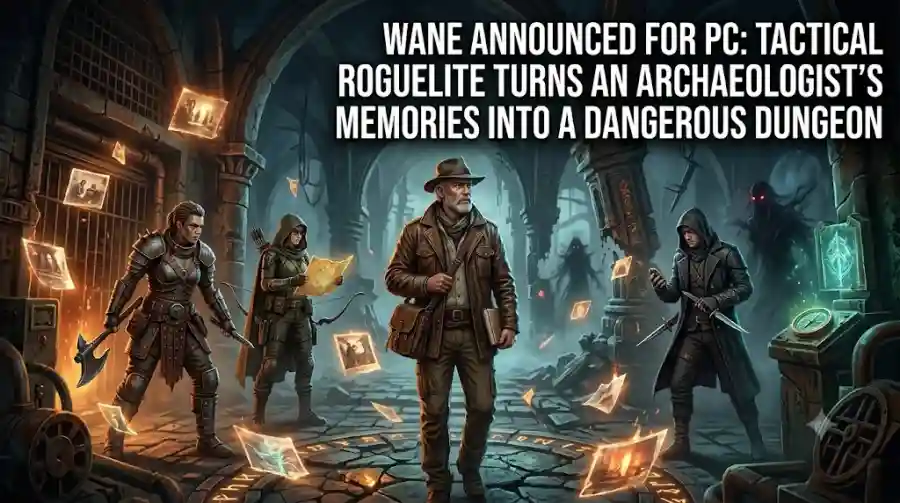
WANE Is a New Occult RPG Where Your Own Memories Become the Dungeon
Its central idea is what immediately separates it from a conventional tactical RPG.
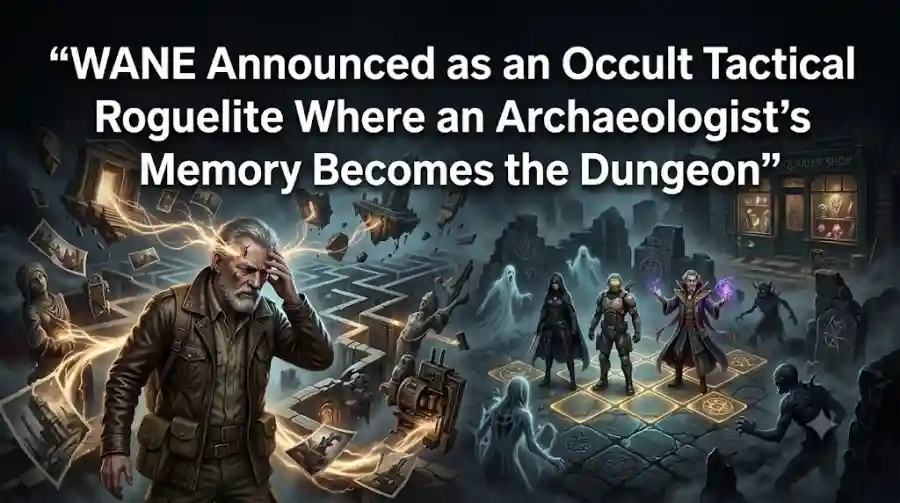
Ravelle is not simply a dungeon that Declan happens to explore.
It is connected directly to his past.
The deeper players travel, the more they uncover about the archaeologist's history, his mistakes and the events that damaged his mind.
WANE combines that narrative concept with grid-based tactical combat, roguelite progression, party management and an economy built around recovered relics.
What Is WANE?
WANE is described as a character-driven tactical roguelite set against an industrial-noir and occult backdrop.
Players control Declan Wayne, an archaeologist who previously discovered Ravelle and the remains of three dead civilizations.
His discovery was supposed to become his legacy.
Instead, he broke seals that were protecting something that should never have been disturbed.
The consequences left his mind permanently damaged.
After years of searching for a cure, Declan returns to Ravelle.
This time, however, he does not explore the ruins alone.
He recruits a group of adventurers and occultists to descend into the strange world that has formed around his memories.
Ravelle Is Built From Declan’s Memories
The most distinctive part of WANE's premise is its setting.
Ravelle has become a labyrinth shaped by Declan's deteriorating memories.
His experiences, trauma, obsessions and regrets influence the environment.
That means the dungeon is not simply a collection of randomly generated rooms.
The world has a narrative relationship with the protagonist.
According to the game's official description, Ravelle's defining moments and memories can reshape the path forward.
This gives the roguelite structure a story-focused purpose.
Repeated expeditions aren't just about getting stronger.
They also reveal more information about Declan and the world inside his mind.
Tactical Combat Uses Grid-Based Positioning
WANE's combat is built around turn-based tactical encounters.
Players assemble a three-person party and fight through grid-based battles where positioning, cover and line of sight matter.
That places the game firmly in tactical RPG territory.
Rather than simply selecting attacks from a menu, players have to think about where characters are positioned and how the battlefield affects each encounter.
The game's combat also incorporates percentage-based attacks, meaning players must account for uncertainty when making offensive decisions.
This adds another layer of risk to each expedition.
A carefully planned attack can still fail.
A risky position can become costly.
And because WANE uses a roguelite structure, mistakes can potentially affect the entire expedition.
Players Build a Three-Person Expedition
Declan does not fight alone.
Players recruit adventurers to form a three-person party before descending into Ravelle.
The available characters are not presented as interchangeable units.
Each has their own reasons for entering the ruins and their own relationship with the expedition.
The game's official description gives several unusual examples.
Players can recruit characters including an assassin with a demon controlling his vocal cords, a disgraced fighter pilot who has become a mecha, and a magician who has an unusual relationship with Death.
These characters give WANE a deliberately strange identity.
It is not presenting a conventional party of warrior, mage and healer.
Instead, the roster appears designed around unusual personalities and narrative conflicts.
Party Relationships Can Affect Expeditions
The party system goes beyond combat statistics.
Every expedition member has personal motivations that extend beyond receiving payment.
Players can discover what individual characters actually want and decide whether to help them or exploit their situations.
Internal conflict is therefore another part of expedition management.
Players need to keep the group together while navigating competing interests.
According to the game's official description, decisions can increase the loyalty of some party members while damaging relationships with others.
That creates a social layer on top of the tactical combat.
A successful expedition is therefore not necessarily just about winning battles.
Players also have to manage the people they bring with them.
The Roguelite Structure Means Every Expedition Matters
WANE is designed around repeated expeditions into Ravelle.
Players descend into the world, fight enemies, encounter obstacles, recover artifacts and eventually return to their base.
The cycle then begins again.
But each run contributes to longer-term progression.
New synergies, shortcuts and permanent upgrades can become available as players continue exploring.
That creates the familiar roguelite progression loop:
Prepare → Descend → Fight → Recover Relics → Return → Upgrade → Prepare Again.
The difference is that WANE ties this structure directly to its story.
Each expedition can also reveal another part of Declan's memories.
The Antiquarian Shop Is Part of the Progression
One of WANE's more unusual systems happens outside combat.
Declan operates an antiquarian shop where recovered relics can be appraised and sold.
The money generated from those artifacts can then be used to fund future expeditions and improve the player's facilities.
This makes treasure more than a simple reward.
Players have to decide what to do with the artifacts they recover.
Some relics can help uncover Ravelle's history.
Others can be sold to provide the resources needed for the next expedition.
That creates a trade-off between preserving information and generating money.
Three Major Biomes Form the Core Journey
WANE currently identifies three major areas connected to Declan's fractured memories.
They are:
- Ravellian Sanatorium
- Palace of Arvanshah
- Death Pilgrimage to Erabel
Each biome is connected to different elements of Ravelle's history and Declan's memories.
This structure gives the game a clear progression framework while still allowing its roguelite systems to reshape individual expeditions.
The environments are not simply different visual themes.
They are connected to the game's narrative.
Memory Is the Map
The developers describe one of WANE's core concepts as “Memory is the Map.”
That phrase explains how the game's setting and story connect.
Declan's memories determine the structure of Ravelle.
As those memories deteriorate, the world can shift with them.
The result is a dungeon that reflects the protagonist rather than functioning as an unrelated location.
This approach could also help explain why repeated runs are important.
If players return to the same broad areas multiple times, their understanding of those locations can change as more of Declan's history becomes clear.
WANE Mixes Occult Horror With Industrial Noir
The game's visual and narrative identity is built around an unusual combination of genres.
It uses:
- Occult themes
- Industrial-noir aesthetics
- Tactical RPG mechanics
- Roguelite progression
- Archaeological mystery
- Psychological storytelling
- Character-driven party management
The combination makes WANE different from a conventional fantasy tactical RPG.
Its world is less about kingdoms and traditional magic systems and more about forgotten civilizations, damaged memories and supernatural forces.
Relics Have Two Purposes
Recovered artifacts are important for two different reasons.
First, they can help players understand the history of Ravelle.
Second, they can be sold to finance future expeditions.
That creates an interesting resource decision.
A player may want to keep an artifact because it provides information about the world.
But the expedition also needs money.
Supplies need to be purchased.
Facilities need to be upgraded.
Mercenaries need to be paid.
Medical costs need to be covered.
The game's economy therefore becomes part of the expedition strategy.
What Happens Between Expeditions?
The expedition doesn't end when the party returns to safety.
Players go back to their base and manage the resources collected during the previous run.
The antiquarian shop is central to this process.
Recovered relics can be appraised and auctioned, while facilities can be improved to prepare for future expeditions.
This gives WANE a clear division between two gameplay phases:
Expedition Phase
Explore Ravelle, fight enemies, manage the party and recover artifacts.
Preparation Phase
Sell or preserve relics, improve facilities, manage resources and prepare the next team.
The two systems feed directly into each other.
The Story Unfolds Through Repeated Runs
WANE is not designed to tell its complete story in a single linear journey.
Instead, the narrative develops through repeated expeditions.
Every run can reveal additional information about Declan and his companions.
That is particularly appropriate for the game's memory theme.
The player is essentially reconstructing a damaged history piece by piece.
The more they return to Ravelle, the more they can understand what happened.
WANE Is Metis Creative’s First Video Game
Metis Creative is known primarily for its tabletop RPG work, including the Historica Arcanum series, E.N.C.O.R.E., and Solaris Arcanum. The Steam page describes WANE as the studio's first video game.
That background helps explain the game's emphasis on characters, narrative and party relationships.
WANE is essentially taking a tabletop-style approach to party building and storytelling and combining it with a digital tactical roguelite structure.
The project is being published by Shoreline Games.
WANE Release Date and Platforms
WANE is currently confirmed for:
- PC
- Steam
No release date has been announced yet. Steam currently lists the release date as To be announced.
The announcement materials also leave the launch timing open.
Players can currently wishlist the game on Steam.
No confirmed PlayStation, Xbox or Nintendo Switch release should be assumed at this stage.
WANE PC System Requirements
The current Steam listing provides PC requirements.
Minimum Requirements
- OS: Windows 10 64-bit (1909+)
- Processor: Intel Core i5-4590 / AMD Ryzen 3 1200
- Memory: 8 GB RAM
- Graphics: NVIDIA GTX 960 4GB / AMD RX 570 / Intel Arc A380
- DirectX: Version 11
- Storage: 3 GB
Recommended Requirements
- OS: Windows 11 64-bit
- Processor: Intel Core i5-9600K / AMD Ryzen 5 3600
- Memory: 16 GB RAM
- Graphics: NVIDIA GTX 1660 Super / AMD RX 5600 XT
- DirectX: Version 12
- Storage: 4 GB
These are the currently listed requirements and could change before release.
What Players Should Expect From WANE
WANE is shaping up as a game built around decisions at several levels.
During combat, players decide where their characters should move and which attacks to use.
During expeditions, they decide how much risk to take.
Between expeditions, they decide how to spend their resources.
And throughout the campaign, they decide how to handle the relationships within their party.
That gives the game several interconnected decision systems instead of relying solely on tactical combat.
What Is Confirmed?
| Detail | Confirmed Information |
|---|---|
| Game | WANE |
| Developer | Metis Creative |
| Publisher | Shoreline Games |
| Genre | Tactical Roguelite RPG |
| Platform | PC |
| Store | Steam |
| Release Date | To be announced |
| Main Character | Declan Wayne |
| Party Size | Three characters |
| Combat | Turn-based, grid-based |
| Structure | Roguelite |
| Setting | Occult industrial-noir world |
| Main Location | Ravelle |
| Major Areas | Three |
| Multiplayer | Single-player |
The core details are supported by the official Steam listing and announcement coverage.
What Is Not Confirmed Yet?
Several important details remain unknown.
There is currently no confirmed:
- Release date
- Release price
- Console launch
- Full playable character roster
- Final number of enemies
- Final number of encounters
- Complete story length
- Post-launch content plans
Players should therefore avoid treating speculation around these areas as official information.
Why WANE Stands Out Among New Tactical RPGs
The tactical RPG market already contains many games built around fantasy armies, sci-fi squads and traditional dungeon adventures.
WANE takes a different route.
Its dungeon is connected to the protagonist's memories.
Its party members have their own motivations.
Its resources come from archaeological artifacts.
And the player's home base includes an antiquarian shop that helps finance future expeditions.
Those systems are connected rather than existing independently.
The story explains the dungeon.
The dungeon provides the relics.
The relics fund the expedition.
The expedition reveals more of the story.
That gives WANE a coherent gameplay loop built around its central memory concept.
WANE is a newly announced tactical roguelite RPG from Metis Creative and Shoreline Games that places players inside the fractured memories of archaeologist Declan Wayne.
Its world, Ravelle, is a shifting labyrinth shaped by Declan's trauma, obsession and regret.
Players recruit a three-person expedition, explore dangerous areas, fight through grid-based turn-based encounters and recover relics.
Those relics can either help uncover Ravelle's history or be sold to finance future expeditions.
Between runs, players can upgrade their facilities, manage resources and deal with the personal motivations of their party members.
The game is currently confirmed for PC via Steam, but its release date has not been announced.
The most interesting part of WANE is the way its narrative premise connects directly to its roguelite structure.
Instead of simply exploring a randomly generated dungeon, players are repeatedly entering a world shaped by a man's damaged memories.
As the expeditions continue, the player isn't just trying to survive.
They are trying to understand what happened to Declan Wayne — and what Ravelle has become because of it.
FAQs
What is WANE?
WANE is an occult tactical roguelite RPG from Metis Creative and Shoreline Games.
When will WANE release?
No release date has been announced. Steam currently lists the release date as To be announced.