Alibaba’s Qwen-Audio 3.1 Realtime Plus Adds Smarter Voice Agents, Web Search and Voice Cloning
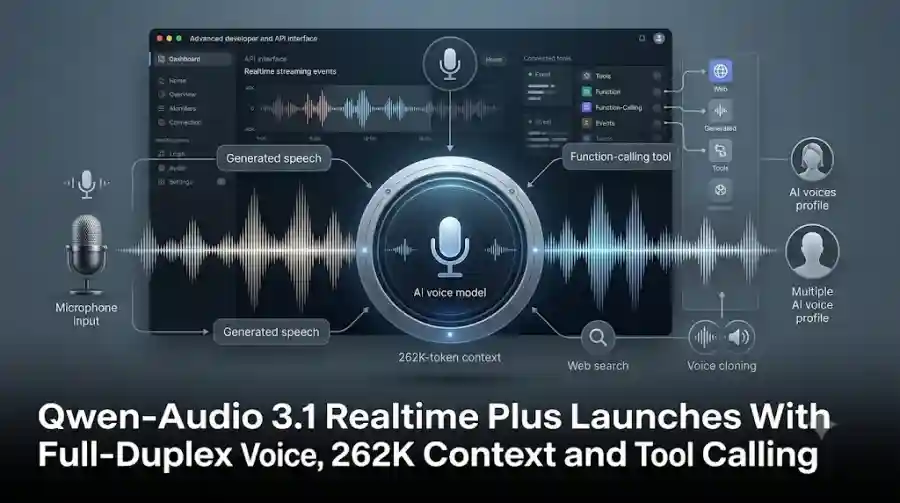
Unlike a traditional voice pipeline that separately runs automatic speech recognition, a language model and text-to-speech, Qwen-Audio is built as an end-to-end real-time voice interaction system.
Alibaba's documentation describes it as a low-latency speech-to-speech model for applications such as voice assistants, intelligent customer service and AI companions.
What Is Qwen-Audio 3.1 Realtime Plus?
Qwen-Audio 3.1 Realtime Plus is the latest version of Qwen's real-time voice interaction model.
The model is designed to take live audio input and produce live audio output while maintaining conversation context.
Its architecture supports full-duplex interaction, meaning audio can continuously stream in both directions rather than forcing the user to wait for one complete speech turn before the system begins processing the next.
This design is important for natural conversations.
People interrupt, pause, change their minds and speak over background noise. A real-time voice system therefore needs more than accurate speech recognition.
It needs to understand when a person has finished speaking and when it should respond.
Qwen-Audio 3.1 includes multiple turn-detection modes to handle those situations.
262K Tokens Give the Model a Large Conversation Window
One of the biggest technical specifications in the new release is the 262,144-token context window.
Alibaba Cloud lists the model with a 262K context capacity, allowing applications to maintain substantially more conversation context than a short-session voice assistant.
A large context window can be useful for applications that need to keep track of longer conversations or maintain more information about an ongoing task.
For example, a voice agent supporting a customer could retain more relevant context within a session instead of repeatedly asking the user to provide the same information.
However, context capacity and practical conversation length are not exactly the same thing.
Alibaba's realtime voice documentation also specifies a maximum of 50 audio turns and 300 seconds of cumulative audio for the model's retained conversation history, with earlier history automatically discarded once those limits are exceeded.
That distinction is important for developers planning long-running voice applications.
Full-Duplex Voice Is the Core Experience
Qwen-Audio is designed around continuous voice interaction.
Alibaba describes it as an end-to-end real-time voice model with streaming input and streaming output.
The system supports several interaction modes.
Acoustic Voice Activity Detection
The server_vad mode uses acoustic signals to determine when the user starts and stops speaking.
This is useful for conventional voice assistants where speech boundaries can be identified primarily from the audio itself.
Semantic Turn Detection
Qwen-Audio also supports a smart_turn mode.
In this mode, the system combines acoustic perception with semantic understanding to determine when the user has actually finished speaking.
That matters because people regularly use filler sounds such as “uh” or “hmm” without intending to give the AI a turn.
Alibaba says semantic turn detection is designed to prevent those sounds from causing unnecessary interruptions.
Push-to-Talk
Developers can also use manual turn control.
The push-to-talk mode gives applications explicit control over when the assistant should begin processing the user's audio.
This can be useful in environments where automatic voice detection is not desirable.
Qwen Adds Eight New System Voices
Qwen-Audio 3.1 Realtime Plus retains the previous system voices and adds eight additional voices.
Alibaba's official model listing confirms the expanded voice set.
The current Qwen documentation lists 3.1-specific voices including:
longanqian_v3.1longanhuan_v3.1longanlingxin_v3.1longanfengyue_v3.1xunanchuanbeth_v3.1betty_v3.1cally_v3.1
Developers can select an available voice through the realtime session configuration.
This gives voice applications more options for branding, assistant personalities and different user experiences.
Voice Cloning Is Built Into the Model Workflow
Qwen-Audio 3.1 Realtime Plus also supports voice cloning.
Alibaba's documentation shows that developers can create cloned voices through the Voice Cloning API and then use the resulting voice ID in realtime sessions.
That could be useful for applications that need a consistent custom voice instead of relying only on predefined system voices.
For example, a company building a branded voice assistant could choose to create a specific voice identity for the service.
At the same time, voice cloning introduces additional considerations around authorization and consent, so developers need to make sure voices are used legitimately.
Function Calling Makes the Voice Model More Useful
Qwen-Audio 3.1 Realtime Plus is not limited to conversation.
Alibaba's official model release page lists function calling as a supported capability.
That allows a voice interface to connect conversation with software actions.
Instead of simply answering:
“Your order is delayed.”
a tool-enabled voice agent could potentially retrieve order information from a business system and provide the result during the conversation.
Similarly, a productivity assistant could use tools to retrieve information or trigger workflows after interpreting a user's spoken request.
The important change is that speech becomes an interface to an agentic system rather than an isolated voice-chat feature.
Web Search Is Also Supported
The model supports web search, according to Alibaba Cloud's official model documentation.
This means developers can build realtime voice applications that are connected to external information sources when current information is required.
That creates another important distinction between a basic voice assistant and a tool-enabled voice agent.
A static assistant may know information only from its model.
A tool-connected assistant can combine conversation with external retrieval.
For time-sensitive applications, that distinction can be significant.
Developers Can Use Multiple Realtime Protocols
Qwen-Audio 3.1 Realtime Plus is not tied to a single communication protocol.
Alibaba Cloud documents support for:
- WebSocket
- AOQ
- WebRTC
The company's documentation describes WebSocket-based realtime interaction and recommends AOQ for client-side applications that prioritize stable latency, resilience on weak networks, and built-in full-duplex noise suppression and echo cancellation.
WebRTC is also supported for realtime communication workflows.
This gives developers more flexibility when integrating the model into different client environments.
The WebSocket API Uses Streaming Events
The realtime API is event-driven.
The client sends events such as session configuration and audio-buffer updates, while the server returns events containing generated audio and other responses.
Alibaba's official server-event documentation lists events such as response.audio.delta, response.done and structured error events.
This event-driven architecture allows applications to process audio incrementally instead of waiting for a complete response.
That is important for realtime voice experiences because even small delays can make conversations feel unnatural.
Applications Can Choose Different Turn Strategies
A major benefit of Qwen-Audio 3.1 is that developers can choose how the voice interface manages conversation turns.
An application with a highly natural conversational assistant may benefit from semantic turn detection.
A controlled enterprise application may prefer acoustic VAD.
A system requiring explicit user control could use push-to-talk.
The model therefore supports more than one interaction philosophy.
That flexibility matters because a call-center voice agent has different requirements from a gaming companion or a hands-free mobile assistant.
Voice AI Becomes More Than ASR + LLM + TTS
Traditional voice applications often use a pipeline:
Speech recognition → Text model → Text-to-speech
That architecture works, but it introduces multiple stages.
Alibaba's documentation contrasts this pipeline with its speech-to-speech approach.
The company says the S2S architecture can provide lower latency because a single model handles the realtime interaction, while a conventional three-stage pipeline processes those components sequentially. It also argues that direct audio processing can retain acoustic information such as tone and emotion that can be lost when speech is converted to text first.
The exact performance benefit will depend on the application, network conditions and implementation, but the architectural difference is clear.
Qwen is positioning the model as a native realtime speech system rather than just a text LLM connected to speech interfaces.
Qwen-Audio 3.1 Supports Multiple Languages
Alibaba Cloud documents realtime voice support for multiple major languages and Chinese varieties.
The currently documented language set includes:
- English
- German
- Spanish
- French
- Indonesian
- Italian
- Japanese
- Korean
- Portuguese
- Russian
- Chinese
The documentation also lists numerous Chinese varieties, including Cantonese and regional forms.
This makes the model relevant to multilingual customer-service and assistant applications.
For developers targeting international users, multilingual realtime interaction can be more useful than building separate voice systems for every language.
The Model Can Maintain More Audio Context
Qwen-Audio's realtime system does not treat every spoken sentence as an isolated request.
According to Alibaba's documentation, the model retains conversation history within defined audio-turn and duration limits.
That lets the model carry context across multiple exchanges.
For example, a user could discuss a problem, provide additional information and ask a follow-up question without repeating the entire conversation.
This is an important part of making a voice agent feel conversational.
The Model Can Be Used for Customer-Service Agents
Alibaba identifies intelligent customer service as one of the target use cases for Qwen-Audio.
A customer-service voice agent can use realtime speech to interact with callers while function calling can connect the assistant to business systems.
A typical architecture could look like:
Customer speaks → Qwen-Audio understands → Agent calls business API → System returns information → Qwen responds by voice
This approach could support applications such as order status, account assistance, appointment handling and other transactional workflows.
The actual actions available would depend on the external tools connected by the developer.
Voice Assistants Can Become Tool-Using Agents
The same architecture can be applied to general voice assistants.
Instead of asking a voice assistant a question and receiving a spoken answer, users can eventually speak requests that require software actions.
Function calling provides the bridge between the voice interface and external tools.
For example, a developer could connect functions for calendar management, information retrieval or business workflows.
The model then acts as the conversational front end while the connected application determines which actions are actually permitted.
Qwen-Audio 3.1 and Qwen3.8-Omni-Flash Serve Different Jobs
Qwen now has several models aimed at different realtime and multimodal tasks.
Qwen-Audio 3.1 Realtime Plus focuses on speech-to-speech interaction.
Qwen3.8-Omni-Flash is designed for broader multimodal workloads involving text, images, audio and video. Alibaba's model documentation says Omni-Flash supports text, image, audio and video inputs and is designed for multimodal analysis and agent applications.
This distinction matters for developers.
An application centered on conversational voice does not necessarily need a full text-image-audio-video model.
A system that needs to inspect video, images and documents alongside audio may need a broader multimodal model.
Qwen-Audio 3.1 vs Traditional Voice Pipeline
| Capability | Traditional ASR + LLM + TTS | Qwen-Audio 3.1 Realtime Plus |
|---|---|---|
| Speech input | Yes | Yes |
| Speech output | Yes | Yes |
| Full-duplex interaction | Depends on implementation | Supported |
| Semantic turn detection | Depends on system | Supported |
| Function calling | Depends on LLM layer | Supported |
| Web search | Depends on LLM layer | Supported |
| Voice cloning | Separate system may be required | Supported |
| Voice selection | Depends on TTS | Built in |
| Realtime protocols | Varies | WebSocket, AOQ, WebRTC |
| Context window | Pipeline-dependent | 262,144 tokens |
The table highlights the architectural direction Qwen is taking.
Instead of assembling multiple independent services for speech recognition, reasoning and speech generation, developers can build around a single realtime speech model and then connect the tools they need.
How Developers Can Start
Alibaba Cloud provides documentation for integrating Qwen-Audio 3.1 Realtime Plus through the realtime API.
The official quick-start documentation uses a WebSocket connection and Python examples to stream microphone audio to the model and receive generated audio in real time.
The platform also provides an AOQ integration path, including Android examples and server-side voice-activity detection.
Developers need an API key for the service, and Alibaba explicitly recommends keeping that key on the application server rather than exposing it in client-side code.
What Developers Should Consider
Realtime voice systems introduce requirements that ordinary text APIs do not.
Latency becomes much more visible.
Audio quality matters.
Turn detection needs to be tuned.
Network conditions can affect user experience.
And voice applications need clear rules for what actions the assistant is allowed to perform.
Qwen-Audio 3.1 provides the technical building blocks, but the final experience still depends heavily on how developers design the application around the model.
The availability of function calling and web search also means developers need to establish appropriate permissions for tools and external systems.
Availability
Qwen-Audio-3.1-Realtime-Plus is listed by Alibaba Cloud as a September 20, 2026 realtime-chat model.
The same model is available across the documented Alibaba Cloud Model Studio environments, with the official listing describing realtime duplex speech, eight additional system voices, a 262,144-token context window, function calling, web search and voice cloning.
Developers can access the model through Alibaba Cloud's realtime voice APIs and related SDK or protocol documentation.
Why This Release Matters for AI Voice Agents
The most important part of Qwen-Audio 3.1 Realtime Plus is that it combines voice interaction with capabilities normally associated with broader AI agents.
The model is not just designed to hear speech and repeat text.
It can maintain conversation context, operate in full duplex, use tools, perform web search and support custom voices.
That combination moves realtime voice AI closer to an agent interface.
Users can speak naturally, while the system can reason about the request and potentially connect to external tools.
This is especially relevant for customer service, workplace assistants, hands-free productivity and other applications where conversations need to lead to actions.
Qwen-Audio 3.1 Realtime Plus is a significant new entry in the rapidly developing realtime voice-AI market.
Alibaba has combined full-duplex speech interaction with a 262,144-token context window, function calling, web search and voice cloning, while expanding the available system voice library.
The model also supports multiple realtime communication protocols and different turn-detection strategies, giving developers more control over how their voice applications behave.
Its architecture is particularly interesting because it treats speech as the native interface to an AI system rather than simply placing a language model between speech recognition and text-to-speech tools.
That creates opportunities for voice assistants that can do more than answer questions.
They can potentially retrieve information, call software tools and complete actions while maintaining a natural spoken conversation.
For developers building the next generation of voice agents, Qwen-Audio 3.1 Realtime Plus provides another concrete option for creating low-latency, tool-enabled and customizable speech experiences.
Frequently Asked Questions
What is Qwen-Audio 3.1 Realtime Plus?
Qwen-Audio 3.1 Realtime Plus is Alibaba's latest realtime speech-to-speech model for low-latency voice interaction and AI voice-agent applications.
What is the context window of Qwen-Audio 3.1 Realtime Plus?
Alibaba Cloud lists the model with a 262,144-token context window.