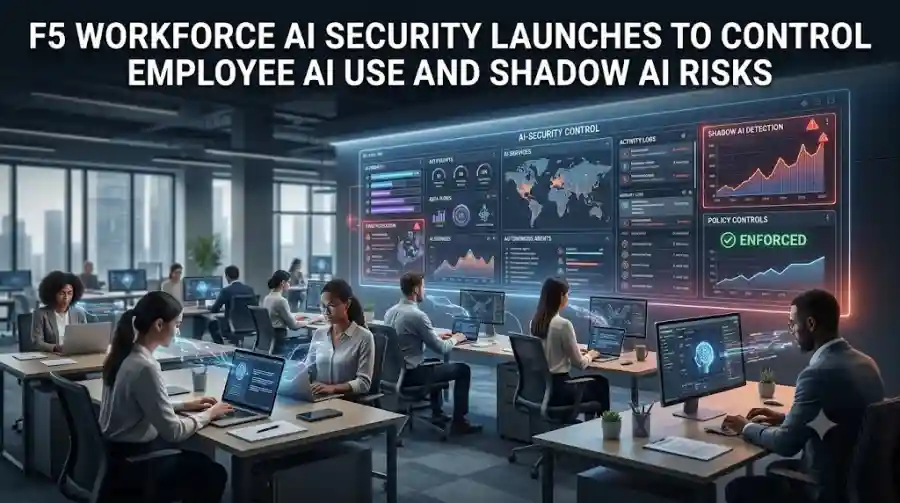
F5 Introduces Workforce AI Security to Give Enterprises Visibility and Control Over Employee AI Activity
Announced on September 9, 2026, the product is designed to give organizations visibility and policy control over workforce AI activity, including employee use of AI tools and actions performed by AI agents on users' behalf. F5 says the offering is agentless, meaning organizations do not need to deploy another endpoint client to monitor this activity.
The company says general availability is planned for October 2026.
What Is F5 Workforce AI Security?
F5 Workforce AI Security is an enterprise AI-governance and security product designed to monitor how employees interact with AI services.
Instead of focusing only on protecting an AI model or application, it looks at the AI activity happening across an organization's workforce.
F5 says the system can provide visibility into:
- AI services employees are using
- Prompts sent to AI systems
- Responses returned from AI systems
- Sensitive data moving through AI interactions
- AI applications used across the network
- Actions performed by agents on behalf of users
- Business intent behind AI activity
The goal is to help security teams understand the organization's complete AI footprint and create policies around how those systems can be used.
This is becoming increasingly important as enterprise AI moves beyond simple chatbots.
Why Shadow AI Is Becoming a Bigger Enterprise Problem
Shadow AI refers to employees using AI services that have not been formally approved or managed by their organization.
The problem is similar to shadow IT, but AI introduces additional risks.
An employee might paste confidential information into an external AI assistant to summarize a document.
A developer might use an AI coding tool with access to proprietary source code.
A sales employee might connect an AI agent to customer information.
A finance employee might use an AI service to process sensitive financial data.
The organization may not know any of this is happening.
F5 says employees are increasingly using AI assistants and coding agents that can access enterprise systems, call tools, manipulate data and perform actions using permissions granted by users.
That changes the security equation.
The risk is no longer limited to what information an employee manually uploads.
An AI agent could potentially access information and perform actions through the permissions available to it.
F5 Wants to See AI Activity Without Endpoint Software
One of the most notable aspects of Workforce AI Security is its agentless design.
F5 says organizations can monitor AI activity at the network level without requiring another endpoint client or browser extension.
That could make deployment easier for large organizations with thousands of employees and multiple device environments.
Instead of installing another security component on every computer, F5 positions the product around visibility into the traffic already moving through the enterprise network.
The platform can capture AI interactions and create audit trails showing the journey of AI requests, responses and user intent.
This is particularly relevant for organizations where employees use a mixture of approved and unapproved AI applications.
The Platform Can Inventory AI Usage
Knowing that employees use AI is not enough.
Security teams also need to know which AI services are actually being used.
F5 says Workforce AI Security can automatically identify and catalog AI services as they appear in network traffic.
The platform can maintain an inventory of AI services, models and agent tools in active use.
This could help organizations identify situations such as:
- An employee using an unapproved AI assistant
- A development team adopting an external coding agent
- A private AI model being used without central oversight
- An AI tool accessing sensitive information
- An AI service being used for a high-risk business process
Instead of relying entirely on employees to report which AI tools they use, security teams can gain a broader picture from actual network activity.
F5 Can Classify Why Employees Are Using AI
Another interesting feature is intent classification.
F5 says its platform can go beyond identifying the AI service being used and determine the business purpose of the interaction.
Examples include activities such as:
- Summarization
- Code generation
- Information analysis
- Content creation
- Other business-related AI tasks
This distinction matters because not every AI interaction carries the same risk.
An employee asking an AI tool to rewrite a public announcement is different from an employee submitting confidential customer records.
Likewise, generating a simple code snippet is different from giving an autonomous coding agent access to a production environment.
By classifying intent, security teams can potentially create more targeted policies rather than blocking AI use altogether.
Workforce AI Security Can Help Manage Sensitive Data Risks
One of the biggest concerns around employee AI adoption is sensitive-data leakage.
Employees may unintentionally send confidential information to AI systems while trying to complete ordinary work.
This can include:
- Customer information
- Internal documents
- Source code
- Financial information
- Business plans
- Credentials
- Proprietary research
F5 positions Workforce AI Security as a way to gain visibility into AI interactions and data flows so organizations can identify and manage these risks.
The product is therefore not simply about monitoring employees.
It is about creating a security layer around how AI interacts with organizational data.
Enterprises Can Create Policies Around AI Usage
Visibility is only useful if organizations can act on what they discover.
F5 says Workforce AI Security includes adaptive usage controls that allow organizations to create policies around AI use.
These policies can be based on factors such as user groups, approved models, business intent and risk.
F5's product documentation says organizations can route requests to approved enterprise models, block high-risk or prohibited services and protect sensitive data before it reaches a model.
That provides a more flexible alternative to simply banning AI.
A company could allow employees to use approved AI assistants while restricting certain categories of data or preventing access to unauthorized services.
The Product Also Covers AI Agents
The rise of AI agents makes workforce AI security more complicated.
A chatbot generally waits for a user prompt and returns an answer.
An agent can potentially perform multiple steps.
It can call tools.
It can access applications.
It can manipulate data.
It can take actions.
F5 says Workforce AI Security extends visibility and control to actions taken by AI agents on behalf of employees.
That means organizations can start looking beyond the question:
Which AI tool is the employee using?
The more important question becomes:
What is that AI tool allowed to do?
This shift is likely to become increasingly important as companies deploy more autonomous AI systems.
Workforce AI Security Connects With F5's Broader AI Security Platform
Workforce AI Security is not a standalone security strategy.
It is part of F5's larger AI Security Platform.
F5 says its platform provides security across enterprise AI applications, models, agents and APIs.
The company previously introduced capabilities including AI Guardrails and AI Red Team.
According to F5, Workforce AI Security can feed discovery information into other components of the platform.
For example, information about AI usage can contribute to security testing and runtime protection through F5's broader AI security capabilities.
That creates a broader security loop:
Discover → Understand → Test → Govern → Protect
Rather than treating AI security as a single firewall or filter, F5 is positioning it as an ongoing enterprise process.
How Workforce AI Security Differs From Traditional AI Security
Traditional AI security often focuses on the AI application itself.
Security teams may look at:
- Model vulnerabilities
- Prompt injection
- Data leakage
- API security
- Model access
- Agent permissions
- Runtime attacks
Those remain important.
But workforce AI creates another layer.
Employees may independently adopt AI services before security teams evaluate them.
That creates an unmanaged AI footprint.
Workforce AI Security focuses on that layer.
It asks:
What AI services are employees using?
What are they sending to those services?
What are the AI systems returning?
What actions are agents performing?
Are those activities allowed by company policy?
This makes the product more about AI usage governance than simply defending an AI model.
Why This Matters as Companies Deploy More AI Agents
The enterprise AI market is moving toward agents that can take action.
Coding agents can modify repositories.
Business agents can interact with enterprise applications.
Financial agents can analyze and prepare transactions.
Customer-service agents can access support systems.
Research agents can gather information across multiple services.
Every new capability increases the importance of permissions.
A company might have hundreds or thousands of employees using AI systems.
If each AI assistant receives some level of access through the employee, the organization's security perimeter can become much harder to understand.
F5's approach is to place visibility and policy enforcement around those interactions.
That could help security teams maintain control without completely slowing down AI adoption.
F5 Is Taking an Agentless Approach
The agentless design is particularly important for enterprise deployment.
Security products that require software installation on every endpoint can create additional management overhead.
F5 says Workforce AI Security does not require another endpoint client or extension.
Instead, it operates at the network level.
For organizations with large and distributed workforces, this could simplify deployment and provide centralized visibility.
It can also help cover AI activity across different types of devices and applications without requiring every AI provider to support a dedicated security integration.
What Businesses Should Evaluate Before Deploying It
F5 Workforce AI Security addresses a real enterprise problem, but organizations should still evaluate how it fits into their existing security architecture.
Important questions include:
- Which AI services are already approved?
- Which employee groups can access external AI?
- What types of data can be submitted?
- Which AI agents have access to business systems?
- How are AI interactions logged?
- How long should AI activity records be retained?
- Which activities require approval?
- What should happen when a prohibited AI service is detected?
- How should security teams respond to high-risk AI behavior?
These questions matter regardless of which AI-security platform an organization chooses.
The technology can provide visibility, but companies still need clear internal AI policies.
F5 Workforce AI Security vs AI Agent Security
The distinction between AI-agent security and workforce AI security is important.
TheInfoBytes has already covered products such as Tenable AI Inspector, which focuses on securing AI agents and MCP servers, as well as other AI-security technologies.
F5's Workforce AI Security addresses a different part of the problem.
It focuses on the employee-to-AI relationship.
That includes discovering what AI tools employees use and controlling how those interactions happen.
Agent security focuses more directly on the AI system's behavior, tools, infrastructure and vulnerabilities.
In mature enterprise environments, both layers could become necessary.
The Bigger Shift: Enterprises Are Moving From AI Approval to AI Governance
The early enterprise AI conversation was largely:
Should employees be allowed to use AI?
That question is quickly becoming outdated.
The more useful questions are:
Which AI tools can employees use?
What information can they provide?
What can AI agents access?
What actions can those agents perform?
How should those actions be monitored?
That is the shift from AI adoption to AI governance.
F5 Workforce AI Security is designed around this new phase.
Instead of assuming companies can prevent employees from using AI, the platform assumes AI use is already happening and focuses on making it visible and controllable.
That could become an increasingly important approach as AI becomes a standard workplace technology.
What Makes F5 Workforce AI Security Different?
Several parts of the product make it notable.
Agentless deployment: F5 says organizations do not need another endpoint client or extension.
AI discovery: The platform can identify AI services appearing in network traffic.
AI inventory: Security teams can maintain an inventory of models, services and agent tools.
Intent classification: The platform can classify why employees are using AI.
Usage visibility: Organizations can inspect AI interactions, prompts and data flows.
Adaptive controls: Companies can create policies around AI usage and risk.
Agent oversight: The platform extends visibility to actions taken by AI agents on behalf of users.
Integration with F5 AI Security Platform: Workforce AI Security can connect with F5's wider AI security capabilities.
Together, these features position the product as an enterprise control layer for workplace AI.
When Will F5 Workforce AI Security Be Available?
F5 announced Workforce AI Security on September 9, 2026.
The company says the new offering is scheduled to become generally available in October 2026.
That means organizations interested in deploying it should treat the current product information as pre-GA information until general availability begins.
Pricing and final availability details should be verified directly with F5 as the release approaches.
F5 Workforce AI Security addresses one of the less visible challenges created by rapid enterprise AI adoption: companies cannot govern AI they cannot see.
Employees are increasingly using external AI assistants, coding tools and autonomous agents for everyday work.
At the same time, those tools can interact with sensitive information and enterprise systems.
F5's answer is to provide network-level visibility into AI usage, classify employee intent, identify shadow AI and create policies around which AI services and activities are allowed.
The product is particularly interesting because it does not attempt to stop enterprise AI adoption.
Instead, it is designed to make AI adoption more manageable.
That distinction could become increasingly important.
As companies move from experimenting with chatbots to deploying AI agents that can access tools and perform real actions, security teams will need visibility not only into the models they approve, but also into the AI systems employees actually use.
F5 Workforce AI Security is built for exactly that gap.
FAQs
What is F5 Workforce AI Security?
F5 Workforce AI Security is an enterprise security and governance offering designed to provide visibility and policy control over employee AI usage and AI-agent activity.
What is shadow AI?
Shadow AI refers to employees using AI services that have not been formally approved, monitored or governed by their organization.