Linux Foundation Launches MCPA, the First Official Certification for Model Context Protocol
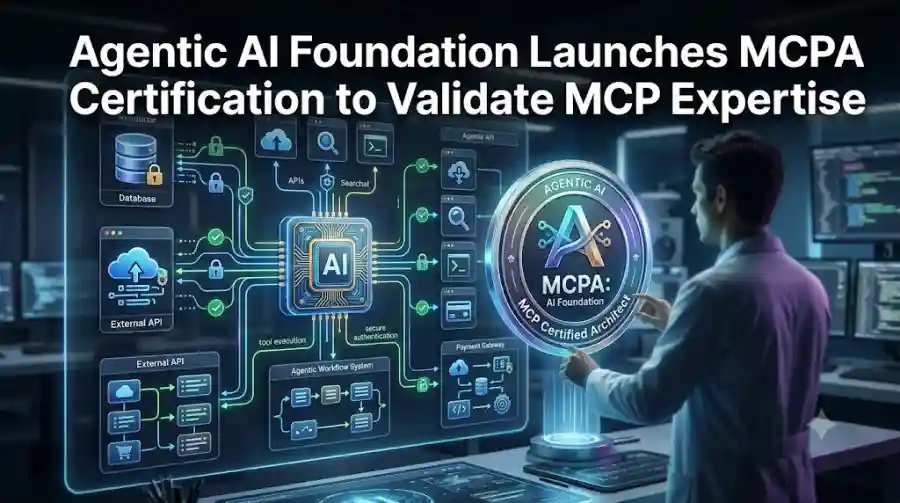
The Agentic AI Foundation (AAIF) has officially launched the Model Context Protocol Associate (MCPA) certification.
The Linux Foundation announced the certification on September 14, 2026, describing MCPA as a foundational, vendor-neutral credential for AI engineers, platform engineers and AI governance professionals.
Unlike certifications tied to a specific AI vendor, MCPA focuses on the protocol itself.
That makes the launch significant for developers building AI agents that need to interact with external systems.
What Is the MCPA Certification?
MCPA stands for Model Context Protocol Associate.
It is designed to validate a candidate's understanding of MCP concepts, architecture, implementation and responsible deployment.
The certification is administered through the Linux Foundation ecosystem and was created by the Agentic AI Foundation, the organization that serves as a neutral home for projects and standards in the agentic AI ecosystem.
The certification is intentionally vendor-neutral.
That means developers are not being tested on how to use one company's proprietary AI platform.
Instead, the focus is on understanding the underlying protocol that allows AI applications to communicate with tools and external systems.
This distinction could make the credential useful across different AI development environments.
A developer working with one AI model today could potentially use the same MCP knowledge when working with another platform tomorrow.
Why MCP Certification Matters Now
The timing of the certification is important.
MCP has moved rapidly from an emerging developer protocol toward widely used infrastructure for AI applications.
The Linux Foundation says monthly downloads across MCP's Tier 1 SDKs are approaching half a billion, while the TypeScript and Python SDKs have each surpassed 1 billion total downloads. The foundation also says MCP tool calls from ChatGPT users reached 98 times their January level by August.
Those figures illustrate why standardized knowledge is becoming more important.
Companies are increasingly building AI systems that can:
- Call external tools
- Retrieve business information
- Access databases
- Interact with APIs
- Execute actions
- Work with enterprise software
- Coordinate agentic workflows
When these systems move from experiments into production, developers need to understand not only how to connect an AI model to a tool but also how permissions, security and trust boundaries work.
That is where MCPA is positioned.
What Does the MCPA Exam Cover?
The MCPA examination is divided into five major domains.
MCP Fundamentals
The first section focuses on the purpose and fundamentals of Model Context Protocol.
Candidates need to understand why MCP exists, what problems it solves and how interoperability benefits AI applications.
This establishes the basic foundation before moving into more technical areas.
Architecture and Components
The second area covers the components that make up an MCP environment.
Candidates are expected to understand concepts such as:
- Hosts
- Clients
- Servers
- Tools
- Resources
- Prompts
- Structured data
- Communication flows
Understanding these components is important because MCP systems are not simply a single API call.
They involve multiple parts communicating through defined protocol mechanisms.
Interactions and Execution
The largest portion of the exam focuses on how MCP interactions actually work.
This section represents 26% of the examination, according to the Linux Foundation.
Candidates are tested on interaction patterns, message flow, protocol primitives, tool invocation and response or error handling.
For developers, this is one of the most practical parts of the certification.
Knowing the terminology is useful, but understanding what happens when an AI agent invokes a tool is much more important when building real systems.
Security and Governance
Security represents another major component of the MCPA examination.
It accounts for 24% of the exam.
Candidates need to understand concepts including:
- Trust boundaries
- Permissions
- Consent
- Risk controls
- Safety
- Auditability
- Observability
This is particularly important as AI agents become capable of taking actions instead of simply generating information.
Giving an AI system access to a database is fundamentally different from asking it to write an email.
Giving it permission to modify records or initiate transactions introduces additional risks.
MCPA therefore treats security and governance as a core part of MCP knowledge.
Use Cases and Ecosystem
The final domain examines how MCP is applied in real-world environments.
Candidates need to understand MCP's role in agentic applications, ecosystem adoption and portability across different systems.
This helps connect protocol knowledge with practical AI engineering.
MCPA Exam Format and Requirements
The MCPA is a 120-minute online, proctored, multiple-choice examination.
The five domains are weighted as follows:
| Exam Domain | Weight |
|---|---|
| MCP Fundamentals | 16% |
| Architecture & Components | 14% |
| Interactions & Execution | 26% |
| Security & Governance | 24% |
| Use Cases & Ecosystem | 20% |
The certification is aligned with the July 28, 2026 MCP specification release, according to the Linux Foundation.
The earlier AAIF announcement described MCPA as a beginner-level credential with no formal prerequisites, while recommending familiarity with JSON-RPC or similar message-based protocols, LLM APIs, agentic tool use and basic security concepts.
Who Is the MCPA Certification For?
MCPA is primarily aimed at people working around AI agents and the infrastructure that supports them.
AI Engineers
AI engineers building tool-using assistants can benefit from understanding how MCP clients, servers and tools communicate.
Platform Engineers
Platform teams increasingly need to manage how AI applications connect with internal services.
MCP knowledge can help these teams understand integration patterns and security boundaries.
AI Governance Professionals
Organizations deploying agents need people who understand the technical layer behind AI tool access.
MCPA's security and governance component is therefore relevant to this group.
Software Developers
Developers who already work with APIs and AI models may find MCP certification useful as the protocol becomes more common across applications.
Enterprise AI Teams
Companies building internal AI assistants can use standardized MCP knowledge when evaluating technical skills.
MCPA Is Vendor-Neutral
One of the most important aspects of the certification is its vendor-neutral design.
The AI market contains many competing platforms.
Developers may work with different models, agent frameworks, cloud providers and enterprise systems throughout their careers.
A certification based on one company's platform can therefore have limited portability.
MCP is different.
The protocol is intended to provide a common way for AI applications to connect with external tools and data.
The MCPA certification follows that same philosophy.
It focuses on the protocol rather than locking candidates into a particular AI vendor.
The Agentic AI Foundation says the credential is aligned with emerging AI engineering, platform engineering and AI governance roles.
Security Is Becoming a Core AI Skill
The security portion of MCPA may be one of the most important elements of the certification.
AI agents are becoming increasingly capable of interacting with real systems.
An agent might retrieve customer information, query a database, update a document or call an external service.
Each connection creates a trust boundary.
Developers therefore need to understand what an AI system is allowed to access and what it is allowed to do.
This becomes even more important when MCP servers provide tools capable of changing data or triggering external actions.
A poorly designed integration could give an AI agent more access than it actually needs.
MCPA's emphasis on permissions, consent, risk controls and trust boundaries reflects that changing reality.
MCPA Comes as MCP Moves Into Production
MCP is no longer being discussed only as an experimental developer technology.
Organizations are increasingly experimenting with production AI agents.
The Linux Foundation says production usage of MCP is growing alongside the rapid expansion of SDK downloads and tool calls.
That creates a new problem for companies.
How do you know whether someone applying for an AI engineering position actually understands MCP?
Traditional programming experience does not automatically mean someone understands agentic protocols.
Likewise, using an AI coding assistant does not necessarily mean a developer understands how an MCP server handles permissions or tool execution.
A standardized credential gives organizations another way to evaluate those skills.
MCPA Is Now Open for Enrollment
The most important difference between today's announcement and the original MCPA announcement is availability.
The Linux Foundation now says MCPA is live and open for enrollment.
People attending AGNTCon + MCPCon Europe in Amsterdam can enroll with a 20% discount.
The same discount is available to people registering for AGNTCon + MCPCon North America, scheduled for October 22–23, 2026, in San Jose, California.
Candidates can also find the current exam information, prerequisites and preparation resources through the Linux Foundation's certification page.
MCPA Certification — Linux Foundation
How MCPA Fits Into the Growing MCP Ecosystem
MCPA is arriving alongside a rapidly expanding MCP ecosystem.
The protocol is being used as a common connection layer between AI applications and external tools.
That includes everything from business software and databases to developer tools and financial systems.
TheInfoBytes has recently covered several examples of this broader trend, including Sokin's MCP connector, which connects AI assistants with payment infrastructure.
The launch of MCPA adds a different layer to that ecosystem.
Instead of introducing another MCP tool, it attempts to standardize the knowledge required to build and operate MCP-based systems.
That could become increasingly important as organizations deploy larger numbers of AI agents.
What Developers Should Learn Before Taking MCPA
The official exam is focused on MCP itself, but developers can prepare by understanding the core concepts behind agentic integrations.
A strong preparation path would include:
- Understanding MCP hosts, clients and servers.
- Learning how tools, resources and prompts work.
- Understanding message flow and protocol primitives.
- Studying tool invocation and error handling.
- Learning MCP security concepts.
- Understanding permissions and trust boundaries.
- Becoming familiar with AI agent tool use.
- Reviewing the current MCP specification.
Candidates should prioritize understanding rather than memorizing terminology.
The goal of the certification is to demonstrate that someone can reason about how MCP works and how it should be implemented responsibly.
What MCPA Could Mean for AI Hiring
If MCP continues to grow as a standard layer for AI applications, certifications like MCPA could eventually become more important in recruitment.
Companies building AI agents may need developers who understand more than prompt engineering.
They may need engineers who can connect models to real systems while maintaining appropriate security controls.
That requires knowledge across several areas:
AI models + APIs + tools + protocols + security + governance
MCPA focuses specifically on the protocol component of that stack.
It is therefore unlikely to replace broader engineering experience.
Instead, its value may come from demonstrating a specific technical competency.
The Bigger Shift: AI Agent Skills Are Becoming Standardized
The launch of MCPA represents a broader change in the AI industry.
During the early generative AI boom, many AI-related skills revolved around prompting, model selection and content generation.
The focus is now shifting toward systems that can use tools and take actions.
That requires a different set of technical skills.
Developers need to understand:
- How agents interact with tools
- How external data reaches models
- How permissions are enforced
- How actions are authorized
- How agent activity is monitored
- How integrations can be secured
MCP is becoming one of the important technical layers in that transition.
The arrival of an official certification suggests that the ecosystem is becoming mature enough to formalize knowledge around it.
The MCPA certification is an important development for the MCP ecosystem because it turns knowledge of Model Context Protocol into a formal, vendor-neutral credential.
The certification covers the fundamentals of MCP, its architecture, tool execution, security, governance and real-world use cases.
Its timing is also significant.
MCP is increasingly being used as the connection layer between AI applications and external systems, while AI agents are moving toward production environments.
For developers, the certification could provide a way to demonstrate practical MCP knowledge.
For companies, it could eventually become another signal when evaluating candidates working on agentic AI infrastructure.
The biggest value of MCPA, however, may be its emphasis on security and responsible implementation.
As AI systems gain access to more tools and business data, knowing how to connect an agent is no longer enough.
Developers also need to know what that agent should be allowed to access, what actions it can perform and how those interactions should be controlled.
That makes the launch of MCPA more than another technology certification.
It is a sign that agentic AI engineering is beginning to develop its own standardized professional skill set.
FAQs
What is MCPA certification?
MCPA stands for Model Context Protocol Associate. It is a vendor-neutral certification from the Agentic AI Foundation and Linux Foundation designed to validate knowledge of MCP concepts, architecture, implementation, security and real-world use cases.
Is the MCPA certification available now?
Yes. The Linux Foundation announced on September 14, 2026, that MCPA is live and open for enrollment.