Qodo Brings Agent-to-Agent Code Review to Claude Code, Codex and Kiro
Tools such as Claude Code, OpenAI Codex and Kiro can now work through multi-step development tasks instead of simply suggesting individual lines of code.
But greater autonomy creates a new problem.
When an AI agent writes or changes software, who checks whether the change is actually safe?
A developer may not immediately see every dependency affected by a modification. The agent may also lack knowledge of previous architectural decisions, repository-specific rules or standards established by an engineering team.
Qodo is targeting this problem with its new Agentic Toolbox, announced on September 9, 2026.
The toolbox brings Qodo's codebase context, independent code review and governance capabilities directly into AI coding-agent workflows. It is designed to allow coding agents to understand the wider system, follow organizational standards and receive independent review while development is still taking place.
This represents a shift from using AI only to write code toward using one AI system to check and govern another AI system's work.
What Is Qodo's Agentic Toolbox?
A Quality Layer for Coding Agents
Qodo describes the Agentic Toolbox as a packaged collection of tools and skills that coding agents can invoke during software development.
Instead of waiting until an AI-generated change reaches a pull request, the toolbox is designed to introduce quality checks earlier.
A simplified workflow looks like this:
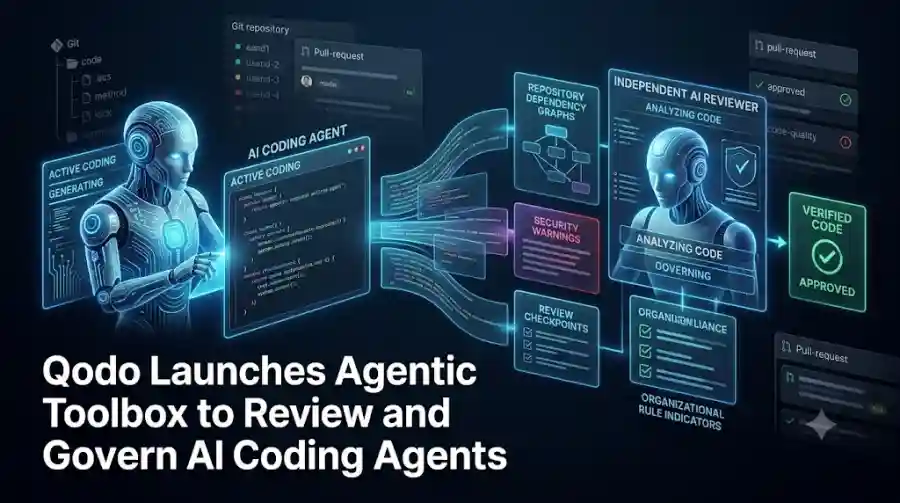
Coding agent → Understand the codebase → Apply standards → Write code → Independent review → Fix issues → Pull request
The goal is to make quality part of the development process rather than a final inspection step.
Qodo says the toolbox is currently available through its integrations with Claude Code, OpenAI Codex and Kiro, while also supporting MCP-compatible clients and coding agents.
Why Normal AI Code Generation Is Not Enough
An AI coding agent can generate technically valid code while still making a poor engineering decision.
For example, an agent might change an API interface without realizing that another internal service depends on the existing behavior.
It could also:
- Ignore a company coding standard.
- Introduce an unsafe retry mechanism.
- Break a dependency in another repository.
- Forget an important security requirement.
- Repeat an issue that was already identified in a previous pull request.
- Modify production-sensitive logic without understanding its wider impact.
Qodo's approach is designed around giving agents more context before they make these decisions.
Qodo Gives Coding Agents More Context
Understanding the Wider Software System
One of the main capabilities of the Agentic Toolbox is access to broader development context.
Qodo says its system can examine information such as:
- Repository relationships
- Cross-repository dependencies
- Pull request history
- Specifications
- Live Git state
- Existing engineering standards
This means the coding agent does not have to rely only on the task description and the files currently open in its workspace.
That could become increasingly important as companies use AI agents across large software environments.
A small change inside one repository can have consequences elsewhere.
Understanding that relationship before making the change is one of the key challenges of autonomous software engineering.
Mapping Dependencies Before Making Changes
Imagine a developer asks an AI agent to modify a payment service.
A basic coding assistant may inspect the payment repository and begin editing.
With broader repository context, the agent can first investigate which other services depend on that interface.
Qodo's example shows the system finding historical information explaining why certain payment failures should not automatically be retried.
That type of historical context can prevent an AI agent from making a technically plausible but operationally dangerous modification.
AI Agents Can Follow Company Rules Before Writing Code
Another major part of Qodo's Agentic Toolbox is organizational governance.
Standards Become Part of the Coding Process
Engineering organizations often have rules that are not obvious from a programming task.
For example, a company may require:
- Specific authentication methods.
- Timeouts on outbound requests.
- Idempotency keys for payment operations.
- Restrictions on sensitive data in logs.
- Particular testing requirements.
- Security review for certain changes.
Qodo's toolbox can retrieve applicable global, workspace and repository rules so the coding agent can use them during implementation.
This is different from asking an AI chatbot to remember a generic coding style.
The objective is to connect the agent with the actual standards used by the organization.
Administrators Can Manage Policies Using Natural Language
Qodo also says authorized administrators can create, update and apply organizational coding and review standards through natural-language instructions.
That could make governance easier for engineering teams that need to manage AI agents across multiple projects.
Instead of configuring every coding agent separately, organizations can establish common rules that are applied throughout their development environment.
Agent-to-Agent Code Review
The most interesting part of the launch is the independent review capability.
One AI Agent Writes, Another AI System Reviews
Traditional AI coding workflows often look like this:
Developer → AI generates code → Developer reviews code
Qodo is introducing another layer:
Developer → Coding agent writes code → Qodo independently reviews code → Coding agent fixes issues → Developer reviews remaining risks
The distinction is important.
The coding agent is not expected to be the only system deciding whether its own work is correct.
Qodo acts as an independent quality layer.
The company describes this as agent-to-agent review.
Review Can Happen Before the Pull Request
Qodo says its full review process can run against both committed and uncommitted local changes.
That means developers do not necessarily have to open a pull request before the AI review begins.
This allows problems to be identified earlier.
For example, the coding agent could implement a feature, run tests and then ask Qodo to independently examine the changes.
If Qodo finds a problem, the coding agent can investigate and attempt to fix it before the developer creates the pull request.
Coding Agents Can Act on Review Findings
Qodo is also connecting review findings back into the coding session.
Structured Feedback Goes Back to the Agent
Instead of requiring developers to manually copy review comments into an AI coding assistant, the agent can retrieve structured findings from Qodo.
The agent can then investigate those issues and attempt fixes within the same development session.
This creates a continuous loop:
Write → Review → Identify → Fix → Review Again
That workflow is closer to how autonomous software engineering could operate in the future.
Humans Still Control High-Risk Decisions
Qodo is not positioning the system as a replacement for engineers.
Instead, the company says developers can decide how much work an agent should perform autonomously.
For example, a developer could allow the agent to fix straightforward issues automatically while requiring human review for changes that could affect production behavior.
This creates a hybrid approach.
AI handles repetitive quality checks and straightforward fixes.
Humans focus on architectural decisions, business requirements and high-risk changes.
Qodo Works With Major Coding Agents
The Agentic Toolbox is particularly interesting because it is not limited to one AI coding environment.
Claude Code
Qodo provides Agentic Toolbox capabilities for Claude Code, allowing the coding agent to access Qodo's context, review and governance features.
OpenAI Codex
Qodo also launched a dedicated Codex integration at the same time.
The company says the Qodo plugin is available through the Codex marketplace, allowing Codex users to install the Agentic Toolbox and connect Qodo's capabilities to their development workflow.
This is particularly notable because developers increasingly use coding agents directly from terminals and integrated development environments.
Kiro and MCP-Compatible Agents
Qodo also lists Kiro support and says the toolbox can connect with MCP-compatible clients or coding agents.
That gives Qodo a broader positioning than a traditional code-review plugin.
It is attempting to become a quality and governance layer that can sit around different AI development agents.
How Qodo Differs From Other AI Coding Platforms
The AI coding market is becoming crowded.
TheInfoBytes has already covered platforms such as Huawei CodeArts Agent, Zoho Catalyst 3.0, Replit's Intelligent Model Routing and Coder Agent Relay.
Huawei Cloud CodeArts Agent focuses on autonomous enterprise development, codebase intelligence and multi-agent workflows.
Zoho Catalyst 3.0 connects AI coding agents with application infrastructure and deployment capabilities.
Replit Intelligent Model Routing focuses on automatically selecting an appropriate AI model for different development tasks.
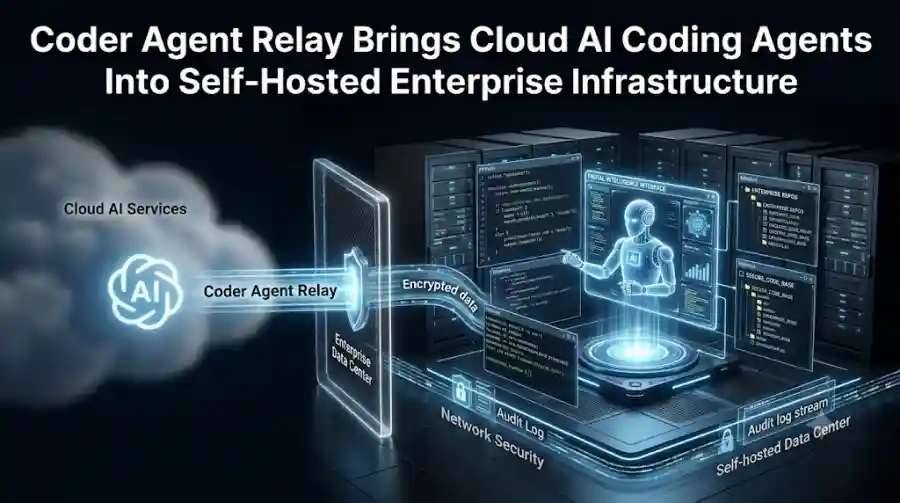
Coder Agent Relay focuses on allowing cloud AI coding agents to execute tools inside infrastructure controlled by enterprises.
Qodo is approaching the market from a different direction.
Its central question is:
How can organizations trust code produced by autonomous coding agents?
That puts Qodo closer to the quality-control and governance layer of the AI coding stack.
Why AI Code Governance Is Becoming More Important
The rapid growth of coding agents changes the economics of software development.
If AI can generate more code in less time, engineering teams may produce significantly more changes.
But more generated code can also mean more opportunities for:
- Bugs
- Security vulnerabilities
- Dependency conflicts
- Poor architectural decisions
- Inconsistent coding practices
- Unreviewed changes
Human reviewers cannot necessarily scale linearly with the volume of AI-generated code.
This is where automated quality systems could become increasingly important.
AI Could Create an AI Review Bottleneck
If one coding agent can produce hundreds of changes, having humans inspect every line becomes difficult.
A review system that understands code context could filter routine issues before they reach engineers.
Humans could then spend more time on decisions that require business or architectural judgment.
This is the broader opportunity Qodo is targeting.
Security Is Another Important Use Case
The Agentic Toolbox could also be useful for security-related development work.
Qodo says the system can support workflows such as tracing relevant code paths, retrieving security standards and validating proposed fixes.
This does not mean every security issue can be solved automatically.
Security decisions often depend on business context and system architecture.
However, having an independent AI review layer could help identify obvious weaknesses earlier in the development process.
That becomes especially valuable when AI agents are writing production code at high speed.
What Qodo's Launch Says About the Future of AI Coding
The AI coding industry may be entering its next phase.
The first major wave focused on autocomplete.
Then came AI assistants capable of generating functions and files.
The current generation is moving toward autonomous agents that can plan, edit, test and debug software.
The next challenge is governance.
Companies will need systems that can answer questions such as:
- What did the AI agent change?
- Why did it make the change?
- Which repositories could be affected?
- Did the change follow company standards?
- Was the code independently reviewed?
- Which issues were automatically fixed?
- Which decisions still require a human?
- Can the organization trust the final result?
Qodo's Agentic Toolbox is aimed directly at this layer.
Qodo has launched its Agentic Toolbox, a new system designed to bring codebase context, organizational standards and independent AI code review directly into coding-agent workflows.
The toolbox works with Claude Code, OpenAI Codex and Kiro, while also supporting MCP-compatible environments. It can help agents understand repository relationships, retrieve relevant rules, review local changes before a pull request and work through structured review findings.
The bigger significance is that AI coding is moving beyond the question of:
“Can AI write the code?”
The more important question is becoming:
“Can we trust AI to write the code?”
Qodo's approach is to put an independent quality layer between autonomous coding agents and production software.
As companies increasingly delegate development tasks to AI agents, tools designed to review, govern and constrain those agents could become just as important as the coding agents themselves.
FAQs
What is Qodo Agentic Toolbox?
Qodo Agentic Toolbox is a collection of AI-powered tools and skills that gives coding agents access to codebase context, organizational standards and independent code review.
Which AI coding agents does Qodo support?
Qodo says the Agentic Toolbox is available for Claude Code, OpenAI Codex and Kiro, with support for MCP-compatible clients and coding agents.