Fergus Brings AI Agents to Job Scheduling, Quotes, Invoices and Daily Trade Business Operations
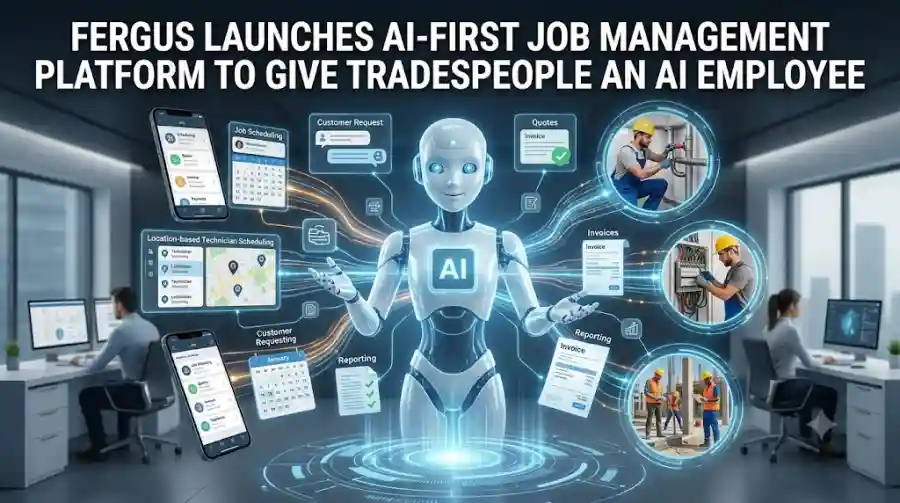
The company announced the new direction on September 13, 2026, positioning its AI experience as an AI employee that can work across jobs, administration and reporting instead of simply answering questions.
For businesses such as plumbers, electricians, builders and HVAC contractors, the goal is straightforward: reduce the amount of administrative work that has traditionally taken owners and office staff away from their actual jobs.
What Is Fergus AI?
Fergus is a job-management platform built for trade businesses.
The existing platform brings together functions such as quoting, scheduling, job tracking, invoicing, payments and reporting. It is designed to give businesses a single place to manage work from the initial customer enquiry through to completion and payment.
The company's new AI-first approach builds intelligence into that workflow.
Rather than creating a separate chatbot that sits alongside the business software, Fergus says its new Fergus AI experience operates like an AI employee across jobs, administration and reporting.
The idea is that users can ask Fergus to perform work and then review the result.
That is a significant difference from conventional software assistants that mainly provide information.
Fergus AI Is Designed Around Actual Business Work
Trade businesses have a particularly large amount of repetitive administration.
A typical job can involve:
- Receiving a customer enquiry
- Creating a job
- Preparing a quote
- Scheduling a technician
- Tracking labour and materials
- Communicating with the customer
- Completing the work
- Creating an invoice
- Following up on payment
- Reviewing profitability
Fergus already provides many of these functions through its job-management platform.
Its AI strategy is designed to connect them more intelligently.
According to Fergus' help documentation, Fergus AI is a new experience that brings forward what needs attention and lines up the next step for the user to review.
That approach puts the emphasis on completing workflows rather than simply generating text.
An AI Employee for Tradespeople
The phrase "AI employee" is particularly interesting because it reflects where enterprise and business AI is heading.
Traditional AI assistants generally wait for instructions.
An AI employee is expected to understand a broader working environment, identify tasks and help move them toward completion.
For Fergus users, this could mean asking the platform to help with business operations without manually navigating through multiple screens.
For example, instead of independently opening scheduling, customer records, job information and reporting tools, a business owner could interact with the AI around the actual business task.
The human still remains in control, but the software handles more of the administrative workload.
Fergus' documentation specifically emphasizes that users can ask for work and check the result, keeping a review step between AI output and business action.
That human-review approach is important for operational software.
A mistake in a casual chatbot response is inconvenient.
A mistake in a customer quote, invoice or technician schedule can directly affect a business.
What Can Fergus Already Automate?
The AI launch builds on a broader collection of automation capabilities already available within Fergus.
The platform supports job scheduling, quoting, job tracking, invoicing, payments and reporting.
Its field-service system also provides real-time job visibility, technician scheduling and mobile access through Fergus Go.
Fergus also uses AI to read and extract information from supplier PDF invoices, allowing businesses to reduce manual data entry and improve job-cost tracking.
The new AI-first direction therefore extends an existing software foundation rather than introducing AI into an otherwise unrelated product.
Fergus Assistant vs Fergus AI
Fergus is also separating its AI experiences into different roles.
The company's documentation describes Fergus Assistant as an extra pair of hands inside the existing Fergus platform.
It can help users record important job information, add notes, tasks and time entries, and keep the office updated from mobile devices.
Fergus AI is positioned differently.
It is described as a broader AI experience that works across jobs, administration and reporting and helps identify what needs attention and what should happen next.
This distinction is important because it shows Fergus is moving toward multiple levels of AI assistance rather than treating every AI interaction as a simple chatbot conversation.
Why AI Could Matter More for Trade Businesses
The AI industry often focuses on developers, knowledge workers and large enterprises.
But millions of businesses operate outside those categories.
A plumbing company, electrical contractor or construction business may not need an AI system to write code or analyze a research paper.
Its biggest problems can be much more practical.
The owner may need to know:
- Which jobs need attention?
- Which quotes are waiting for approval?
- Which technicians are available?
- Which customers need communication?
- Which invoices remain unpaid?
- Which jobs are profitable?
- Which administrative tasks are consuming the most time?
An AI system connected directly to the company's operational data can potentially answer those questions while also helping execute the associated work.
That makes AI less about generating content and more about running a business.
Fergus Already Connects the Entire Job Lifecycle
One of the reasons an AI layer can be useful on top of Fergus is that the underlying platform already connects multiple parts of the job lifecycle.
Fergus describes its system as covering everything from capturing leads and creating quotes to scheduling, job management and payment.
That gives an AI assistant more context than an isolated chatbot.
For example, an AI that only knows what a user types into a conversation has limited visibility.
An AI integrated with job-management software can potentially work with structured information about customers, jobs, technicians, schedules, costs and invoices.
That context is becoming one of the biggest competitive advantages in business AI.
The Human Still Stays in Control
Greater AI autonomy does not mean businesses should hand everything to an AI system without review.
Fergus' own AI documentation emphasizes checking the results.
That is especially relevant for business-critical tasks.
A quote might contain incorrect assumptions.
A customer message could require a human adjustment.
A schedule may need to account for information that is not represented in the software.
A financial report may require additional verification.
The strongest business AI systems are therefore likely to combine automation with human approval rather than attempting to remove people completely.
Fergus appears to be following that model.
What Makes Fergus Different From a General AI Assistant?
A general-purpose AI assistant can potentially help write an email, summarize information or answer questions.
But it usually does not have direct access to a trade company's complete operational workflow.
Fergus is taking the opposite approach.
Its AI is built around a specialized business system that already understands jobs, customers, scheduling, invoices and field operations.
That specialization could make the AI more useful for its target customers.
Instead of asking a general AI model to understand what a "job card," technician schedule or supplier invoice means in a particular business, the underlying software already contains that context.
This is part of a larger trend in AI software: vertical AI.
Rather than building one AI assistant for everyone, companies are increasingly embedding AI into specific industries and workflows.
Fergus' Existing Customer Base Gives the AI a Practical Target
Fergus says its software is used by more than 26,000 tradespeople across Australia, New Zealand and the United Kingdom, according to the September 13 launch announcement.
Its broader platform also serves markets including the United States and Canada.
That existing customer base gives Fergus an important advantage.
It does not need to convince businesses to adopt an entirely new AI platform before demonstrating value.
Instead, AI can be introduced into workflows customers already use.
That could make adoption easier because the software is solving familiar problems rather than asking businesses to create entirely new AI processes.
What This Means for the AI Tools Market
Fergus' launch highlights an important change in the AI tools market.
The biggest opportunities may not always come from another general-purpose chatbot or larger language model.
AI can also become valuable when it is deeply integrated into a specific business workflow.
In Fergus' case, that means combining AI with field-service management.
Other industries are following a similar path.
AI is increasingly appearing inside accounting platforms, CRM systems, developer tools, customer-support software, data platforms and enterprise applications.
The common idea is simple:
AI becomes more useful when it understands the work around it.
For trade businesses, that work involves jobs, people, schedules, customers, materials and payments.
Fergus is now attempting to make AI part of that entire operating system.
What Comes Next for Fergus AI?
The most important test will be how much work Fergus AI can reliably complete without requiring constant human intervention.
The company's current positioning suggests a move toward an AI system that can identify work, prepare actions and help users move through their daily operations.
As these systems become more capable, the boundary between software assistant and software operator will become increasingly blurred.
For small businesses in particular, that could be significant.
An AI system that saves a few minutes on a single task is useful.
An AI system that continuously handles dozens of administrative tasks across hundreds of jobs could become a fundamental part of how the business operates.
Fergus' AI-first strategy is an early example of that broader transition.
Rather than building AI as a standalone chatbot, the company is putting it directly inside the operational workflow of trade businesses.
That makes Fergus an interesting company to watch as vertical AI moves from experimentation toward everyday business operations.
FAQs
What is Fergus AI?
Fergus AI is a new AI-first experience from Fergus designed to work across jobs, administration and reporting for trade businesses. Fergus describes it as working like an AI employee that can help identify what needs attention and prepare the next steps for users to review.
Who is Fergus AI designed for?
Fergus is designed primarily for trade businesses such as plumbers, electricians, builders, HVAC technicians and other field-service businesses.