Google AI Plans Get Major Productivity Upgrade With Voice Controls, Sheets Mini-Apps and Gemini Agents
Instead, the company is turning the subscription into a broader productivity layer across its software ecosystem.
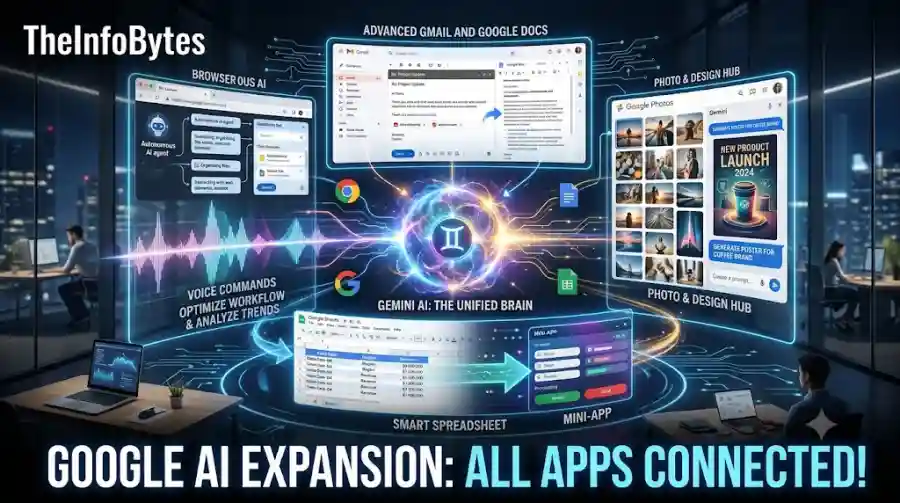
Users can now use their voice to work with Gmail, Docs and Keep, create visuals through Google Pics, transform spreadsheets into interactive mini-apps through Sheets Canvas, and let Gemini Spark handle certain web and photo-related tasks.
Some of these capabilities are limited to higher-tier plans or specific regions, so availability is not identical across all Google AI subscriptions.
What Google Is Adding to Its AI Plans
Google's September update introduces several different capabilities rather than one single new AI model.
The major additions include:
- Voice-powered workflows in Gmail, Docs and Keep
- Google Pics inside Google Workspace
- Sheets Canvas for creating interactive mini-apps
- Gemini Spark integrations with Chrome and Google Photos
- Expanded AI subscription benefits for eligible college students
Together, these changes show Google's broader strategy of embedding AI directly into applications that people already use every day.
Voice Comes to Gmail, Docs and Keep
One of the most practical additions is the ability to use voice more deeply inside Google's productivity applications.
Google says users can use their voice in Gmail, Docs and Keep to perform tasks such as drafting documents, finding information in an inbox and quickly capturing thoughts.
This could make AI assistance more useful for people who do not want to type every instruction.
For example, a user could verbally describe an idea and use Gemini to turn it into structured content. Someone dealing with a busy inbox could ask for information instead of manually searching through messages.
Google is effectively treating voice as another input method for productivity rather than restricting it to conventional conversational AI.
Which Plans Get Voice Features?
Google's announcement says the availability varies by application.
AI Plus, Pro and Ultra subscribers can access the voice features in Gmail and Keep, while Docs access is available to AI Pro and Ultra subscribers.
That distinction is important for users comparing Google's subscription tiers.
The company continues to divide its most advanced AI productivity capabilities between different plans rather than making every feature available to every subscriber.
Google Pics Comes to Google Workspace
Google is also expanding Google Pics into Google Workspace.
The company describes Google Pics as a tool for designing posters, producing social media posts and editing digital illustrations. The feature is available with Google AI Pro and Ultra plans.
This gives Google's AI subscription a stronger creative component.
Instead of requiring users to move between a document editor and a separate image-generation or design service, Google is bringing more visual creation capabilities into its existing productivity ecosystem.
For small businesses, marketers and content creators, this could be particularly useful.
A person preparing a campaign could potentially move from written content to visual assets without leaving Google's ecosystem.
Google Pics also fits into Google's larger push to make AI-generated and AI-edited visuals part of everyday productivity rather than treating image generation as a separate experimental technology.
Sheets Canvas Can Turn Spreadsheets Into Mini-Apps
One of the more interesting additions is Sheets Canvas.
Google says Sheets Canvas can turn spreadsheets into custom, interactive "mini-apps" using a simple prompt. The feature is available with AI Pro and Ultra.
This is potentially more significant than a conventional AI spreadsheet assistant.
Instead of simply asking AI to summarize rows or generate a formula, users can describe what they want to build and have AI transform spreadsheet data into a more interactive experience.
For example, a business could have a spreadsheet containing sales information and ask AI to create a custom interface for exploring that information.
A team could potentially use a similar workflow for tracking projects, monitoring budgets or exploring operational data.
The exact usefulness will depend on how flexible the resulting mini-apps are, but the concept points toward a future in which spreadsheets become starting points for lightweight software.
Gemini Spark Gets More Connected
Google is also expanding Gemini Spark, its agentic system designed to handle tasks beyond simple conversations.
According to Google, Spark is now connected with Google Chrome and Google Photos, allowing it to handle tasks such as web errands, photo editing and album curation. These capabilities are currently available to AI Pro and Ultra subscribers in the United States.
This is an important development because agentic AI works differently from traditional chatbot interactions.
A conventional chatbot generally waits for a prompt, produces a response and stops.
An agent can potentially take a goal and perform several actions to complete it.
Google's earlier Gemini Live updates showed the company moving in this direction by connecting Gemini with Spark for multi-step tasks across Docs, Sheets, Drive and the web.
The September update expands that direction into more Google services.
What Can Gemini Spark Actually Do?
Google says Spark can help with web errands and photo-related tasks.
For example, users can ask Gemini for help with an online task and have Spark handle parts of the process. The integration with Google Photos also opens possibilities around editing images and organizing albums.
The important point is that these tasks are being handled through an AI agent rather than simply answered with text.
This represents Google's broader shift toward AI that performs actions instead of only generating information.
However, availability is currently restricted to AI Pro and Ultra users in the U.S. for the Chrome and Photos integrations, meaning users elsewhere should not assume they have access to every Spark capability yet.
Google Is Turning AI Plans Into a Productivity Platform
The most interesting part of this announcement is not any individual feature.
It is the way the features fit together.
Google already has an enormous software ecosystem:
- Gmail
- Google Docs
- Google Sheets
- Google Drive
- Google Photos
- Chrome
- Google Keep
- Gemini
The company's AI strategy is increasingly about connecting these services.
That gives Google an advantage that standalone AI applications may struggle to reproduce.
A user can already keep email, documents, spreadsheets, photos and browser activity inside one ecosystem. AI can potentially become the layer connecting all of those activities.
AI Is Moving From Chat to Action
The September update also highlights a larger change in the AI industry.
Early generative AI products were primarily designed around conversations.
You asked a question.
The model answered.
The next generation is increasingly focused on actions.
Google's Spark system is an example of this transition. Rather than simply telling a user how to complete a task, the goal is increasingly for AI to perform parts of the task itself.
That could eventually change how people interact with software.
Instead of opening Sheets, creating formulas and designing a dashboard manually, users could describe the outcome they want.
Instead of searching Gmail manually, users could ask AI to locate and summarize relevant messages.
Instead of opening a photo editor and manually performing several operations, users could describe the desired result.
The challenge will be reliability.
As AI gets more control over applications and personal information, accuracy, permissions and user oversight become increasingly important.
Google Also Offers AI Plans to Eligible College Students
Google is also expanding the reach of its AI subscriptions among students.
The company says eligible college students around the world can receive one year of a Google AI plan free of charge.
This could significantly increase the number of students experimenting with Google's AI productivity tools.
Students are a particularly important audience for AI assistants because their workflows already involve research, writing, presentations, spreadsheets, note-taking and information management.
Giving students extended access also gives Google an opportunity to make Gemini part of their everyday productivity habits earlier in their education.
Which Google AI Plan Is Most Relevant?
The new features also make the differences between Google's AI subscription tiers more important.
Based on Google's September announcement:
| Feature | AI Plus | AI Pro | AI Ultra |
|---|---|---|---|
| Voice in Gmail | Yes | Yes | Yes |
| Voice in Keep | Yes | Yes | Yes |
| Voice in Docs | No | Yes | Yes |
| Google Pics in Workspace | No | Yes | Yes |
| Sheets Canvas | No | Yes | Yes |
| Gemini Spark + Chrome | No | Yes* | Yes* |
| Gemini Spark + Google Photos | No | Yes* | Yes* |
* Google says the Chrome and Google Photos Spark integrations are available to AI Pro and Ultra subscribers in the U.S.
The exact benefits of each plan can change as Google adds new capabilities, so users should check Google's current subscription information before choosing a plan.
Why This Update Matters for AI Users
Google's latest AI plan update is important because it shows where consumer AI subscriptions are heading.
Instead of competing only on model intelligence, companies are increasingly competing on what their AI can actually do across existing software.
Google has a particularly strong position because of its ecosystem.
The company does not need to build an entirely new productivity environment for AI.
It can add AI to Gmail, Docs, Sheets, Chrome, Photos and other services that people already use.
That makes the subscription more valuable if users regularly work inside Google's ecosystem.
Google's September 2026 AI plan update is one of the company's more interesting productivity-focused expansions.
The additions include voice-powered workflows in Gmail, Docs and Keep, Google Pics for Workspace, Sheets Canvas mini-apps and expanded Gemini Spark integrations with Chrome and Google Photos.
The bigger story, however, is the direction of Google's AI strategy.
Gemini is increasingly becoming more than a chatbot.
Google wants it to understand information, create content, interact with applications and eventually complete tasks on behalf of users.
The addition of Sheets Canvas and Gemini Spark is especially notable because both move AI closer to actually building or performing things rather than simply describing how they could be done.
For Google AI subscribers, these updates make the ecosystem more useful. For the broader AI industry, they provide another indication that the next phase of competition will be about AI agents embedded directly inside the software people already use.
Frequently Asked Questions
What new features did Google add to its AI plans?
Google added voice capabilities in Gmail, Docs and Keep, Google Pics in Workspace, Sheets Canvas mini-apps, and new Gemini Spark integrations with Chrome and Google Photos.
What is Sheets Canvas?
Sheets Canvas is a Google AI feature that can turn spreadsheets into custom interactive mini-apps using a simple prompt. Google says it is available with AI Pro and Ultra.