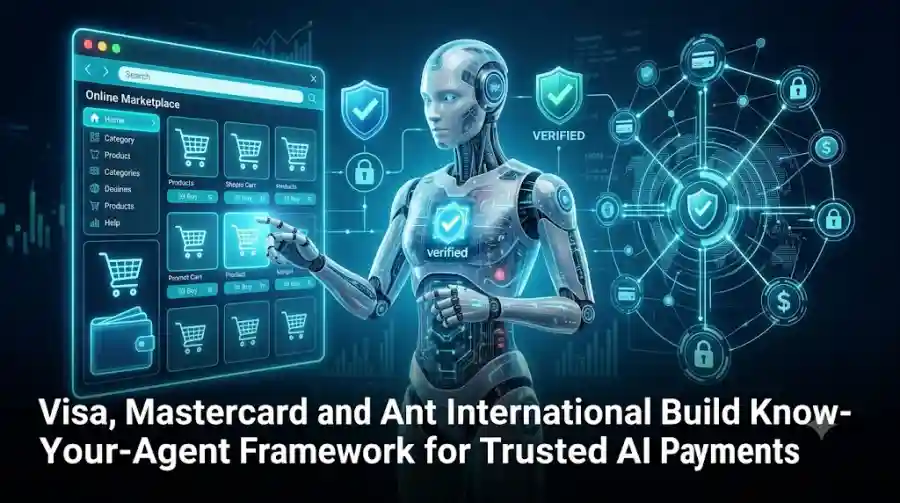
Visa, Mastercard and Ant International Team Up to Verify AI Agents Before They Make Purchases
They are increasingly being designed to perform actions on behalf of users, including searching for products, selecting services and eventually completing purchases.
That creates a new challenge for the payments industry.
A payment network needs to know not only who the customer is, but also which AI agent is attempting to act for that customer, what authority the agent has and whether the transaction should be trusted.
Visa, Mastercard and Ant International are now working on that problem.
The three companies announced on September 10, 2026, that they have begun collaborating on a Know-Your-Agent (KYA) interoperability framework designed to help payment networks, digital wallets, agent platforms and marketplaces identify and onboard AI agents across different ecosystems.
The goal is not to create one payment system.
Instead, the companies want to establish shared principles that can allow trusted AI agents to be recognized across participating payment environments while individual networks maintain their own verification, approval and risk-management processes.
What Is the Know-Your-Agent Framework?
From Know Your Customer to Know Your Agent
Financial institutions have long relied on Know Your Customer, or KYC, processes to establish who is using a financial service.
Agentic commerce introduces another identity layer.
An AI agent could be acting on behalf of a real person, but the agent itself may be the system communicating with a merchant or payment platform.
The new KYA concept is designed to address that additional layer.
The proposed framework would help participating ecosystems identify AI agents and establish the information needed to determine whether those agents can be trusted to perform specific transactions.
This becomes increasingly important as AI systems move from simply recommending products to actually completing purchases.
Why AI Agents Need Their Own Trust Layer
A traditional online purchase normally involves a user directly interacting with a merchant.
An agentic transaction can look very different.
A user might tell an AI assistant:
Find me the best available flight within my budget and book it.
The agent could then search several websites, compare prices, select an option and eventually initiate a payment.
The user may not be directly interacting with the merchant at every step.
That creates several questions:
- Is the AI agent legitimate?
- Who authorized it?
- What is the agent allowed to purchase?
- Can the payment provider verify its identity?
- Has the user actually approved the transaction?
- What happens if the agent makes a mistake?
- Which party is responsible if something goes wrong?
The KYA initiative is aimed at creating common infrastructure for answering these types of questions.
Visa, Mastercard and Ant Already Have Agentic Payment Protocols
The new collaboration is not starting from zero.
Each company has already developed technology or protocols for agentic commerce.
Visa Trusted Agent Protocol
Visa has been developing its own infrastructure for AI-driven commerce, including mechanisms intended to help merchants and payment systems distinguish trusted AI agents from other automated activity.
Visa also reported recently that consumer trust remains a major factor in the adoption of agentic commerce. Its September 9 research found that only 23% of surveyed U.S. consumers trusted generative AI to handle payment transactions on their behalf, highlighting why identity and verification are becoming important parts of the technology.
Visa's existing rules also already define specific roles for agentic payment providers and establish requirements around agentic transactions.
Mastercard Verifiable Intent
Mastercard has also been working on mechanisms for establishing what a user intended an AI agent to do.
Its broader agentic-commerce strategy includes the idea of making machine-driven transactions more identifiable, controlled and secure.
Mastercard's work on agentic commerce has already included initiatives such as Agent Pay, which is designed around payments made by AI systems and machines.
Ant International Agentic Mobile Protocol
Ant International has developed its own Agentic Mobile Protocol as part of its work on AI-driven financial services and commerce.
The three companies will now explore how these different approaches can work together through common principles rather than forcing every ecosystem to build completely separate integrations.
How KYA Could Make AI Shopping More Interoperable
One of the biggest problems with agentic commerce is fragmentation.
Imagine an AI shopping agent that works with one digital wallet but not another.
The agent platform might understand one identity system while a merchant uses a completely different verification mechanism.
A payment network could also have its own risk rules.
Without interoperability, every combination could require another technical integration.
The proposed KYA framework could help reduce that complexity.
Common Principles, Different Risk Decisions
Importantly, the initiative does not mean Visa, Mastercard and Ant International will surrender their individual approval systems.
The companies say the framework is intended to provide shared principles for onboarding and identifying agents while allowing each network to maintain its own verification and decision-making processes.
That distinction matters.
A shared identity and trust layer does not necessarily mean every transaction will receive the same risk decision.
Each network can still apply its own policies.
Lower Integration Costs
The companies also expect interoperability to reduce the effort required to connect agent platforms, payment providers and marketplaces.
Instead of every company developing completely separate systems for recognizing AI agents, common principles could make it easier for new agentic services to connect with existing financial infrastructure.
This could become particularly important if AI agents become a mainstream way of shopping online.
Why This Matters for Agentic Commerce
The most important part of this announcement is not simply the three companies involved.
It is the direction of online commerce.
For years, AI shopping assistants have mainly focused on discovery.
A user asks an AI system to compare products.
The system provides recommendations.
The user then opens a website and completes the purchase.
Agentic commerce changes that relationship.
AI Could Eventually Handle the Entire Purchase
In a mature agentic commerce system, a user could give an AI agent a goal rather than a detailed list of instructions.
For example:
“Buy a new laptop under my budget with at least 16GB of RAM and the best battery life you can find.”
The agent could potentially:
- Search multiple retailers.
- Compare specifications.
- Check availability.
- Compare prices.
- Select an appropriate product.
- Confirm the user's purchasing rules.
- Initiate payment.
- Receive an order confirmation.
At that point, the payment system is no longer dealing with a human clicking a checkout button.
It is dealing with software acting under delegated authority.
That makes agent identity and authorization fundamental.
The Security Problem Goes Beyond Payment Fraud
KYA could also become important for security.
AI agents are software systems, and software can be compromised, manipulated or misconfigured.
A malicious actor could potentially attempt to impersonate a legitimate agent or exploit weaknesses in an agent's permissions.
A reliable identity framework could give payment ecosystems another layer of information for evaluating whether an agent should be trusted.
This is part of a much larger movement toward securing autonomous AI.
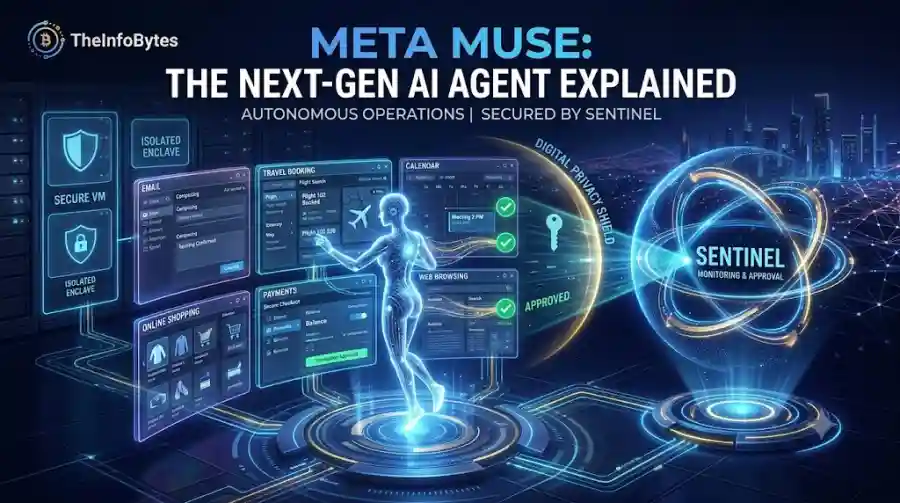
TheInfoBytes has already covered the security challenges around autonomous agents, including Meta's use of a dedicated security layer for Muse and Operant AI's approach to monitoring agent intent.
Meta Muse: Personal AI Agent With Secure VM and Sentinel
Operant AI Semantic Firewall for AI Agents
These developments address different parts of the same emerging problem: how do we allow AI systems to take meaningful actions without giving them uncontrolled authority?
BuildFin.ai Will Support the Collaboration
Visa, Mastercard and Ant International said their work will take place through BuildFin.ai, a platform convened by the Monetary Authority of Singapore.
BuildFin.ai brings together financial institutions, technology companies and researchers to work on AI-related financial solutions.
Using such a collaborative environment could help the companies explore interoperability across different types of financial infrastructure rather than designing the framework around only one payment network.
The Bigger AI Industry Is Moving Toward Delegated Authority
The KYA initiative is another sign that AI development is moving into a new phase.
The first generation of generative AI largely focused on producing information.
The next generation is increasingly focused on taking action.
AI agents can now write software, browse websites, access business systems and coordinate workflows.
The next logical step is allowing them to transact.
TheInfoBytes has already covered several developments demonstrating this shift, including enterprise AI agents, coding agents and systems that connect AI to real-world business software.
One relevant example is Salesforce's Headless 360 expansion, which allows AI agents to interact with enterprise applications through agent-oriented infrastructure.
Salesforce Headless 360 and AI Agents
Payment systems are now becoming another major piece of that infrastructure.
What Could Happen Next?
The announcement is an important step, but it is not yet a universal KYA standard.
The companies have said they are beginning collaboration and exploring common principles.
That means the practical implementation details will matter.
Future developments could address questions such as:
Agent Identity
How should a payment network uniquely identify an AI agent?
User Authorization
How can an agent prove that a user actually gave it permission to make a particular purchase?
Transaction Limits
Can users establish limits for price, merchant category or transaction frequency?
Risk Management
How should networks respond when an agent behaves differently from its expected profile?
Cross-Network Recognition
Can one trusted agent identity work across multiple card networks, wallets and marketplaces?
These questions will become increasingly important as AI agents become capable of handling larger financial decisions.
AI Payments Could Become a New Internet Infrastructure Layer
The development of KYA suggests that the future of online commerce may require infrastructure specifically designed for machines.
The web was originally designed around humans interacting with websites.
Then mobile apps changed how people interacted with services.
AI agents could create another major shift where software systems increasingly interact with other software systems on behalf of people.
Payments need to evolve alongside that change.
Visa, Mastercard and Ant International's KYA collaboration is an attempt to create some of the trust infrastructure required for that transition.
The companies are effectively trying to answer a simple but important question:
How do you know that an AI agent is authorized to act for a person?
That question may become as important to digital commerce as passwords, authentication and payment tokens have been in previous generations.
Visa, Mastercard and Ant International are collaborating on a Know-Your-Agent interoperability framework designed to help identify and verify AI agents across card networks, digital wallets, agent platforms and marketplaces.
The initiative builds on Visa's Trusted Agent Protocol, Mastercard's Verifiable Intent and Ant International's Agentic Mobile Protocol. The goal is to establish shared principles while allowing each payment ecosystem to retain its own approval and risk controls.
The announcement is significant because AI agents are moving from recommendation systems toward autonomous commerce.
If AI agents eventually become capable of making purchases on behalf of millions of users, payment networks will need reliable ways to identify those agents, understand their authority and manage their risks.
KYA could become an important part of that infrastructure.
The bigger trend is clear: AI is not only becoming an interface for information. It is becoming an interface for action and commerce.
FAQs
What is Know-Your-Agent or KYA?
Know-Your-Agent is a proposed framework for identifying and verifying AI agents that act on behalf of users in digital commerce and payment environments.
Who is developing the KYA framework?
Ant International, Mastercard and Visa announced the collaboration in September 2026.