Suno v6 Brings New AI Music Models, Image-to-Music Creation and Smarter Song Editing
Instead of competing only on how realistic an AI-generated song sounds, music-generation platforms are increasingly trying to give creators more control over the entire creative process.
Suno is making a major move in that direction with the launch of Suno v6, a new generation of AI music models introduced on September 9, 2026.
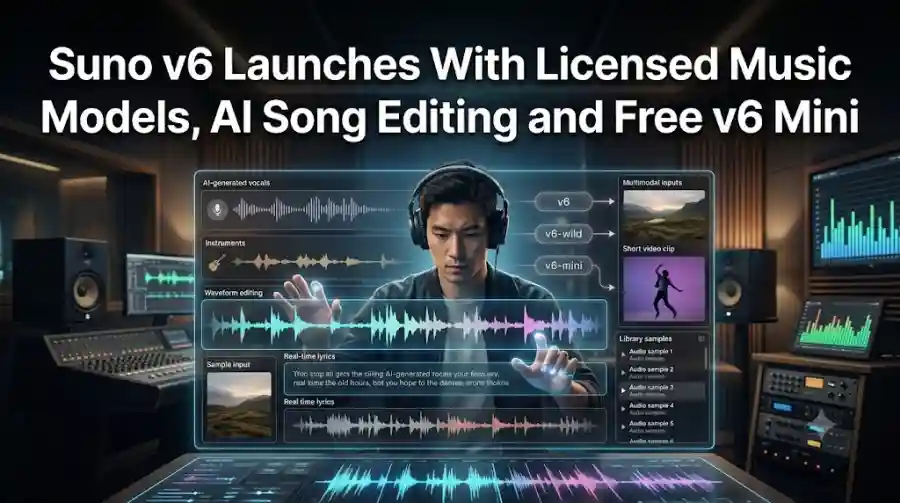
The new generation includes three different models: v6, v6-wild and v6-mini. Suno says the models are faster, more expressive and higher quality than its previous generation, while adding new tools for editing, remixing, sampling and multimodal music creation.
The launch is also significant because Suno developed the new models with industry partners including Warner Music Group, BMG and Believe.
That gives the release an important second dimension: the company is trying to build AI music technology with the traditional music industry rather than operating entirely separately from it.
What Is Suno v6?
Suno v6 is the company's latest generation of AI music-generation models.
Rather than offering one model for every type of creator, Suno has created three versions aimed at different creative workflows.
Suno v6
The standard v6 model is the flagship option.
Suno describes it as reliable, precise and capable of producing polished music across different genres and styles.
It is designed for creators who already know what they want and need greater control over the final result.
Suno v6-wild
The v6-wild model takes a different approach.
Instead of prioritizing predictable results, it is designed to be more experimental and less predictable.
This can be useful when a creator has an idea but wants the AI to introduce unexpected musical directions.
Suno describes it as a model for exploration, experimentation and discovering ideas that may not emerge from a highly controlled generation process.
Suno v6-mini
The third model is v6-mini.
It is designed to be faster and more efficient and is available to all users.
Unlike v6 and v6-wild, which require Pro or Premier access, v6-mini is available across Suno's plans, including the Free plan.
That makes v6-mini particularly important for users who want to experiment with the new generation without immediately paying for a subscription.
Suno v6 Was Developed With Music Industry Partners
One of the biggest differences between v6 and earlier Suno models is how the new generation was developed.
Suno says v6 was created with industry partners including Warner Music Group, BMG and Believe.
This follows a period of significant legal and business pressure around AI-generated music.
Suno previously faced copyright lawsuits from major music companies over the use of copyrighted recordings in AI training.
The company has since moved toward licensing agreements and industry partnerships.
TechCrunch reports that Suno says v6 was not trained using the data used for its previous models, while the new generation was developed using licensed material associated with its industry partnerships.
That makes the launch important beyond its technical improvements.
It represents an attempt to create a more structured relationship between generative AI and music rights holders.
AI Music Creation Becomes More Interactive
The biggest practical change for creators is that Suno v6 is not limited to generating an entire song from one prompt.
Users can now modify specific parts of an existing track using natural-language instructions.
For example, a creator could ask Suno to change the chorus while keeping the rest of the song intact.
This changes the creative process.
Instead of repeatedly generating complete songs and choosing the closest result, creators can make targeted changes to individual sections.
Suno says users can:
- Edit sections using plain-language instructions
- Change individual lyrics
- Build mashups from multiple sources
- Isolate musical elements
- Sample parts of existing tracks
- Create music from text
- Use audio as creative input
- Use images as inspiration
- Use video as an input
- Combine multiple creative references
These features are part of Suno's broader attempt to make AI music creation behave more like an interactive creative studio.
Edit a Song Without Starting Over
One of the most useful additions is natural-language section editing.
Previously, if a generated song contained a good verse but an unwanted chorus, a creator could face a difficult choice: accept the result or regenerate the track.
Suno v6 is designed to make that process more precise.
A creator can ask the system to change one section while preserving the parts that already work.
For example:
Change the chorus into a gospel-style vocal arrangement.
The purpose is not simply to regenerate another song.
It is to edit the existing creative asset.
That brings AI music closer to the editing experience creators already expect from traditional music-production software.
Suno v6 Can Build Mashups
Suno is also introducing a workflow for combining elements from multiple songs.
A creator can select different components and tell the system how they should work together.
For example, a user could combine:
- Vocals from one track
- Drums from another
- A guitar element from another
- Newly generated lyrics
- A completely different musical style
Suno says its new system can perform these operations in a single workflow.
This could be particularly useful for creators who already have a library of AI-generated material.
Instead of treating every generation as an isolated song, users can begin treating their previous creations as building blocks.
Image, Video and Audio Can Now Inspire Music
Suno v6 also expands beyond text prompts.
Users can create music from text, audio, images and video.
This is one of the more interesting changes because it makes AI music generation multimodal.
A creator could start with a photograph and ask the system to create a soundtrack that matches its mood.
A video could become the starting point for a musical composition.
A voice memo could provide the initial idea.
An existing audio recording could become the basis for a new musical direction.
Suno says users can also combine multiple types of creative references in one workflow.
This turns the tool into something closer to a general-purpose creative engine rather than a simple text-to-song generator.
Single-Lyric Editing Adds More Control
Another small but useful feature is the ability to change a single lyric without rebuilding the entire song.
A creator might discover that one word does not fit the meaning they intended.
Instead of regenerating the entire track, Suno allows the user to make a targeted lyric change.
This matters because AI-generated music often involves many small imperfections.
The ability to make precise changes can reduce the number of full generations required to reach a final result.
Suno Is Moving Toward a Complete AI Music Workflow
The combination of these features suggests that Suno is trying to cover more of the music-creation process.
The workflow can now look something like:
Idea → Generation → Editing → Sampling → Mashup → Refinement → Final Track
That is different from the older AI music experience:
Prompt → Generate Song
The difference could become important as AI music becomes more professional.
Casual users may still want instant songs.
Professional creators, however, need control.
They need to be able to make decisions about specific sections, lyrics, sounds and arrangements.
Suno v6 is clearly moving toward that second use case.
What Is Different About v6-wild?
The v6-wild model is designed around unpredictability.
That might sound like a minor feature, but creativity sometimes benefits from unexpected results.
A highly controlled model is useful when a creator knows exactly what they want.
But someone experimenting with a new genre may prefer an AI system that makes unusual choices.
Suno's approach effectively gives users two different creative modes:
v6: control and precision.
v6-wild: experimentation and surprise.
This is similar to how professional creative software can offer both controlled editing tools and experimental effects.
Free Users Get v6-mini
One of the most important decisions in the release is Suno's inclusion of v6-mini for all users.
The standard v6 and v6-wild models are available to Pro and Premier subscribers.
v6-mini is available to everyone.
That means users can experience the new generation without immediately paying for the premium models.
For Suno, this could also help bring more people into the new v6 ecosystem.
Once users become familiar with the new workflows, some may eventually upgrade for greater control and more advanced generation capabilities.
Suno Is Retiring Previous Models
The v6 launch is not simply another option alongside a long list of previous Suno models.
Suno says it will retire its previous models and move the platform entirely to the v6 generation.
That is a significant change.
It means v6 is intended to become the foundation of the company's music-generation platform rather than an experimental side product.
For existing Suno users, the transition could also change how older workflows behave as the new models become the default generation technology.
Why the Licensed-Model Shift Matters
The biggest industry question surrounding AI-generated music has always been training data.
Music companies have argued that AI systems should not use copyrighted recordings without permission.
Suno's new partnerships represent an attempt to address that issue through licensing and collaboration.
The company has also introduced safeguards around uploaded audio and lyrics and says it wants to make unauthorized use more difficult.
This does not eliminate every legal or ethical question surrounding AI-generated music.
However, it represents a different business model.
Instead of:
AI company vs. music industry
the new approach attempts to create:
AI company + music industry + artists + creators
That could become an important model for the broader generative-AI industry.
New Revenue Opportunities for Artists
Suno says v6 is also intended to lay the foundation for new products where individual artists can choose to participate.
The company's planned direction involves opt-in experiences in which artists can participate and potentially receive payment when their involvement contributes to an AI product.
That is potentially important because AI-generated music has traditionally created a difficult question:
If an AI product benefits from an artist's creative identity or catalog, how should that artist be compensated?
An opt-in model provides one possible answer.
It could allow artists to decide whether they want to participate rather than having AI systems operate around them without direct involvement.
Suno v6 and the Future of AI Music
The launch arrives at a time when AI-generated music is becoming increasingly competitive.
Platforms are improving audio quality, generation speed and control while music companies are becoming more involved in how these systems are trained and commercialized.
Suno's v6 strategy suggests that the next phase will focus on three areas:
Better Generation
AI models need to produce more convincing music across different genres and styles.
Better Control
Creators need to modify specific parts instead of repeatedly regenerating complete tracks.
Better Industry Relationships
AI companies need sustainable agreements with artists, publishers, labels and distributors.
Suno is attempting to address all three at the same time.
What This Means for Content Creators
For YouTubers, podcasters, filmmakers and social-media creators, AI music tools can reduce the time required to create original background music.
Suno v6 could make that workflow more flexible.
A creator could start with a video, generate a soundtrack, edit a specific section and then refine the music without leaving the platform.
That could be particularly useful for creators who need custom music frequently but do not have access to professional musicians or a full production team.
What This Means for Musicians
The impact on musicians is more complicated.
AI can provide a faster way to experiment with arrangements, melodies and ideas.
But it also changes the economics of music creation.
The new licensing partnerships are therefore important because they attempt to bring professional rights holders into the AI ecosystem.
If Suno's opt-in model succeeds, future AI music products could potentially give artists another way to earn money from their participation.
If it fails, disputes over training data, artist identity and copyright could continue to dominate the sector.
Suno v6 vs Traditional AI Music Generation
| Feature | Earlier AI Music Workflow | Suno v6 |
|---|---|---|
| Full-song generation | Yes | Yes |
| Section editing | Limited | Yes |
| Natural-language editing | Limited | Yes |
| Mashups | Limited | Yes |
| Image input | Limited | Yes |
| Video input | Limited | Yes |
| Audio input | Yes | Yes |
| Individual lyric editing | Limited | Yes |
| Experimental model | Limited | v6-wild |
| Free new-generation model | — | v6-mini |
| Music-industry partnerships | Limited | Warner, BMG, Believe |
The important change is not one individual feature.
It is the combination of generation, editing and creative control in one platform.
Suno v6 is a major update for AI-generated music because it changes the role of the AI from a song generator into a more interactive creative tool.
The new generation includes three models: v6 for controlled creation, v6-wild for experimentation and v6-mini for faster and more accessible generation.
The platform can now edit sections using natural language, build mashups, sample musical elements, change individual lyrics and create music from text, images, video and audio.
But the most important part of the launch may be outside the technology itself.
Suno is building v6 with Warner Music Group, BMG and Believe, signaling a major attempt to establish a more collaborative relationship between generative AI and the music industry.
For creators, v6 means more control.
For artists, it could eventually mean new opt-in revenue opportunities.
For the AI industry, it could provide an example of how generative technology and copyright holders might work together.
AI music is moving beyond simply asking a computer to make a song.
The next generation is about giving creators an AI-powered music studio that can generate, edit, combine and transform musical ideas.
Suno v6 is one of the clearest examples of that transition so far.
FAQs
What is Suno v6?
Suno v6 is Suno's newest generation of AI music models, launched on September 9, 2026. It includes v6, v6-wild and v6-mini.
Is Suno v6 free?
The standard v6 and v6-wild models require Pro or Premier subscriptions. Suno v6-mini is available to all users, including users on the Free plan.