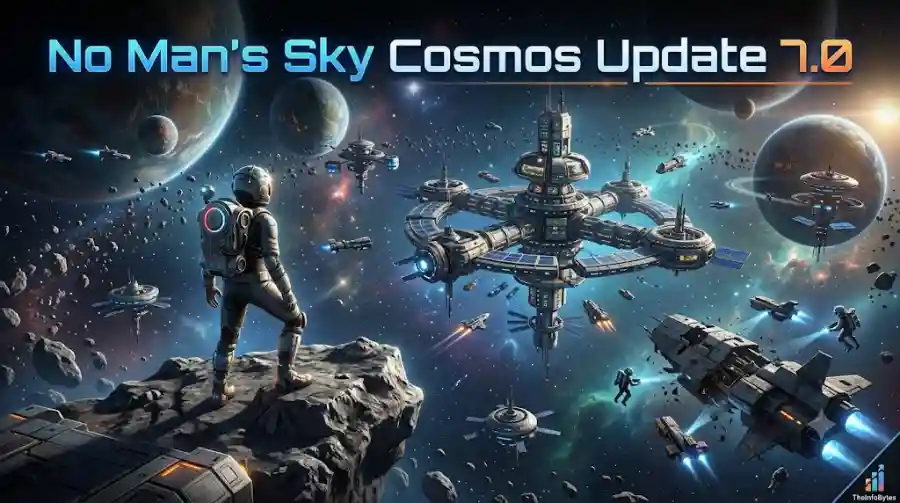
Hello Games’ Biggest Space Overhaul in a Decade Adds Space Station Ownership, Orbital Bases, Derelict Hulks, New Missions and a 10-Year Anniversary Expedition
The update focuses on an area that has remained comparatively unchanged throughout the game's long history: the space between planets.
Players can now become the director of a space station, build bases directly in space, establish their own galactic alliance, explore enormous derelict ship hulks, visit deep-space outposts, travel through new asteroid belts and even attempt to reach the center of a star.
The update also includes a major 10-year anniversary expedition called Our Journey Continues, which celebrates the history of No Man’s Sky by taking players through milestones inspired by the game's previous major updates.
Most importantly, Cosmos is available as a free update for existing players across the game's supported platform ecosystem.
Space Finally Becomes a Place to Explore
No Man’s Sky has always been a space exploration game, but Hello Games says the actual space environment had remained largely unchanged since the original release.
Cosmos is designed to fix that.
Warping into a solar system now gives players much more information through a new interactive star system map.
Instead of treating space as a simple path between planets, the update fills it with new points of interest and activities.
Players can discover outposts, abandoned freighters, asteroid belts, anomalies and other locations that can be revisited.
These locations can lead to missions, salvage opportunities, resources and new encounters.
The goal is to make space feel alive rather than empty.
Players Can Become Space Station Directors
One of the biggest additions is the ability to own and manage a space station.
Players must first prove themselves to local authorities before becoming a station director.
Once they earn that position, they can customize the station's interior and exterior.
The central lobby can be redesigned, additional rooms can be added and existing furnishings can be rearranged.
Players can also unlock hundreds of decorative station components and use them to give their station a completely different personality.
A station can become a practical base, a social hub, a trading location or simply a massive personal building project.
The important difference is that this is not just another planetary base.
Players can now construct and personalize a home in orbit.
Build Bases Anywhere in Space
Cosmos also introduces Orbital Construction.
Players can establish a free-floating base almost anywhere in space.
A deep-space base computer allows Travellers to claim an area and begin construction.
Natural asteroid platforms can be used as foundations, while completely empty areas of space can also be developed.
This opens up a new category of building possibilities.
Instead of placing a conventional base on a planet, players can create an orbital habitat overlooking an entire world.
Players can also build unusual structures such as floating outposts, restaurants, industrial facilities or military-style installations.
The system effectively turns empty space into another building environment.
Galactic Alliances Create a New Multiplayer Goal
Cosmos also expands No Man’s Sky's multiplayer side through Galactic Alliances.
Station directors can create their own alliance and invite other players to join.
Travellers can join up to three alliances.
Members can coordinate exploration and work toward controlling a larger connected territory.
The game also includes Alliance Leaderboards.
The most active and expansive alliances can compete for recognition at their station's core.
This gives multiplayer players a new long-term goal.
Previously, cooperation in No Man’s Sky could focus heavily on exploration, missions and base building.
Now players can also build a social organization around multiple stations and systems.
A successful alliance could eventually become a network of player-owned locations spread across the galaxy.
Deep-Space Outposts Add Missions and Trading
New deep-space outposts are another major part of Cosmos.
Alien communities have established these facilities in inhabited systems.
Players can visit them to trade, process resources and accept contracts.
Outposts also provide new opportunities for material recovery and salvage missions.
Some facilities are not safe, however.
Certain locations have been overrun by biological infestations.
Players must clear out these hazards before safely collecting their rewards.
This gives space exploration a stronger sense of progression because new locations are not merely things to look at.
They can become destinations with their own activities, risks and rewards.
Derelict Hulks Turn Space Into a Salvage Operation
One of the most interesting new activities is exploring derelict hulks.
These enormous shipwrecks drift through deep space and function as dangerous explorable environments.
Players can perform spacewalks through their damaged interiors, searching for technology, cargo and other valuable materials.
The hulks also introduce a risk-reward mechanic.
Their structures are unstable.
Salvaging too much can damage their remaining integrity and potentially trigger a catastrophic meltdown.
That means players need to balance greed with survival.
The smartest approach may be to scan the hulk, identify the most valuable targets and get out before the structure collapses.
It turns what could have been a simple scavenging activity into a pressure-filled expedition.
The Tractor Beam Makes Salvaging More Dynamic
Cosmos also introduces a new Tractor Beam upgrade for Corvette-class ships.
Once equipped, the tractor beam can collect physical salvage extracted from deep-space points of interest.
Players can use the new Gravitino Coil to launch salvage toward the beam, which then stores it inside the ship.
This makes the process of collecting large physical objects much more interactive than simply receiving an item after destroying or scanning something.
It also gives Corvette-class ships another useful role during long-range exploration.
Players can venture into dangerous areas, extract valuable materials and physically haul them back to outposts or their own station.
Spacewalking Gets a Major Upgrade
Spacewalking has been significantly expanded as part of Cosmos.
Previously, spacewalking was more limited.
Now every pilot can leave their ship while in space.
The new system supports six degrees of freedom, including full rotational movement.
That means players can move through deep space in a way that is much closer to true zero-gravity exploration.
This becomes especially important when exploring derelict hulks.
Players need to navigate narrow spaces, control their movement and manage environmental hazards while searching for valuable salvage.
Spacewalking also introduces survival considerations because the exosuit's cold protection can be drained while outside the ship.
The feature therefore adds both freedom and risk to deep-space exploration.
Reach the Sun at Your Own Risk
Cosmos adds another unusual challenge: the ability to fly toward the sun.
Stars are now reachable through long-distance flight within a solar system.
The experience is visually impressive, but it is also dangerous.
The closer players get to a star, the greater the environmental threat becomes.
Hello Games has effectively turned something that normally functions as distant background scenery into a physical destination.
For adventurous players, reaching the sun can become another strange objective to attempt.
It is exactly the kind of optional exploration challenge that fits No Man’s Sky's sandbox philosophy.
New Asteroid Belts and Ice Fields Make Space More Alive
Asteroid belts have also received a major overhaul.
Players can now find denser fields of rare asteroids containing valuable minerals and strange crystals.
Some can attract traders, miners and outlaws, creating more activity around these high-value areas.
Cosmos also adds ice fields containing valuable resources.
These locations can become contested gathering zones because valuable materials attract other ships and NPC activity.
The result is a more varied space environment.
Instead of simply flying from one planet to another, players now have reasons to slow down and explore what is happening between celestial bodies.
Infested Outposts Add a Horror Element
Not every new space location is peaceful.
Some deep-space outposts are covered by a strange biological infestation.
The spreading material creates a dangerous environment that players must carefully investigate.
Players can extract useful materials from these locations, including biological samples and other valuable resources.
But the process is risky.
Clearing an infested outpost becomes a combination of exploration and combat rather than a simple trading stop.
This also gives Cosmos a darker side.
The update is not only about beautiful space stations and asteroid fields.
Some of its best discoveries may be hidden inside genuinely hostile environments.
The New Star System Map Improves Navigation
Cosmos also introduces a dedicated Star System Map.
The map displays planets, celestial bodies, unidentified signals and other points of interest within the current system.
Players can mark locations and activate navigational assistance from their starship.
This may seem like a quality-of-life improvement compared with the larger features, but it could have a major effect on everyday exploration.
With more locations now appearing in space, having a clearer way to track destinations becomes much more important.
The map essentially acts as the organizational layer for the new Cosmos systems.
Our Journey Continues Celebrates 10 Years
Alongside the space overhaul, Hello Games is launching Our Journey Continues, a special anniversary expedition.
The expedition celebrates No Man’s Sky's 10-year history.
Instead of simply giving players another standard set of objectives, each milestone is connected to one of the game's major updates or important moments.
As players progress through the expedition, they revisit the history of No Man’s Sky and unlock features inspired by different stages of the game's development.
Hello Games says developer commentary from Sean Murray accompanies the milestones.
The comments become permanently accessible in the game's Collected Knowledge system once unlocked.
That makes the expedition both a gameplay event and a retrospective on the game's unusually long journey.
Anniversary Rewards Include Classic No Man’s Sky Items
The expedition also includes several nostalgia-focused rewards.
Players can earn:
- Framed commemorative artwork
- Special decals and titles
- A golden Rasamama S36 starship
- An astronaut cockpit figurine
- The vintage Starbound v0.27 Multi-Tool
- A classic Sentinel Interceptor
- A Diplodocus companion
Some of these rewards are inspired by early versions and pre-release material from the game's development.
That gives longtime players a direct connection to the game's history while also giving newer players a reason to experience the expedition.
New Visual and Performance Improvements
Cosmos is not only about new systems.
Hello Games has also made significant technical improvements.
Planetary terrain receives higher detail through improved tessellation and textures.
Clouds viewed from space have been upgraded with better shape detail, lighting and textures.
New particle effects have been added around deep-space locations, including electrical fields, debris, stardust, smoke and biological effects.
The developers have also made performance improvements across the game.
The update includes multiplayer latency optimizations, CPU improvements and changes intended to reduce console loading times.
These improvements are important because the game's environments are becoming more complex.
More objects, effects and player-built structures require stronger performance management.
Twitch Drops Add More Anniversary Rewards
Cosmos also comes with a new Twitch Drops campaign.
Players can earn in-game rewards simply by watching participating No Man’s Sky streamers.
The reward pool includes base parts, starships, Multi-Tools, alien creatures and fireworks.
The campaign runs from September 10 through September 14.
An important detail is that players can claim the rewards even if they do not currently own No Man’s Sky.
That means someone watching the anniversary event can earn items that will remain available for them later.
Cosmos Is Free for Existing Players
One of the strongest parts of the update is its pricing model.
Cosmos is a free update for existing No Man’s Sky players.
Hello Games is releasing the 7.0 update across its supported platform ecosystem rather than dividing major gameplay systems into separate paid expansions.
That includes PlayStation, Xbox, PC, Nintendo Switch, Switch 2, Mac and VR versions listed by Hello Games.
The approach has become a defining characteristic of No Man’s Sky.
Players who bought the game years ago continue receiving major gameplay systems without needing to purchase every individual update.
Supported Platforms
Hello Games lists Cosmos for the following supported platforms:
- PlayStation 4
- PlayStation 5
- Xbox One
- Xbox Series X|S
- Nintendo Switch
- Nintendo Switch 2
- PC
- Mac
- PSVR
- PSVR2
- PC VR
- Xbox Game Pass
The exact feature experience can vary between platforms, but the update is part of the same broad No Man’s Sky ecosystem.
Why Cosmos Matters for No Man’s Sky
Cosmos is important because it addresses one of the game's longest-standing weaknesses.
No Man’s Sky has always had enormous planets, huge galaxies and countless destinations.
But space itself could often feel like a loading corridor between those destinations.
Cosmos changes that relationship.
Now space has stations to own, outposts to visit, hulks to salvage, asteroid belts to mine, alliances to create and orbital bases to construct.
Players have reasons to remain in space instead of immediately warping toward the next planet.
That is a major philosophical change for a game built around exploration.
The New Features Work Together
The strongest part of Cosmos may be how its systems connect.
A player could discover a derelict hulk.
They could salvage materials using spacewalking and a tractor beam.
Those materials could then be transported to an outpost.
The profits could help improve a player-owned space station.
That station could become the headquarters of a galactic alliance.
Alliance members could then use the station as a shared hub while exploring nearby systems.
At the same time, the player could construct an orbital base nearby and use it as another part of their wider network.
This creates a much deeper gameplay loop than simply collecting resources on planets.
What Players Should Expect After the Update
The size of Cosmos means players will probably need time to understand all of its systems.
There are new locations to discover, new building possibilities, new multiplayer goals and new salvage mechanics.
Some features are straightforward.
Others are designed around experimentation.
Space station ownership alone can become a major long-term project for builders.
The alliance system may be more appealing to multiplayer communities.
Derelict hulks offer a riskier option for players who enjoy exploration and survival.
The anniversary expedition provides another structured experience for anyone who wants guided objectives.
There is therefore no single way to play Cosmos.
That flexibility remains one of No Man’s Sky's biggest strengths.
No Man’s Sky: Cosmos is one of the most important updates Hello Games has released since the game's original launch.
Update 7.0 transforms space itself into a much more active part of the game.
Players can become space station directors, redesign station interiors and exteriors, build orbital bases, create galactic alliances and compete on alliance leaderboards.
Deep-space outposts create new missions and trading opportunities, while derelict hulks introduce dangerous salvage expeditions where greed can literally trigger a meltdown.
Spacewalking has also been expanded with six degrees of freedom, and new asteroid belts, ice fields, infested outposts and star system mapping make ordinary travel much more interesting.
The Our Journey Continues expedition then adds a completely different layer by celebrating the game's 10-year history through milestones, developer commentary and rare anniversary rewards.
The biggest achievement of Cosmos is that it does not simply add more content.
It changes how players think about space.
For years, the planets were the stars of No Man’s Sky and space was mostly the journey between them.
With Cosmos, the journey itself has finally become an adventure.
Frequently Asked Questions
What is No Man’s Sky Cosmos?
Cosmos is No Man’s Sky Update 7.0, a major overhaul focused heavily on space exploration, stations, orbital construction, alliances, salvage and new deep-space activities.
Is the Cosmos update free?
Yes. Cosmos is a free update for existing No Man’s Sky players.