Medieval Roguelike Deckbuilder Brings Its Permadeath Card Battles to Consoles on September 10
Its console edition includes the improvements and content that have been added to the PC version since launch, while Xbox players get an additional benefit: the game arrives day one on Xbox Game Pass.
The Xbox release also supports Xbox Play Anywhere, allowing players to move between supported Xbox and PC environments while keeping their progress connected.
The Royal Writ is built around a simple but unusual idea.
Players do not merely play cards to create effects.
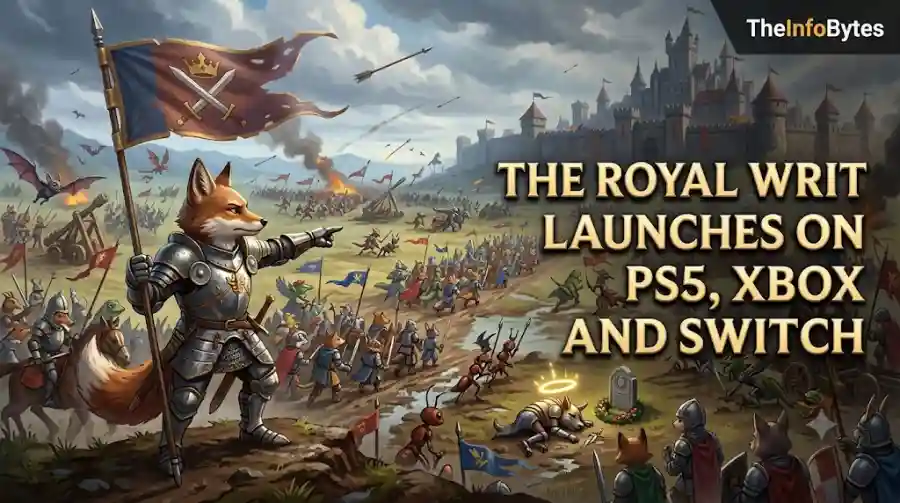
They send those cards onto a battlefield where their units physically march toward an opposing base.
If a card reaches the enemy base before the battle is completed, that unit is permanently lost for the current run.
That combination of card-building, lane-based movement, tactical positioning and permanent loss gives the game a distinctive identity in a crowded deckbuilder market.
What Is The Royal Writ?
The Royal Writ is a single-player medieval roguelike deckbuilder developed by Save Sloth Studios and published by Yogscast Games.
Instead of placing cards into a traditional turn-based combat interface, players command armies directly on the battlefield.
Cards represent troops and units.
They are deployed across lanes and then advance toward the enemy.
The objective is to use those units, abilities and strategic decisions to overwhelm the opposing side.
The game's presentation takes a very different approach from its serious medieval setting.
Its picture-book visual style mixes cute animals with dark humor and surprisingly brutal consequences.
A weak-looking creature may be one of the most useful units in a deck, while another card may be deliberately sacrificed to create a tactical advantage.
That contrast is one of the central ideas behind the game's design.
The Card System Is Built Around Permanent Loss
The most important mechanic in The Royal Writ is card permadeath.
When a card reaches the enemy base before the victory condition is met, it is permanently removed from that run.
That makes every battle more than a simple question of dealing the most damage.
Players also need to think about whether the units they deploy are worth risking.
A powerful card can potentially turn a difficult fight around, but losing it may weaken the rest of the run.
A cheaper unit may be the better choice when the player needs to preserve a stronger card for a later encounter.
This system creates pressure that is very different from conventional deckbuilders.
A failed decision can affect the composition of the deck for the rest of the run.
The result is a constant balance between aggression and conservation.
Battles Take Place Across Multiple Lanes
The battlefield itself is another major part of the strategy.
Players deploy their cards across one to three lanes, then watch those units advance toward the enemy.
That creates several simultaneous tactical problems.
You may have a powerful enemy approaching on one lane while your strongest attack is developing somewhere else.
A card placed in the wrong lane can waste valuable resources.
A weaker troop may be useful as a distraction, while another unit can exploit an opening created elsewhere.
Because the battlefield is constantly changing, players need to think about positioning rather than only card value.
This gives The Royal Writ a more physical feel than many traditional card games.
Two Different Campaigns Offer Different Challenges
The Royal Writ contains two campaigns, each with its own enemies, cards and strategic conditions.
The first campaign centers on a growing rebellion.
Players attempt to defend the kingdom while moving through dangerous environments containing hazards such as deep pits and poison swamps.
The second campaign introduces a completely different problem: gunpowder.
Once firearms and experimental weapons enter the battlefield, the player's strategy has to change.
Units now face incoming bullets while trying to advance.
This introduces another layer of positioning and timing.
A strategy that worked in the first campaign may not be enough against the second campaign's ranged threats.
That structure also gives the game a natural sense of progression.
Players are not simply moving through increasingly difficult versions of the same battlefield.
The game introduces new systems that force them to reconsider how they build and use their decks.
Every Run Can Play Differently
The Royal Writ uses roguelike progression, meaning each run is built around changing challenges and decisions.
Players encounter different opponents, events, cards and strategic situations.
That makes experimentation an important part of the game.
A deck that succeeds during one run can fail in the next because the available resources or enemy composition changes.
This encourages players to learn from failed attempts rather than treating failure as wasted time.
A bad run can still teach the player which cards work well together, which units are worth protecting and which upgrades are too risky.
The result is a gameplay loop built around repeated attempts and gradually improving decision-making.
Relics Add Another Layer of Strategy
Cards are not the only tools available to players.
The game also features Relics that provide additional effects and can dramatically influence the way a run develops.
A relic can reinforce a particular deck strategy or help compensate for a weakness.
That creates opportunities for players to develop specialized builds.
One run might focus heavily on aggressive attacks.
Another could prioritize defensive units.
A third could revolve around a specific combination of relics and cards that creates a powerful interaction.
These systems work together to make each run feel more like a strategic puzzle than a fixed campaign.
Challenge Modes Push the System Further
Once players become comfortable with the normal campaigns, Challenge Modes offer additional ways to test their skills.
These modes introduce special rules that can dramatically change how players approach the battlefield.
That is important for a roguelike because mastering the basic mechanics is only the beginning.
Players looking for a harder experience can deliberately choose conditions that interfere with their usual strategy.
The game's gradual difficulty ladder also provides a structured path for players who want to keep improving.
Instead of simply finishing the campaign and stopping, players can continue experimenting with stronger and more demanding challenges.
The Game Uses a Charming but Dark Visual Style
The Royal Writ's presentation is one of its most recognizable features.
The game uses hand-drawn, picture-book-style visuals filled with expressive animals and medieval environments.
That cheerful appearance is deliberately contrasted with the game's darker humor and permanent-loss mechanics.
Seeing a small animal troop march proudly toward an enemy fortress can look charming.
Watching that unit permanently disappear because of a strategic mistake is considerably less cheerful.
The visual design helps the game avoid the grim and realistic appearance often associated with medieval strategy games.
Instead, it creates a world that feels playful on the surface while remaining surprisingly ruthless underneath.
Animal Armies Are Part of the Fun
The Royal Writ's armies include a range of unusual animal characters.
Players can command creatures such as ants, bats, lizards, chickens, flamingos and other strange fighters.
Each has its own characteristics and strategic purpose.
Some are fragile but efficient.
Others are stronger but more expensive.
Some have special abilities that can change the flow of a fight.
The animal designs are not simply cosmetic.
Their abilities and limitations form an important part of deck construction.
That makes building an effective army partly about understanding which creatures complement one another.
Fallen Units Become Part of the Kingdom's Story
The game's permanent-loss system also has a narrative purpose.
When a card is lost, that sacrifice becomes part of the kingdom's evolving story.
The developers describe fallen units as becoming part of the kingdom's legend.
That idea gives individual cards more personality.
Instead of treating every card as a disposable mathematical resource, the player can begin to recognize particular units and remember how they performed.
A failed attack can therefore become part of the story of a run.
This is a small but effective way to make roguelike failure feel more meaningful.
Console Players Get the Latest PC Improvements
The September 10 console release is not simply a direct port of the original 2025 PC version.
Yogscast Games says the console edition includes the latest content updates, balance improvements and refinements from the PC version.
That means new console players do not have to wait through an extended period of catching up with earlier patches.
The development team has also used its PC release to gather community feedback and refine the game.
That makes the console launch an opportunity to introduce a more mature version of the experience.
Xbox Game Pass Makes the Console Launch More Accessible
The biggest platform-specific advantage belongs to Xbox users.
The Royal Writ arrives on Xbox Game Pass on day one.
Xbox has listed the game for Game Pass Ultimate, Game Pass Premium and PC Game Pass, with the title playable through cloud and Xbox Series X|S environments where supported.
It also supports Xbox Play Anywhere.
That means players can move between compatible Xbox and PC versions without treating them as completely separate purchases.
For a niche strategy title, this is particularly useful.
Players who might hesitate to purchase an unfamiliar deckbuilder can instead try it through their existing Game Pass subscription.
That could expose the game to a significantly larger audience than its original PC launch.
PlayStation 5 and Nintendo Switch Complete the Console Expansion
The Royal Writ is not being limited to the Xbox ecosystem.
It is also launching on PlayStation 5 and Nintendo Switch on September 10.
That gives the game access to three major console audiences simultaneously.
The Nintendo Switch version is particularly suited to a game built around short, repeatable runs.
Players can pick up the system for a quick challenge and return later for another run.
The PS5 version, meanwhile, gives the game a larger audience among strategy and indie players looking for something outside mainstream action releases.
This broad console launch is likely to be the game's biggest opportunity to expand beyond its original PC community.
Pricing and Game Pass Create Different Entry Points
The Royal Writ's console launch uses two different approaches.
Players on PlayStation 5 and Nintendo Switch can purchase the game directly.
Xbox players have the additional option of playing through Game Pass.
On Steam, the game is normally sold as a premium title, while the September console launch effectively gives Xbox subscribers another route into the experience.
That flexibility could be important for a game that is not backed by a major AAA franchise.
A lower barrier to entry makes it easier for curious players to try the mechanics before deciding whether they want to continue playing.
Why The Royal Writ Stands Out
The deckbuilder market is crowded.
Games such as Slay the Spire and other roguelike card titles have established a very recognizable formula.
The Royal Writ differentiates itself by physically placing cards on a battlefield and making them advance toward an enemy base.
The addition of permanent card loss creates another layer of tension.
Players do not simply ask, "What is the strongest card?"
They need to ask, "Which card am I willing to risk?"
That is a much more interesting strategic question.
The two-campaign structure also keeps the game from relying on a single mechanical trick.
The introduction of gunpowder in the second campaign demonstrates how the developers can change the basic rules while keeping the same underlying system.
What New Players Should Know Before Starting
New players should expect The Royal Writ to be easy to understand initially but increasingly demanding as the game progresses.
The basic concept of placing units and sending them toward the enemy is straightforward.
The difficulty comes from understanding when to spend cards, when to sacrifice units and how to preserve powerful options for later battles.
Players should also expect failure.
The roguelike structure means that losing a run is part of the experience.
Instead of treating every defeat as a setback, players should use it to learn which strategies work.
The permanent-loss system makes reckless decisions especially costly.
Careful players may therefore have an advantage over players who simply deploy their strongest cards immediately.
Is The Royal Writ Worth Playing in 2026?
The console launch gives The Royal Writ a useful second chance.
The PC version already has a substantial history, with Steam currently showing Mostly Positive overall reviews.
That suggests the game has built a respectable audience without becoming a mainstream hit.
The new launch is different.
Xbox Game Pass, PlayStation 5 and Nintendo Switch give the title access to players who may never have considered the PC release.
For strategy fans, the combination of tactical lanes, roguelike progression, deckbuilding and card permadeath offers a distinctive package.
For players who prefer fast action games, however, the deliberate pace may take some adjustment.
The game is about planning several moves ahead rather than reacting with split-second reflexes.
What Happens After the Console Launch?
The Royal Writ's console arrival should also increase the game's visibility.
More players means more feedback and potentially more discussion around future improvements.
The developers have already shown that they are willing to refine the game following community input.
Whether that leads to future campaigns, additional cards or other major content remains unknown.
No new post-launch expansion was confirmed as part of the September 10 announcement.
For now, the priority is bringing the existing game and its accumulated improvements to the largest possible audience.
The Royal Writ is making a much bigger move into the console market on September 10, 2026.
The medieval roguelike deckbuilder arrives on PS5, Xbox Series X|S and Nintendo Switch, more than a year after its original Steam launch.
Its biggest strength remains the unusual combination of traditional deckbuilding and battlefield tactics.
Cards become physical troops.
Units advance across lanes.
Permanent losses make every decision matter.
Relics and randomized runs encourage experimentation.
Two campaigns introduce different challenges, including a second chapter where gunpowder changes the battlefield.
The console edition is also arriving with the latest improvements from the PC version, giving new players a more polished starting point than the original release.
Xbox players get the most convenient entry point through day-one Game Pass, while Xbox Play Anywhere adds further flexibility between Xbox and PC.
For strategy fans looking for something different from conventional deckbuilders, The Royal Writ is an interesting game to watch as it expands to consoles.
Its charming visual style hides a surprisingly unforgiving tactical system, and the permanent-loss mechanic gives every battlefield decision real consequences.
September 10 could therefore mark the beginning of a much larger audience for a game that has spent its first year building a loyal PC following.
Frequently Asked Questions
When does The Royal Writ release on consoles?
The Royal Writ launches on September 10, 2026 for PlayStation 5, Xbox Series X|S and Nintendo Switch.
Is The Royal Writ coming to Xbox Game Pass?
Yes. The game launches day one on Xbox Game Pass for supported plans including Game Pass Ultimate, Premium and PC Game Pass.