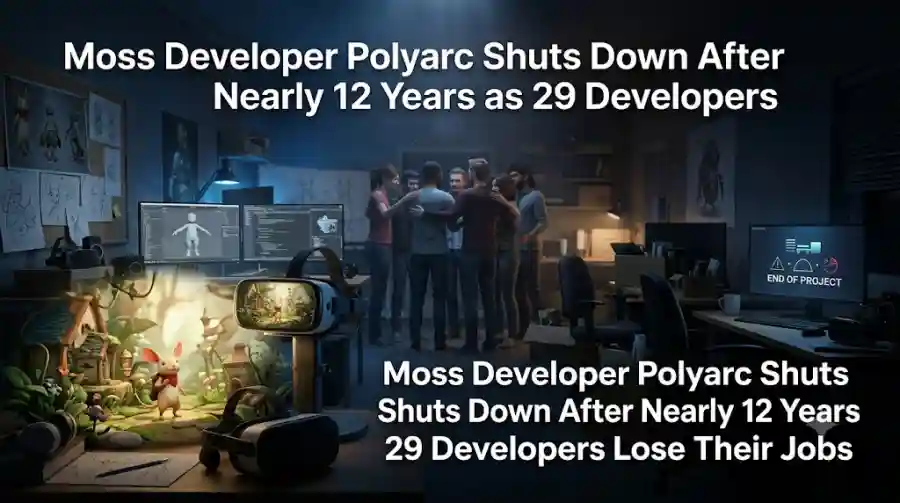
Polyarc Closes After Moss and Moss: Book II as VR Studio Struggles to Fund Its Next Game
The decision marks the end of a developer that helped demonstrate how traditional adventure and platforming mechanics could work inside virtual reality.
It is also another painful example of the financial pressure facing game developers, particularly studios working in specialized markets such as VR.
Around 29 employees are affected by the closure, according to reporting following Polyarc's announcement. The studio has also shared a recruiting spreadsheet intended to help its former developers find new positions.
Why Polyarc Was Important to VR Gaming
Polyarc made its debut with Moss in 2018.
The game immediately stood out because it did something relatively unusual for VR.
Instead of placing the player completely inside a first-person world, Moss combined traditional third-person platforming with the unique perspective and interaction possibilities of virtual reality.
Players guided the small mouse hero Quill through miniature environments while physically interacting with parts of the world around her.
That design helped Moss feel less like a technology demonstration and more like a complete traditional adventure game rebuilt around VR.
Its success gave Polyarc a reputation as one of the studios capable of demonstrating what VR could offer beyond simple first-person experiences.
Moss Became Polyarc's Signature Franchise
Moss was followed by Moss: Book II, which continued Quill's adventure and expanded the mechanics introduced in the original.
Together, the two games earned more than 160 awards and nominations, according to reporting on Polyarc's closure.
The games became particularly associated with Meta's VR ecosystem while also appearing on other virtual-reality platforms.
Their reception helped establish Polyarc as a specialist studio with a strong reputation for polished VR design.
The franchise's importance therefore goes beyond sales alone.
Moss became one of the best-known examples of how VR could support expressive characters, environmental storytelling and traditional adventure-game structure.
Polyarc's Final Years Were Much Harder
The shutdown did not happen completely without warning.
Earlier in 2026, Polyarc announced a significant reduction in staff after a major project was cancelled and the studio was unable to secure new funding.
That earlier restructuring reportedly removed around two-thirds of the company's workforce.
The company continued operating with a much smaller team while trying to find a sustainable path forward.
Ultimately, that effort did not succeed.
The September closure means the remaining team has now also been affected.
The Studio Had Been Working on Another Project
Before its final closure, Polyarc had been developing a project outside the direct Moss formula.
The studio was working on Glassbreakers: Champions of Moss, a competitive multiplayer strategy title built around the Moss universe.
The game represented a major shift from the single-player VR adventure structure that made Polyarc famous.
According to reporting on the closure, Glassbreakers struggled to attract a sufficiently large audience.
That performance created another problem for the studio.
Polyarc had to balance development costs against the limited audience available for a specialized VR competitive game.
The result was not enough momentum to support the company's longer-term plans.
Glassbreakers Was a Risky Direction
The contrast between Moss and Glassbreakers is important.
Moss was designed around a focused single-player adventure.
Glassbreakers moved toward competitive multiplayer and a more traditional live-service-style structure.
That meant Polyarc was no longer relying only on the audience that had already embraced Moss.
Instead, it was attempting to reach a much broader and more difficult market.
Competitive multiplayer games typically need enough active players to sustain matchmaking, updates and community engagement.
That can be challenging even for large publishers.
For a smaller VR-focused studio, the risk is considerably higher.
Polyarc Also Tried to Move Moss Beyond VR
One of Polyarc's final projects was Moss: The Forgotten Relic, a non-VR compilation bringing earlier Moss content to traditional platforms.
The release included the first two Moss games and the original game's Twilight Garden expansion, rebuilt for a conventional non-VR presentation.
Critics reportedly responded positively to the game.
However, positive reviews were not enough to prevent the studio from closing.
The project apparently did not generate the commercial performance necessary to keep Polyarc operating.
That makes its closure especially notable.
The studio had a respected franchise, strong critical recognition and a long track record of quality, yet still could not establish a sustainable future.
The Forgotten Relic Was Polyarc's Final Release
Moss: The Forgotten Relic arrived in July 2026, making it Polyarc's final released game.
The project was an unusual attempt to introduce the Moss games to people without VR hardware.
That strategy potentially addressed one of the biggest limitations of the franchise.
VR hardware remains a more specialized gaming platform than consoles or PCs.
A traditional version of Moss could therefore have expanded the audience.
The challenge was timing.
By the time The Forgotten Relic arrived, Polyarc was already under significant financial pressure.
The game's positive reception could not reverse the underlying funding problems facing the studio.
Around 29 Developers Are Looking for New Jobs
Polyarc has acknowledged the impact on its remaining staff.
The studio has circulated a spreadsheet containing information about affected developers so that other companies can identify and contact them about available positions.
The list reportedly covers around 29 people across different disciplines.
That means the closure is not simply the end of a company name.
It represents the loss of an active development team containing designers, artists, programmers and other specialists.
For the wider industry, those developers now become available talent at a time when many studios are also reducing headcount.
Polyarc's Closure Is Another Warning for VR Development
The shutdown has broader implications for the VR market.
VR has produced some critically acclaimed games, but the audience remains smaller than traditional console and PC gaming.
That creates a difficult business equation.
A studio can make an excellent VR game without necessarily selling enough copies to support a large development team.
Polyarc's history illustrates that problem.
Moss earned strong critical recognition and became one of VR's best-known franchises.
Yet maintaining a studio over many years requires predictable revenue and sufficient funding for multiple projects.
Critical acclaim alone cannot guarantee that.
A Great VR Game Does Not Automatically Become a Great Business
This is perhaps the most important lesson from Polyarc's closure.
Moss succeeded creatively.
It received strong reviews.
The franchise accumulated awards and nominations.
It established a recognizable identity.
But those accomplishments did not guarantee that Polyarc could fund its next game.
Game development is an expensive and uncertain business.
A studio must continually finance future projects while paying a development team between releases.
For smaller studios, a single cancelled project or unsuccessful release can have an outsized impact.
Polyarc's experience demonstrates that reality particularly clearly.
The Studio Was Around for Nearly 12 Years
Polyarc was founded in 2015.
Its first game arrived three years later with Moss in 2018.
That gives the company a development history spanning nearly 12 years.
During that time, Polyarc became strongly associated with premium VR experiences.
Its work helped establish a particular style of VR adventure built around small environments, expressive characters and physical interaction.
The closure therefore represents the end of a significant chapter in VR development.
Moss Helped Show That VR Could Be More Than First Person
One reason Polyarc's work mattered so much was its rejection of a narrow definition of VR.
Many early VR games focused heavily on first-person immersion.
Moss took another route.
The player effectively became a presence inside a miniature world rather than simply becoming the protagonist's eyes.
That design allowed the developers to combine:
Platforming
Puzzle solving
Environmental interaction
Character animation
Exploration
Traditional adventure storytelling
The result demonstrated that VR could support genres that were not naturally first-person.
That influence continues even though Polyarc is now closing.
The Moss Games Will Not Disappear
Polyarc's closure does not automatically remove the existing Moss games from digital stores.
The developer has reportedly discounted the Moss titles as part of its farewell, while encouraging players to experience the games in their original VR form.
That creates a final opportunity for players who missed the series.
It also gives the wider VR community a chance to revisit games that helped define the medium's earlier years.
The closure is sad for the developers, but it does not erase the work they already created.
What Happens to the Moss Franchise Now?
This is one of the biggest unanswered questions.
Polyarc owns the development history and has been the studio most closely associated with Moss.
With the company shutting down, the future of the franchise is unclear.
There is currently no confirmed new Moss game announcement following the closure.
That does not necessarily mean the franchise can never return.
A publisher, rights holder or future team could potentially continue the property.
But there is no basis yet for saying that is happening.
For now, the practical situation is simple:
Polyarc has closed, and no new Moss project has been confirmed.
What Happened to Glassbreakers?
The future of Glassbreakers: Champions of Moss is also uncertain following the shutdown.
Polyarc's closure means active development by the original studio is ending.
The title's commercial difficulties were part of the broader financial pressure described in reporting surrounding the shutdown.
The precise future of the game, including continued server support or any possible acquisition, has not been fully established in the available announcements.
Players should therefore avoid assuming that every online feature will continue indefinitely.
The studio's closure creates a very different situation for an online game than it does for a finished single-player title.
Could Another Studio Hire the Polyarc Team?
Polyarc itself is actively helping its former developers find work by sharing the recruiting spreadsheet.
That creates the possibility that the team's expertise could continue elsewhere.
Developers with experience in VR interaction, environmental design and character-focused adventure games are relatively specialized.
A future studio could potentially benefit from the knowledge accumulated during the development of Moss and Moss: Book II.
In that sense, the closure does not mean the end of Polyarc's creative influence.
Its former employees may continue building VR games at other companies.
What the Closure Says About Game Development in 2026
The Polyarc shutdown comes during another difficult period for the game industry.
Studios of different sizes have faced layoffs, project cancellations, restructuring and funding problems.
The common thread is that development costs have increased while audiences and revenue can be unpredictable.
VR adds another layer of difficulty.
Developers need hardware-specific expertise, but the addressable market remains smaller than the market for standard console and PC games.
That makes financing ambitious VR projects particularly challenging.
Polyarc's experience shows that even a respected studio with a successful franchise can eventually run out of viable options.
The VR Market Still Has Potential
Polyarc's closure should not be interpreted as proof that VR gaming is finished.
The medium continues to have an active audience and developers continue experimenting with new designs.
The problem is more specific.
Building a sustainable company around premium VR software can be difficult.
A studio needs enough customers to cover development costs while also funding future projects.
Polyarc managed that challenge for many years.
Its inability to continue does not erase the potential of the medium.
It does, however, demonstrate the financial risk involved.
Why Moss Still Deserves Attention
Moss remains worth discussing because of what it achieved.
The games proved that VR could support a cinematic adventure structure without forcing the player into a conventional first-person perspective.
Quill became one of the medium's most recognizable characters.
The miniature-world presentation gave players a sense of physically existing inside a handcrafted storybook environment.
Those ideas helped distinguish Moss from the flood of VR games focused primarily on shooting, rhythm or technology demonstrations.
That creative legacy is likely to survive even without Polyarc.
What Players Should Take Away
The most important point is not simply that another studio has closed.
It is that quality and commercial sustainability are two different things.
Polyarc created games that earned critical praise and industry recognition.
But a studio still needs a viable business model to keep operating.
The cancellation of a major project, unsuccessful attempts to secure funding and disappointing performance from later projects eventually made that impossible.
That is why the closure feels particularly significant.
It is a reminder that the games industry can lose talented teams even when their work remains highly respected.
Polyarc Games Closure Key Details
Studio: Polyarc Games
Location: Seattle, Washington
Founded: 2015
Years Active: Nearly 12
Best Known For: Moss, Moss: Book II
Other Project: Glassbreakers: Champions of Moss
Final Release: Moss: The Forgotten Relic
Closure Announced: September 11, 2026
Affected Staff: Approximately 29 remaining developers
Earlier 2026 Layoffs: About two-thirds of staff
Main Cause: Unsuccessful funding effort following cancellation of a major project
Future Moss Game: Not currently announced
The closure of Polyarc Games marks a major loss for the VR development community.
For nearly 12 years, the Seattle studio built a reputation around thoughtful virtual-reality experiences, most notably Moss and Moss: Book II, games that demonstrated how traditional adventure and platforming concepts could be transformed by VR.
The studio's final years were far more difficult.
An important project was cancelled, a major round of layoffs reduced the team by roughly two-thirds, and attempts to secure new funding did not succeed.
Polyarc later released Moss: The Forgotten Relic, a non-VR collection designed to bring the franchise to a wider audience.
The game reportedly received positive critical feedback, but it was not enough to keep the company operating.
Now roughly 29 remaining developers are affected by the closure, with Polyarc helping them find new opportunities through a public recruiting spreadsheet.
The future of Moss is uncertain.
There is no confirmed new sequel following the studio's shutdown, and the status of Glassbreakers is also unclear.
But the legacy of Moss is secure.
Polyarc helped show that virtual reality could support more than first-person shooting and tech demos. Its miniature worlds, expressive characters and physical interaction systems became some of the medium's most memorable examples.
The closure is therefore not simply the end of another game studio.
It is the end of one of VR gaming's most distinctive development teams.
And for players who have never experienced Moss, Polyarc's final farewell may be the strongest reminder yet to discover the games that made the studio special.
FAQs
Why did Polyarc shut down?
Polyarc said it was winding down after nearly 12 years. Reporting indicates that the studio struggled to secure new funding after a major project was cancelled, following significant layoffs earlier in 2026.
When did Polyarc close?
Polyarc announced that it was winding down operations on September 11, 2026.