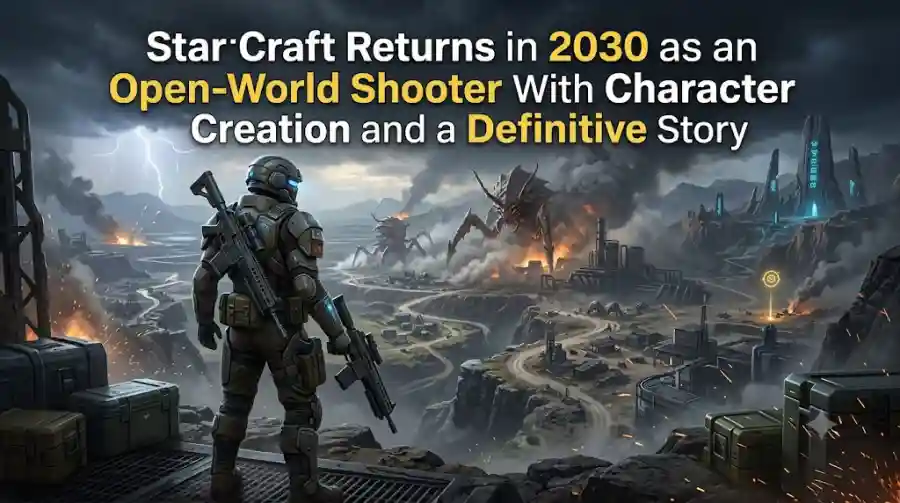
Blizzard Is Reimagining StarCraft as a Narrative Open-World Shooter Instead of Another RTS
At BlizzCon 2026, Blizzard revealed a new game simply titled StarCraft, and it is being developed as an original open-world shooter rather than a traditional real-time strategy game. The project is targeting a Spring 2030 release and is being led by Dan Hay, the former Far Cry executive producer who now serves as StarCraft's general manager and creative director.
The announcement was accompanied by a cinematic trailer set in the StarCraft universe, but Blizzard did not show conventional gameplay footage.
Since the reveal, Dan Hay has provided additional information about the project's structure, describing it as a narrative-driven open-world shooter with a beginning, middle and end.
That detail is particularly important because it immediately separates the game from today's large seasonal shooter model.
Blizzard is currently describing StarCraft as a standalone experience rather than a title built around endless seasonal progression.
What Is the New StarCraft Game?
The upcoming game is simply called StarCraft.
Blizzard describes it as an original open-world shooter returning to the Koprulu Sector.
That means the project takes the universe, factions, visual identity and dark science-fiction atmosphere established by StarCraft and places them into a completely different gameplay structure.
Instead of commanding armies from an overhead perspective, players will experience the world from a character-level viewpoint.
The game is being built around:
- Open-world exploration
- Third-person or first-person shooter-style combat
- Character creation
- Character progression
- Main missions
- Side quests
- Gear collection and customization
- A narrative with a defined conclusion
The exact camera perspective and complete combat system have not yet been fully detailed by Blizzard, so those aspects should not be confused with confirmed information.
What is confirmed is the much broader shift from RTS to open-world action.
StarCraft Will Not Be a Traditional RTS Sequel
This is easily the most controversial part of the announcement.
StarCraft has historically been defined by real-time strategy.
Players traditionally control groups of Terran, Zerg or Protoss units, manage resources, establish bases and direct large armies across battlefields.
The new game changes that relationship completely.
Instead of looking at the battlefield from above, the player becomes an individual character inside the StarCraft universe.
That is a huge creative departure.
It also gives Blizzard an opportunity to tell stories that are difficult to deliver through traditional RTS missions.
Rather than constantly jumping between multiple armies and strategic objectives, the new game can focus closely on one protagonist and the events surrounding that character.
Blizzard Is Calling It a Narrative-Driven Open World
Dan Hay has described the current vision as a narrative-driven open-world shooter.
The distinction matters.
Open-world games can sometimes prioritize endless activities and systems over a central story.
Blizzard's current approach is different.
Hay says the player will create and name a character and then follow that character's story through a narrative with a clear beginning, middle and end.
That suggests the game is being designed more like a large standalone adventure than a traditional live-service shooter.
The world can remain open for exploration, but the main story still has a defined conclusion.
StarCraft Will Have Character Creation
Players will not simply control an established StarCraft hero.
According to Hay, the current structure allows players to create and name their own character.
That is an important design decision.
StarCraft's established universe contains famous characters such as Jim Raynor, Sarah Kerrigan, Artanis and many others.
A user-created protagonist allows Blizzard to tell a new story without being completely dependent on one of those existing characters.
It also gives players a personal connection to the events of the campaign.
Instead of simply watching another chapter in the history of famous StarCraft heroes, players can experience the world through someone they created.
The Story Takes Place 70 Years After StarCraft II
The new game also gets considerable freedom from its timeline.
Hay has confirmed that the new StarCraft is set 70 years after the events of StarCraft II.
That is a significant time jump.
It creates enough distance from the established storyline to allow Blizzard to introduce new characters, political developments and conflicts without simply replaying the events of previous games.
The long gap can also change the existing factions.
A political movement that was powerful decades earlier might no longer exist.
A faction that once fought alongside another could have become an enemy.
Old alliances can fracture.
New organizations can rise.
That gives Blizzard a large amount of creative freedom.
The Koprulu Sector Returns
Despite the new gameplay format, the game remains firmly rooted in StarCraft's universe.
The announcement places the player back in the Koprulu Sector, the region that has defined the franchise since its beginning.
That means the new shooter does not abandon the universe to create an unrelated science-fiction setting.
The familiar themes remain.
Humans fighting for survival.
Zerg biological terror.
Protoss technology and culture.
Colonies struggling to survive.
Political conflicts inside the Terran world.
The larger difference is how players experience those elements.
Instead of controlling hundreds of units at once, players encounter the conflict from ground level.
The New Game Wants to Preserve StarCraft's Dark Space-Western Tone
Hay has also emphasized that Blizzard wants to preserve the franchise's dark, gritty mood and space-western atmosphere.
That is important because StarCraft's identity is not simply based on its three major factions.
The franchise has always combined military science fiction with a rough frontier atmosphere.
Terran settlements often feel isolated.
Colonies can be dangerous.
Military organizations operate far from centralized civilization.
The Zerg are relentless.
The Protoss bring another layer of ancient technology and culture.
A first-person or character-level experience could potentially make those themes feel even more immediate.
The Open World Will Be Used for More Than Traveling Between Missions
One of the most interesting details to emerge from Hay's interview is how the open world connects to missions.
The game will contain major story missions, but players can leave those missions and explore the surrounding world.
If a mission is too difficult, players can return to the open world and undertake other activities before attempting it again.
That suggests progression will not be completely linear.
The world itself acts as a resource.
Players can search for equipment, explore locations, discover side activities and improve their character before returning to the main storyline.
That is very different from the tightly structured mission-to-mission design often associated with classic RTS campaigns.
Gear Will Be Part of Progression
Hay has also explained that players will be able to scavenge for gear and improve their armor while exploring the world.
This introduces a progression layer that does not traditionally exist in StarCraft's RTS format.
Instead of researching technologies for an entire army, the player can improve the equipment of an individual character.
That creates a natural role-playing element.
A difficult mission might become easier after the player explores another area and acquires stronger gear.
The player can then return to the mission with a better-equipped character.
It is an approach that combines open-world exploration with RPG-style progression.
Main Missions and Side Quests Are Confirmed
The new StarCraft will include both main missions and side quests.
That is important because side quests can help make a large open world feel meaningful.
Instead of simply moving across a large map between major objectives, players can discover smaller stories and encounters.
Those side activities can also provide opportunities for additional world-building.
A Terran settlement might contain a local conflict.
A remote colony could reveal information about a larger political situation.
A dangerous region might contain equipment that becomes useful elsewhere.
Blizzard has not yet described the full quest structure, but the confirmed presence of side quests suggests exploration will be a meaningful part of the game rather than simply a backdrop.
The Game Is Being Designed Around Player Exploration
Hay has described himself as someone who enjoys wandering through open worlds, slowly discovering locations and encountering unexpected events.
That preference appears to be reflected in the design philosophy of the new StarCraft.
Instead of constantly pointing players toward the next major objective, Blizzard wants exploration to have value in its own right.
That could produce a very different StarCraft experience.
The universe has traditionally been explored through campaigns, missions and multiplayer maps.
An open-world structure can make the locations between major battles almost as important as the battles themselves.
The 70-Year Time Jump Can Help Build New Factions
The large gap between StarCraft II and the new game gives Blizzard room to reshape the political landscape.
Hay specifically points out that groups can change their perspectives over decades, splinter into smaller factions or disagree with old allies.
This is useful for storytelling.
The StarCraft universe no longer has to remain locked in the same political arrangement established during StarCraft II.
New generations can have different priorities.
Old movements can disappear.
New organizations can emerge.
A faction once associated with heroes can potentially become an antagonist.
That creates the possibility of a story that feels genuinely new while still respecting the franchise's history.
The Zerg Are Clearly Returning
The announcement trailer establishes that the Zerg remain an important part of the new game.
The cinematic shows a Terran soldier preparing for combat before facing a deadly Zerg threat.
That means the new perspective does not eliminate the franchise's most recognizable enemies.
Players should therefore expect the biological horror of the Zerg to remain part of the game's identity.
However, Blizzard has not yet revealed the complete enemy roster or explained how Protoss and other factions will function during gameplay.
The trailer alone is not enough to establish the full faction structure.
Protoss Are Part of the Universe's Future
Although the reveal trailer concentrates heavily on Terran and Zerg imagery, the wider StarCraft setting naturally includes the Protoss.
The franchise's three-faction identity remains one of its most defining characteristics.
However, Blizzard has not yet detailed exactly how the Protoss will appear in the new game's story or whether players will directly control Protoss characters.
Those questions remain open.
This is important because fans should distinguish between confirmed universe continuity and confirmed playable content.
The Game Is Not Being Presented as a Seasonal Live Service
Perhaps the most interesting modern design decision is what the game isn't.
Hay explicitly describes the current vision as a standalone boxed product with a story that has a beginning, middle and end.
He also says the project is not a seasonal game.
That does not necessarily mean Blizzard will never provide post-launch updates or additional content.
It does mean the core experience is currently being designed around a complete standalone narrative rather than an endless seasonal progression model.
That distinction could appeal to players who are tired of games requiring constant seasonal participation.
Blizzard Is Taking a Different Approach From Its Other Shooters
Blizzard has experience making multiplayer shooters through Overwatch.
But StarCraft's new shooter is being developed around a significantly different foundation.
Overwatch is a hero-based multiplayer game.
The new StarCraft is being presented as an open-world narrative experience centered on a player-created protagonist.
This gives Blizzard an opportunity to experiment with storytelling and world design in ways that are not possible within Overwatch's match-based format.
Dan Hay Brings Far Cry Experience to the Project
The project is being led by Dan Hay, whose previous career includes major work on Ubisoft's Far Cry franchise.
That background is particularly relevant because Far Cry is closely associated with open-world first-person exploration, enemy outposts, character progression and narrative-driven environments.
It does not mean the new StarCraft will simply be “Far Cry in space.”
StarCraft has its own universe and design requirements.
But Hay's previous experience helps explain why Blizzard is comfortable placing him at the center of a major open-world shooter project.
His approach to open-world exploration is already visible in the way he has described StarCraft's structure.
StarCraft Is Still Years Away
Blizzard has set a target release window of Spring 2030.
That is a long way from the current date.
The developers are therefore revealing the project substantially before it reaches release.
Blizzard has defended the early announcement as a way of demonstrating confidence in some of its major long-term projects, and Hay has described the date as one the team feels confident about.
Still, four years is enough time for the design to change.
Players should therefore treat the current information as the game's present direction rather than a promise that every system shown or discussed today will remain unchanged through launch.
No Gameplay Demo Has Been Shown Yet
Despite the large announcement, Blizzard has not yet shown a full gameplay demonstration.
The debut was built around a cinematic trailer.
That means there is still no detailed footage showing:
- Actual open-world traversal
- Combat controls
- Enemy AI
- Character customization
- Gear management
- Mission structure
- Side-quest gameplay
- Vehicle systems
- Multiplayer features
These details will be crucial to understanding the project.
A cinematic can communicate tone.
Only gameplay footage can demonstrate whether the new formula actually works.
What Is Confirmed About the Gameplay So Far?
Based on Blizzard's announcement and Hay's subsequent comments, the following elements are currently confirmed:
Open-world shooter
Player-created character
Character naming
Main story
Side quests
Character progression
Gear and armor improvements
Open-world exploration
Scavenging
Standalone narrative
Definitive ending
Not a seasonal game
Those details already tell us considerably more than the original trailer did.
But they still leave many systems unknown.
What We Don't Know Yet
Blizzard has not confirmed a final platform list for the new StarCraft game.
The company has also not announced the exact camera perspective, multiplayer structure, price or detailed PC requirements.
Other unanswered questions include:
How large is the world?
Will vehicles be playable?
Can players command NPC squads?
Will there be co-op?
Will PvP exist?
How will Protoss gameplay work?
Will Zerg infest open-world areas dynamically?
Will the game feature base building?
Will there be multiple endings?
None of these features should be presented as confirmed until Blizzard officially reveals them.
Why the Open-World Direction Is So Significant
The announcement is important because StarCraft has traditionally existed at the strategic level.
The new game goes in the opposite direction.
One soldier.
One character.
One world.
One story.
That does not necessarily weaken the StarCraft identity.
In fact, it could provide a new way to explore the franchise's universe.
An RTS can show the scale of a battle.
An open-world shooter can show what that battle feels like from the ground.
A Zerg attack can become a personal survival event rather than a collection of animated unit movements.
A Terran colony can become a place that players physically explore.
A Protoss ruin can become an actual environment rather than simply a story background.
That is the opportunity Blizzard is creating.
Could This Finally Give StarCraft a New Audience?
The switch from strategy to shooter will almost certainly attract players who have never seriously played StarCraft.
Many modern players know Blizzard primarily through games such as Overwatch, Diablo and World of Warcraft.
An open-world shooter is a more familiar structure for a much broader audience.
That could make the StarCraft universe easier to enter.
A player does not need to understand build orders, resource management or RTS unit counters to enjoy a character-driven shooter.
The lore can be introduced through missions and exploration.
This could become a significant gateway into the StarCraft universe.
Longtime RTS Fans May Have Mixed Reactions
At the same time, there is a legitimate risk.
Some longtime StarCraft players have been waiting for another traditional RTS.
The new project is not that.
There is currently no announcement of a StarCraft III RTS.
Instead, Blizzard has chosen an entirely different genre.
That means the game's success will depend partly on whether it can convince existing fans that the StarCraft universe works outside its traditional strategic framework.
The project does not need to replace the RTS identity.
It needs to prove that the universe itself is flexible enough to support another genre.
StarCraft Remains One of Blizzard's Most Important Universes
The return is significant because StarCraft has been largely dormant as a major new-release franchise.
StarCraft II ended its major expansion cycle years ago, while Nova Covert Ops represented one of the last substantial pieces of new single-player content in the franchise.
The new game therefore signals a much larger commitment.
Blizzard is not simply releasing another remaster.
It is creating a completely new interpretation of the property.
That makes the project one of the most important announcements from BlizzCon 2026.
StarCraft Open-World Shooter Release Details
Game: StarCraft
Developer: Blizzard Entertainment
Project Lead: Dan Hay
Genre: Open-World Shooter
Story: Narrative-driven standalone experience
Release Target: Spring 2030
Setting: Koprulu Sector
Timeline: 70 years after StarCraft II
Player: Custom-created protagonist
Core Features: Open-world exploration, main missions, side quests, character progression, scavenging, gear customization
Business Structure: Currently described as a standalone boxed product, not a seasonal game
Gameplay Demo: Not yet shown
Platforms: TBA
Blizzard's new StarCraft game is one of the boldest genre changes the company has attempted with a major franchise.
Instead of making another real-time strategy game, Blizzard is creating an open-world shooter set in the Koprulu Sector. The current target is Spring 2030.
The new project will let players create and name a character, follow a narrative with a defined beginning and end, explore a large world, complete side quests and improve their gear.
The decision to set the story 70 years after StarCraft II is equally important.
It gives Blizzard the freedom to create new factions, relationships and conflicts while maintaining the dark, gritty space-western identity that defines StarCraft.
The most intriguing aspect may be the decision to avoid making the game a seasonal live service.
Dan Hay describes the current structure as a standalone product with a definitive ending, suggesting Blizzard wants players to experience a complete story rather than an endlessly expanding progression loop.
That does not mean the game will have no post-launch support, and Blizzard has not yet explained every multiplayer or online system.
There is still a huge amount to learn.
We have not seen gameplay.
We do not yet know the full platform lineup.
The exact combat model remains unclear.
The role of the Protoss has not been fully explained.
And Blizzard has not shown how large or interactive the open world will actually be.
But the direction is now unmistakable.
StarCraft is coming back, and Blizzard is taking the franchise somewhere it has never gone before.
FAQs
When is the new StarCraft game releasing?
Blizzard is targeting Spring 2030 for the new StarCraft open-world shooter.
Is the new StarCraft game an RTS?
No. Blizzard describes it as an original open-world shooter, making it a major departure from the franchise's traditional RTS gameplay.